
MBBS Abroad Under 10 Lakhs: 2026 Total Cost Guide
Neha Tripathi
Author
Share this article
💡 Plan your budget: Use the free MBBS Cost Calculator to estimate your all-in cost, see which colleges fit with our MBBS College Predictor, or get free counselling from our team.
Introduction: Is Quality MBBS Really Possible Under 10 Lakhs?
For thousands of aspiring medical students in India, the dream of becoming a doctor often collides with harsh financial realities. With private MBBS colleges in India charging anywhere from 50 lakhs to 1.5 crores, and NEET competition making government seats nearly impossible to secure, many students wonder: is there a path to quality medical education that won't financially devastate their families?
The answer is nuanced but hopeful. While finding a complete MBBS program under 10 lakhs is challenging, several countries offer programs that come close to or fit within this budget when considering tuition fees alone. However, the critical question isn't just about affordability—it's about whether these budget-friendly options can deliver quality education that prepares you for a successful medical career in India.
This examines the realistic options for MBBS abroad under or around 10 lakhs, breaks down actual costs versus advertised fees, evaluates quality indicators, and helps you make an informed decision about pursuing affordable medical education abroad.
Understanding the 10 Lakh Budget Reality
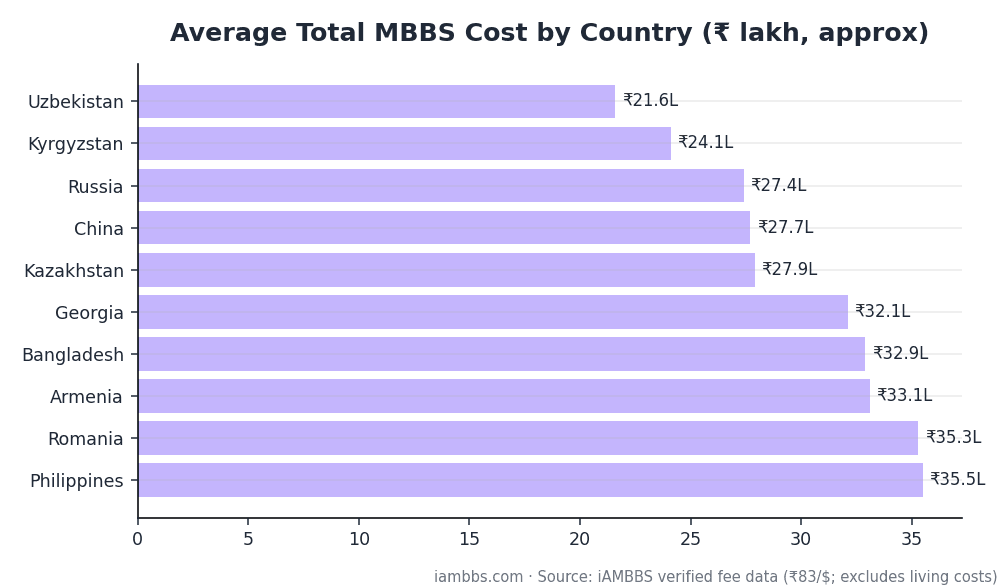
Before diving into specific universities, let's establish realistic expectations. When consultancies advertise "MBBS under 10 lakhs," they typically mean one of three things:
- Annual tuition fees are under 2 lakhs (totaling 10-12 lakhs for 5 years)
- Tuition-only costs for the entire program are under 10 lakhs (excluding living expenses, travel, visa, and other costs)
- Marketing tactics that don't account for actual total expenses
The reality is that the complete cost of studying MBBS abroad includes tuition fees, accommodation, food, medical insurance, visa fees, travel, books, and other living expenses. For most countries, the total realistic budget ranges from 15-25 lakhs for the entire program.
However, if your family can manage around 2-3 lakhs per year from savings or through education loans, several legitimate options exist that keep annual costs manageable.
Planning MBBS abroad?
Get a free counselling call — we'll shortlist NMC-approved universities for your NEET score and budget.
Universities Under 10 Lakhs: The Complete Picture
Based on comprehensive research of NMC-approved universities, here are institutions where the total tuition cost for the complete program comes closest to the 10 lakh budget:
| University Name | Country | Total Tuition (6 Years) | Annual Cost | NMC/WHO Status | FMGE Pass Rate | Overall Rating |
|---|---|---|---|---|---|---|
| Ningxia Medical University | China | 15-18 Lakhs | 2.5-3 Lakhs | NMC & WHO Approved | 9-12% | 3.5/5 |
| Asian Medical Institute | Kyrgyzstan | 16-19 Lakhs | 2.5-3.2 Lakhs | NMC & WHO Approved | 15-18% | 3.5/5 |
| Osh State Medical University | Kyrgyzstan | 18-21 Lakhs | 3-3.5 Lakhs | NMC & WHO Approved | 15-18% | 3.5/5 |
| Jalal-Abad State Medical University | Kyrgyzstan | 17-20 Lakhs | 2.8-3.3 Lakhs | NMC & WHO Approved | 15-18% | 3/5 |
| Kyrgyz State Medical Academy | Kyrgyzstan | 25-28 Lakhs | 4-4.5 Lakhs | NMC & WHO Approved | 31.56% | 4/5 |
| South Kazakhstan Medical Academy | Kazakhstan | 24-28 Lakhs | 4-4.6 Lakhs | NMC & WHO Approved | 18-25% | 3.5/5 |
| Semey Medical University | Kazakhstan | 26-30 Lakhs | 4.3-5 Lakhs | NMC & WHO Approved | 18-25% | 3.5/5 |
Note: Costs include tuition and basic accommodation. Additional expenses for food, travel, visa, insurance, and personal expenses typically add 30-40% to the total budget.
Country-Wise Breakdown: MBBS Programs Closest to 10 Lakhs
China: The Most Affordable Option
China remains one of the most budget-friendly destinations for MBBS studies, with some universities offering programs where tuition costs stay within reasonable limits.
Ningxia Medical University - The Budget Leader
- Annual Tuition: 29,800 RMB (approximately 2.5-2.8 lakhs INR)
- Accommodation: 4,000 RMB per year (approximately 33,000 INR)
- Total Tuition for 6 Years: Approximately 15-18 lakhs
- Medium of Instruction: English
- NMC/WHO Status: Fully recognized
- Duration: 6 years including internship
Ningxia Medical University stands out as having the lowest fees among MOE-listed Chinese medical universities offering English-medium MBBS programs. The university provides three-sharing dormitory accommodation, and students pay half the tuition fee during their 6th-year internship.
Other Affordable Chinese Universities
While Ningxia offers the lowest fees, other Chinese medical universities also maintain relatively affordable structures:
- Annual tuition typically ranges from 30,000-45,000 RMB (3-5 lakhs INR)
- Total program costs range from 18-30 lakhs including living expenses
- 48 medical universities in China are NMC-approved
- Chinese universities follow international medical education standards
Challenges with Chinese Medical Education
Despite the affordability, Chinese medical universities face a significant challenge: FMGE pass rates. Students from Chinese medical schools typically show pass rates between 9-12%, which is among the lowest for popular MBBS abroad destinations. This means you'll need exceptional self-study and potentially invest in additional FMGE coaching to successfully practice in India.
However, the Chinese MBBS curriculum is comprehensive, facilities are modern, and the universities are globally recognized. The low FMGE rates may reflect the difference in exam patterns rather than education quality, but it's a factor you must seriously consider.
Kyrgyzstan: The Budget-Friendly Alternative
Kyrgyzstan has emerged as one of the most popular destinations for budget-conscious Indian medical students, with several universities offering programs in the lower cost range.
Asian Medical Institute (ASMI)
- Annual Tuition + Hostel: $3,800 (approximately 3.2 lakhs INR)
- Total Program Cost: Approximately 16-19 lakhs
- Food/Mess: $500 per semester additional
- Medium of Instruction: English
- NMC/WHO Status: Recognized
- Duration: 5 years + 1 year internship
Asian Medical Institute offers one of the most affordable complete packages in Kyrgyzstan. The university provides hostel accommodation within the tuition fee, which simplifies budgeting for families.
Jalal-Abad State Medical University
- Total Program Cost: 17-20 lakhs
- Medium of Instruction: English
- NMC/WHO Status: WHO, NMC, and IMED approved
- FMGE Performance: Moderate (15-18% range)
This university offers a balanced combination of affordability and recognition, making it accessible for students with budget constraints.
Osh State Medical University
- Total Program Cost: 18-21 lakhs
- Medium of Instruction: English
- Living Costs: Relatively low (8,000-10,000 INR per month)
- FMGE Performance: Moderate (15-18% range)
Osh State Medical University is one of the older medical institutions in Kyrgyzstan, providing established infrastructure and experienced faculty.
Why Kyrgyzstan Works for Budget Students
Kyrgyzstan offers several advantages beyond just affordability:
- Low cost of living: Monthly expenses of 8,000-10,000 INR are manageable
- No entrance exams beyond NEET
- English-medium instruction across all universities
- Significant Indian student population providing community support
- Relatively straightforward admission process
- Similar climate and lifestyle making adaptation easier
The primary trade-off is that FMGE pass rates from Kyrgyzstan institutions hover around 15-18%, requiring dedicated exam preparation alongside your regular studies, especially given the June 2026 pass rate of ~12.4%.
Kazakhstan: Slightly Higher but Quality-Focused
Kazakhstan's medical universities typically fall just outside the strict 10 lakh budget for tuition alone, but they offer better infrastructure and slightly improved FMGE performance.
South Kazakhstan Medical Academy
- Total Program Cost: 24-28 lakhs
- Medium of Instruction: English
- NMC/WHO Status: Fully recognized
- FMGE Performance: 18-25% (better than Kyrgyzstan and China)
Semey Medical University
- Total Program Cost: 26-30 lakhs
- Infrastructure: Modern facilities and teaching hospitals
- FMGE Performance: 18-25% range
Kazakhstan universities generally offer better FMGE pass rates (18-25%) compared to Kyrgyzstan and China, which may justify the slightly higher costs. The country has invested significantly in medical education infrastructure, with universities equipped with modern simulation labs and clinical facilities.
Bangladesh: The Hidden Cost Reality
Bangladesh is often marketed as an affordable MBBS destination, but the reality is quite different from the advertised costs.
The Fee Reality
While some sources claim MBBS in Bangladesh can be done affordably, research reveals:
- Total costs typically range from 24-35 lakhs
- Some universities charge up to 40-50 lakhs for the complete program
- Army Medical College Chattogram offers exceptional tuition of just 5 lakhs for 5 years, but admission is extremely competitive
Should You Consider Bangladesh?
For students specifically aiming for the 10 lakh budget, Bangladesh generally doesn't fit the criteria except for the rare seats at Army Medical College Chattogram. However, Bangladesh offers:
- Better FMGE pass rates (26.79%) compared to China and Kyrgyzstan
- Curriculum similar to Indian medical education
- Cultural proximity and easier adaptation
- Over 20 NMC-approved medical universities
If your budget can stretch to 25-30 lakhs, Bangladesh becomes a strong option with better FMGE outcomes than the cheaper alternatives.
Russia and Philippines: Budget Considerations
Russia
Russian medical universities were traditionally budget-friendly but costs have increased:
- Annual tuition: 3-5 lakhs INR typically
- Total program cost: 25-40 lakhs for the complete course
- FMGE Pass Rates: Mixed (9-12% overall, but some universities like Kyrgyz Russian Slavic University show much higher rates)
- Infrastructure: Generally excellent with modern facilities
Russia offers 54 NMC-approved medical colleges, but most fall outside the strict 10 lakh budget when considering total costs.
Philippines
- Total course fee: Approximately 9-20 lakhs
- FMGE Performance: Moderate (around 32% for some universities)
- US-style curriculum preparing students for USMLE and NMC exams
The Philippines offers better FMGE preparation due to its American-style medical curriculum, but total costs when including living expenses typically exceed 20-25 lakhs.
Complete Cost Breakdown: What's Really Included?
Understanding the complete financial picture is essential for planning your MBBS abroad journey. Here's what you need to budget for:
Costs Typically Included in Quoted Fees
- Tuition Fees: The primary educational charges for 5-6 years
- Hostel/Accommodation: Usually basic dormitory accommodation (often 2-4 sharing rooms)
- Sometimes Medical Insurance: Some universities include basic medical coverage
Additional Costs You Must Budget For
One-Time Initial Costs
- Visa Fees: 5,000-15,000 INR depending on country
- Travel to Country: 15,000-50,000 INR for initial journey
- Initial Documentation: 10,000-25,000 INR for attestation, notarization, translations
- Medical Tests: 5,000-10,000 INR for required health examinations
- Consultancy Fees: 50,000-150,000 INR (if using an agent)
Annual Recurring Costs
- Food/Mess Charges: 50,000-150,000 INR per year
- China: 30,000-60,000 INR per year
- Kyrgyzstan: 50,000-80,000 INR per year
- Kazakhstan: 60,000-100,000 INR per year
-
Books and Study Materials: 10,000-25,000 INR per year
-
Personal Expenses: 30,000-60,000 INR per year
- Clothing, toiletries, phone/internet
- Local transportation
- Entertainment and miscellaneous
- Annual Travel Home: 20,000-40,000 INR per trip
- Most students travel home once or twice yearly
-
Medical Insurance (if not included): 15,000-30,000 INR per year
-
Examination Fees: 5,000-15,000 INR per year
Final Year Additional Costs
- for clearing the licensing exam
- Can be started during clinical years
The Real Total Budget
For a university advertising "10 lakhs tuition," here's what you'll actually spend:
- Tuition for 6 years: 10 lakhs (as advertised)
- Accommodation (often included): 0-3 lakhs
- Food (6 years): 3-5 lakhs
- Annual travel (6 trips): 1.5-2.5 lakhs
- Initial costs: 1-2 lakhs
- Books and materials: 60,000-1.5 lakhs
- Personal expenses: 2-3.5 lakhs
- FMGE coaching: 50,000-2 lakhs
- Contingency (10% buffer): 1.5-2.5 lakhs
Realistic Total: 19-32 lakhs for a program with "10 lakhs tuition"
This is why education planning requires looking beyond advertised tuition fees.
Hidden Costs to Watch For
-
Currency Fluctuation: Fees quoted in USD, RMB, or other currencies can increase significantly if the rupee weakens
-
Language Course Fees: Some universities charge extra for initial language orientation courses
-
Extension Fees: If you fail any subject and need to extend your stay, additional charges apply
-
Attestation and Document Verification: Required multiple times throughout your education and when returning to India
-
Coaching for University Exams: In some universities, students need additional coaching to clear internal examinations
-
Internship Costs: While the 6th year is internship, some universities charge fees, and you may need to cover your living expenses without earning
Quality Assessment: Are These Universities Good Enough?
The most critical question for budget-conscious students is whether affordable universities provide quality education that prepares you for a medical career in India.
What Quality Means in Medical Education
Quality medical education should provide:
-
Strong Basic Sciences Foundation: Comprehensive understanding of anatomy, physiology, biochemistry, pathology, microbiology, and pharmacology
-
Clinical Exposure: Adequate patient interaction, clinical skills training, and hands-on experience
-
Modern Infrastructure: Well-equipped laboratories, simulation centers, and teaching hospitals
-
Qualified Faculty: Experienced professors with appropriate credentials
-
FMGE Preparation: Curriculum alignment with Indian medical licensing requirements
How Budget Universities Measure Up
Infrastructure and Facilities
Most NMC-approved universities in the budget category provide:
- Basic but functional laboratory equipment
- Access to teaching hospitals for clinical training
- Library facilities with medical texts
- Hostel accommodation meeting minimum standards
Premium universities in India or expensive international options offer more advanced simulation labs, better hospital facilities, and more extensive libraries, but budget options meet the minimum requirements for comprehensive medical education.
Faculty Quality
Faculty at budget-friendly universities typically include:
- Local professors with relevant medical degrees
- International faculty for English-medium programs
- Experienced clinicians from attached teaching hospitals
The student-to-faculty ratio may be higher than premium institutions, meaning less individual attention, but the core teaching quality meets NMC recognition standards.
Clinical Training
This is where significant variations exist:
- China: Excellent hospital infrastructure, large patient volumes, good clinical exposure
- Kyrgyzstan: Moderate clinical facilities, adequate patient interaction
- Kazakhstan: Good clinical infrastructure in major universities
All NMC-approved universities must meet minimum clinical training requirements, but the quality and extent of exposure vary.
FMGE Success Rates: The Critical Metric
For Indian students, FMGE (Foreign Medical Graduate Examination) success is the ultimate measure of education quality. Here's how budget-friendly destinations compare:
FMGE Pass Rates by Country (2024-2025 Data)
-
China: 9-12% overall
-
Reflects curriculum differences from Indian medical education
-
Requires significant self-study and FMGE-focused preparation
-
Kyrgyzstan: 15-18% overall
-
Top universities like Kyrgyz State Medical Academy: 31.56%
-
Kyrgyz State Medical Academy: up to 31.56%
-
Shows significant variation between universities
-
Kazakhstan: 18-25% overall
-
Improving medical education standards
-
Better curriculum alignment with international standards
-
Bangladesh: 26.79% overall
-
Indian curriculum similarity helps
-
Better preparation for FMGE format
National Average Context
The overall FMGE pass percentage has dropped sharply, with June 2026 seeing only ~12.4% success, making focused preparation for all students.
Top Performing Countries for Comparison
- Georgia: Higher pass rates (30-40% range)
- Russia: Mixed (9-12% overall, but specific universities perform much better)
- Philippines: Moderate (32% approximately)
What Low FMGE Rates Really Mean
Before rejecting budget options based solely on FMGE statistics, consider:
-
Pass rates reflect average students: Dedicated, focused students consistently outperform average statistics
-
Curriculum differences matter: Low pass rates often reflect differences between the country's medical curriculum and FMGE's India-focused content, not necessarily education quality
-
Self-study discipline is key: Budget universities require more self-directed learning and FMGE-specific preparation
Success Factors Beyond University Choice
Research shows that FMGE success depends significantly on:
- Student's Self-Study Discipline: Regular revision and India-focused study materials
- FMGE Coaching: Enrolling in specialized coaching during clinical years
- Study Groups: Forming effective peer study networks
- Previous Academic Performance: Students with strong NEET scores tend to perform better
- Consistency: Regular studies throughout the program rather than last-minute cramming
The Honest Quality Assessment
Budget-friendly universities under or near 10 lakhs offer:
Strengths:
- NMC and WHO recognition ensuring minimum quality standards
- Legitimate medical degrees recognized in India
- Cost-effective pathway to medical career
- International exposure and diverse patient populations
- Modern basic infrastructure meeting educational requirements
Limitations:
- Lower FMGE pass rates requiring extra preparation
- Less advanced facilities compared to premium institutions
- Larger student-to-faculty ratios
- May require more self-directed learning
- Limited research opportunities
Bottom Line: These universities can provide adequate medical education for students who are self-motivated, disciplined, and willing to invest extra effort in FMGE preparation. They work best for students who understand they're trading some premium facilities for affordability while still receiving recognized medical education.
Graduate Outcomes: Real-World Success
Despite the challenges, thousands of Indian students have successfully completed MBBS from budget-friendly destinations and established medical careers in India.
Success Patterns
- FMGE Clearing Timeline: Most successful students clear FMGE within 1-2 attempts
- Career Paths: Working as medical officers, pursuing postgraduate studies, joining private hospitals
- Average Timeline to Practice: 7-8 years from starting MBBS to practicing in India (6 years study + 1-2 years for FMGE)
Success Factors from Graduate Experiences
Interviews and testimonials from successful graduates reveal common patterns:
- Early FMGE Preparation: Starting FMGE-focused studies from the 3rd or 4th year
- Strategic Coaching: Investing in quality FMGE coaching programs
- Indian Study Materials: Maintaining connection with Indian medical textbooks and question banks
- Peer Support: Creating study groups with serious, focused students
- Regular India Visits: Staying connected with Indian medical education trends
The Growing Trend
Each year, approximately 20,000-25,000 Indian students pursue MBBS abroad, with budget-friendly destinations attracting a significant portion. The FMGE pass rate has seen dramatic shifts, with June 2026 showing only ~12.4% success compared to January 2026's 23.9%, indicating better preparation strategies and possibly improved education quality.
Financing Your MBBS: Making 10 Lakhs Work
Even with budget-friendly universities, most families need to arrange 15-25 lakhs total. Here's how to finance your medical education:
Education Loans for MBBS Abroad
Education loans are the most common financing method for MBBS abroad.
Loan Amounts Available
- Unsecured Loans: Up to 40 lakhs without collateral
- Secured Loans: Up to 3 crores with collateral (property, fixed deposits)
- For Budget Universities: Most families need loans of 15-25 lakhs
Interest Rates
-
Public Sector Banks: 8.50% - 10.50% per annum
-
State Bank of India (SBI)
-
Bank of Baroda
-
Canara Bank
-
Private Sector Banks: 10% - 12.50% per annum
-
HDFC Bank
-
Axis Bank
-
ICICI Bank
Loan Features
- Moratorium Period: No repayment required during course duration plus 6-12 months after completion
- Coverage: Tuition fees, living costs, travel, books, equipment
- Collateral Requirements:
- Below 7.5 lakhs: Typically unsecured
- Above 7.5 lakhs: May require collateral (margin of 5-15%)
Tax Benefits
- Interest paid on education loans is eligible for tax deduction under Section 80E
- Deduction available for 8 years starting from the year you begin repayment
- No upper limit on deduction amount
Strategic Borrowing for Budget Students
If you're attending a budget-friendly university:
- Borrow conservatively: Calculate actual needs including contingencies
- Maintain emergency buffer: Keep 10-15% extra for unexpected costs
- Consider partial loans: If family can fund 50%, loan only 50%
- Compare lenders: Interest rate differences compound significantly over repayment period
Scholarship Options
While scholarships specifically for MBBS abroad are limited, several options exist:
Government Scholarships
- Central Sector Interest Subsidy Scheme (CSIS)
- Provides interest subsidy during moratorium period
- For families with annual income less than Rs 4.5 lakhs
- Covers interest during study period
- Dr. Ambedkar Central Sector Scheme
- For SC/ST category students
- Provides 100% interest subsidy on education loans
- Covers courses abroad at recognized institutions
Private and Organizational Scholarships
- ONGC Foundation Scholarships
- For students from SC, ST, OBC, and EWS categories
- Merit-cum-means based
- Can be applied to MBBS education
- State Government Scholarships
- Several states offer financial assistance for medical education
- Eligibility varies by state
- Check with your state's education department
University-Specific Scholarships
Some universities offer merit scholarships:
- Based on previous academic performance
- Typically 10-25% fee reduction for top performers
- Limited seats available
- Application required during admission process
Part-Time Work Opportunities
Work options vary significantly by country:
China
- Student visas generally restrict working
- Limited part-time opportunities
- Focus should remain on studies given FMGE preparation needs
Kyrgyzstan and Kazakhstan
- Some students find informal tutoring opportunities
- Teaching English or other subjects to locals
- Income typically modest (10,000-20,000 INR per month)
- Work can interfere with studies
Creative Financing Strategies
-
Staggered Payment Plans: Some universities allow semester-wise payment rather than annual lump sums
-
Family Pooling: Extended family members contributing smaller amounts collectively
-
Pre-Departure Savings: Working for 1-2 years after 12th to build initial fund
-
Mixed Funding: Combining family savings, education loan, and small scholarship
Sample Budget Plan for 6-Year MBBS
For a university with 16 lakhs total tuition:
Year 1:
- Tuition: 2.6 lakhs
- Initial setup (visa, travel, documents): 1.5 lakhs
- Living expenses: 1.5 lakhs
- Total: 5.6 lakhs
Years 2-5 (each year):
- Tuition: 2.6 lakhs
- Living expenses: 1.5 lakhs
- Annual travel: 30,000
- Books: 15,000
- Total per year: 4.45 lakhs
- Four years total: 17.8 lakhs
Year 6:
- Tuition: 1.3 lakhs (half fee for internship)
- Living expenses: 1.5 lakhs
- FMGE coaching: 1.5 lakhs
- Total: 4.3 lakhs
Grand Total: 27.7 lakhs
Financing Mix:
- Family savings: 8 lakhs (29%)
- Education loan: 18 lakhs (65%)
- Scholarship/part-time work: 1.7 lakhs (6%)
This shows that even with budget universities, families need to plan for 25-30 lakhs total investment, but it's significantly less than private MBBS in India (50 lakhs - 1.5 crores).
How to Choose the Right University: Decision Framework
With multiple budget-friendly options available, how do you choose the right one?
Step 1: Prioritize Your Criteria
Rank these factors by importance to you:
- Total Cost: Absolute budget ceiling
- FMGE Pass Rate: Future career probability
- Infrastructure Quality: Learning environment
- Location: Cultural adaptation and distance from home
- Indian Student Population: Support network
- Climate: Personal comfort and health
- Recognition: NMC approval (non-negotiable) and global recognition
Step 2: Research Specific Universities
For each shortlisted university, investigate:
Official Verification
- NMC Website: Confirm the university is listed in NMC-approved foreign medical institutions
- WHO WDMS: Check World Directory of Medical Schools listing
- ECFMG: Verify eligibility for international medical graduate certification
Ground Reality Research
- Student Reviews: Search for current student experiences (be aware of both promotional and overly negative biases)
- YouTube Vlogs: Current students often share candid campus life experiences
- Alumni Network: Connect with graduates now practicing in India
- Facebook Groups: Join groups like "Indians in [University Name]" for honest insights
Infrastructure Verification
- Hospital Bed Strength: More beds typically mean better clinical exposure
- Laboratory Facilities: Check if basic sciences labs are well-equipped
- Library Resources: Access to current medical literature
- Hostel Conditions: Clean, safe, and comfortable living environment
Step 3: Assess FMGE Support
Critical questions to ask:
- Does the university provide FMGE-specific coaching?
- What is the university's specific FMGE pass rate (not just country average)?
- Do they have connections with FMGE coaching institutes in India?
- What percentage of the curriculum aligns with FMGE syllabus?
- Are Indian medical textbooks incorporated into the curriculum?
Step 4: Calculate Complete Costs
Create a comprehensive budget including:
- Tuition for all 6 years
- Accommodation (if separate)
- Food (local mess vs. Self-cooking)
- Annual travel home
- Books and materials
- Personal expenses
- FMGE coaching
- 10-15% contingency
Compare the total realistic costs, not just advertised tuition.
Step 5: Visit or Connect
If possible:
- Physical Visit: Some families visit universities before final decision
- Virtual Tours: Request live virtual tours from admission offices
- Direct Student Contact: Admission offices often connect prospective students with current students
Red Flags to Avoid
Walk away from universities showing these warning signs:
- No NMC Listing: Non-negotiable deal-breaker
- Guaranteed FMGE Passing Claims: No university can guarantee this
- Pressure Tactics: Legitimate universities don't force immediate decisions
- No Transparent Fee Structure: Hidden costs and unclear breakdowns
- Poor Student Reviews Consistently: One or two complaints are normal, but patterns matter
- Consultancy-Only Information: Can't find independent verification of university quality
- Language Barrier Concerns: If most teaching is in local language despite English medium claims
Green Flags of Quality Universities
Look for these positive indicators:
- Long Track Record: Established universities with 20+ years of history
- Clear Information: Transparent fee structures and admission processes
- Active Alumni Network: Graduates successfully practicing in India
- Modern Infrastructure: Updated facilities visible in authentic photographs
- Responsive Administration: Quick, professional responses to queries
- Accreditation: Multiple international recognitions beyond NMC/WHO
- Research Output: Faculty and students engaged in medical research
- International Collaborations: Partnerships with other medical institutions
The Final Decision Matrix
Create a comparison spreadsheet:
| University | Total Cost | FMGE Rate | Infrastructure | Location | Indian Students | Overall Score |
|---|---|---|---|---|---|---|
| Option 1 | [cost] | [%] | [1-5] | [1-5] | [1-5] | [total] |
| Option 2 | [cost] | [%] | [1-5] | [1-5] | [1-5] | [total] |
Weight the categories based on your priorities and make a data-driven decision.
Success Stories: Budget Students Who Made It
While comprehensive individual case studies are limited in public domain, patterns from successful graduates reveal:
Dr. Priya's Journey (Kyrgyzstan Graduate)
"I completed my MBBS from Asian Medical Institute with a total expenditure of around 18 lakhs including everything. My family could afford only 3 lakhs per year, so we took an education loan of 12 lakhs. The key was starting FMGE preparation from my 4th year. I cleared FMGE in my second attempt and now work at a district hospital. The budget constraints were challenging, but the education was solid enough if you're self-motivated."
Success Pattern Elements
Successful budget MBBS graduates typically:
- Maintained Focus: Stayed disciplined with studies despite being far from home
- Strategic FMGE Prep: Started India-focused preparation early
- Utilized Resources: Made maximum use of available facilities
- Built Networks: Connected with serious students for group study
- Managed Finances: Lived within budget without compromising health
- Stayed Motivated: Kept long-term career goals in focus during difficult periods
The 7-8 Year Reality
Most successful budget MBBS graduates follow this timeline:
- Years 1-6: Complete MBBS abroad
- Year 6-7: Intensive FMGE preparation and 1-2 attempts
- Year 7-8: Start practicing in India
This is longer than students in Indian government colleges but shorter and cheaper than completing MBBS in Indian private colleges and then struggling with limited opportunities.
Watch: Top 10 Budget Universities for MBBS Abroad
Frequently Asked Questions
Can I really complete MBBS under 10 lakhs total?
Honestly, no. While tuition at some universities may be around 10 lakhs, the total realistic cost including living expenses, travel, visa, books, and FMGE preparation will be 15-25 lakhs minimum. However, if your family can manage 2.5-3 lakhs per year from savings/income, the remaining 12-15 lakhs can be covered through education loans with manageable EMIs.
Are these budget universities recognized in India?
Yes, all universities listed in this guide are NMC (National Medical Commission) approved, which is mandatory for practicing in India. However, you must clear the FMGE/NExT licensing examination after completing your degree to practice medicine in India.
What's the FMGE pass rate reality?
For budget-friendly destinations:
- China: 9-12%
- Kyrgyzstan: 15-18% (with some universities reaching 30-40%)
- Kazakhstan: 18-25%
- Bangladesh: 26.79%
These are average rates. Individual performance depends heavily on your dedication, self-study, and FMGE-specific preparation. Many students clear FMGE in 1-2 attempts with proper preparation.
Is the education quality good enough?
NMC-approved universities meet minimum quality standards for medical education. Budget universities provide legitimate medical degrees with adequate basic sciences education and clinical training. However, you'll need more self-directed learning and FMGE preparation compared to more expensive options or Indian government colleges.
The education is "good enough" if you're disciplined, motivated, and willing to supplement your learning with India-focused materials.
Which country is best for MBBS under 10 lakhs?
Based on comprehensive analysis:
For Absolute Lowest Cost: China (Ningxia Medical University) with 15-18 lakhs total For Balance of Cost and FMGE Rates: Kyrgyzstan (specifically Kyrgyz State Medical Academy) at 25-28 lakhs total For Better FMGE Support: Kazakhstan at 24-30 lakhs total
The "best" depends on your priorities: absolute minimum cost vs. Better FMGE preparation support.
Can I work part-time while studying?
Working while studying MBBS is not recommended because:
- Medical curriculum is intensive and demanding
- You need extra time for FMGE preparation
- Student visas in most countries restrict working
- Potential income is minimal compared to the time cost
Focus on completing your degree efficiently rather than extending it due to work commitments.
What about hidden costs?
Major hidden costs to budget for:
- Currency exchange rate fluctuations (15-20% potential increase)
- Mandatory university mess charges in first year
- Annual travel costs (often underestimated)
- FMGE coaching (50,000 - 2 lakhs)
- Document attestation and verification fees
- Extension fees if you fail any subject
- Medical emergencies and health costs
Always budget 10-15% more than calculated costs as contingency.
How do I get an education loan?
Steps to secure education loan:
- Research Lenders: Compare interest rates from SBI, Bank of Baroda, Canara Bank, HDFC, Axis Bank
- Check Eligibility: Most require co-applicant (parent/guardian) with income proof
- Prepare Documents: Admission letter, cost breakdown, academic records, income proof, identity documents
- Collateral Assessment: For loans above 7.5 lakhs, arrange property papers or fixed deposit certificates
- Apply Early: Start loan process immediately after admission confirmation
- Negotiate Terms: Compare offers and negotiate interest rates
- Understand Repayment: Clarify moratorium period and EMI calculations
What if I don't clear FMGE?
If you don't clear FMGE:
- You can attempt the exam multiple times (no limit)
- Many students clear in 2nd or 3rd attempt with better preparation
- You can pursue medical careers that don't require FMGE (research, medical writing, pharma companies)
- You can practice in countries that recognize your degree without additional licensing
- You can pursue postgraduate studies abroad
However, the goal should be clearing FMGE, and proper preparation during your MBBS makes this achievable.
Is MBBS abroad worth it compared to studying in India?
Worth it if:
- You didn't get a government college seat in India
- Your family can't afford private MBBS fees of 50 lakhs - 1.5 crores in India
- You're disciplined enough for self-study and FMGE preparation
- You're open to international exposure and cultural adaptation
Not worth it if:
- You have a government college seat in India (fees of 50,000-5 lakhs with better recognition)
- You're not self-motivated and need constant supervision
- Your family can't arrange even 15-20 lakhs total
- You're not comfortable adapting to different cultures and languages
When should I start FMGE preparation?
Start FMGE-focused preparation:
- 3rd Year: Begin familiarizing yourself with FMGE pattern and syllabus
- 4th Year: Start solving previous year FMGE questions alongside regular studies
- 5th Year: Intensive subject-wise FMGE preparation
- 6th Year: Full-time FMGE coaching and mock tests
Early preparation significantly increases your chances of clearing FMGE in the first attempt.
Conclusion: Making Budget MBBS Work for You
Pursuing MBBS abroad under or around 10 lakhs is challenging but not impossible. The key is understanding the complete financial picture, choosing the right university strategically, and preparing yourself for the extra effort required for FMGE success.
Key Takeaways
-
Realistic Budgeting: "Under 10 lakhs" typically means tuition only. Total realistic budget is 15-25 lakhs including all expenses.
-
Best Budget Options:
- Lowest Cost: China (Ningxia Medical University) - 15-18 lakhs total
- Balanced: Kyrgyzstan (Asian Medical Institute, Osh State) - 16-21 lakhs
- Better FMGE Support: Kazakhstan universities - 24-30 lakhs
-
Quality Trade-offs: Budget universities provide NMC-recognized education but require more self-study and FMGE preparation compared to expensive alternatives.
-
FMGE is Critical: Your success depends more on FMGE preparation than which budget university you choose. Start early and stay focused.
-
Financing Options: Education loans with 8-12% interest rates make budget MBBS accessible. Combine with scholarships and family savings.
Your Action Plan
If you're serious about budget MBBS abroad:
Step 1: Verify Budget Reality (This Week)
- Calculate total family savings available
- Assess education loan eligibility
- Determine realistic total budget (15-30 lakhs)
Step 2: University Research (Next 2 Weeks)
- Shortlist 3-5 universities within budget
- Verify NMC approval for each
- Research specific FMGE rates
- Connect with current students
Step 3: Application Preparation (Weeks 3-4)
- Prepare NEET scorecard and documents
- Contact university admission offices
- Request detailed fee breakdowns
- Clarify hidden costs
Step 4: Financial Planning (Weeks 4-6)
- Apply for education loans
- Research scholarship opportunities
- Create 6-year budget plan
- Arrange initial funds
Step 5: Final Decision (Week 6-8)
- Compare total costs and FMGE rates
- Make informed final choice
- Confirm admission
The Honest Bottom Line
Budget MBBS abroad is not the easiest path, but it's a legitimate pathway to medical practice in India for students who:
- Are highly self-motivated and disciplined
- Can manage 15-25 lakhs total budget through savings and loans
- Are willing to work harder on FMGE preparation
- Can adapt to international living conditions
- Have realistic expectations about challenges ahead
For students who didn't secure Indian government college seats and can't afford private medical college fees, budget MBBS abroad offers a realistic alternative. Success depends not just on choosing the right university, but on your dedication, preparation strategy, and commitment to your medical career goals.
The dream of becoming a doctor is achievable even with budget constraints. Plan carefully, choose wisely, and prepare diligently. Thousands of Indian doctors now practicing successfully took this same budget-conscious path. With the right approach and mindset, you can too.
Final Resources
- NMC List of Approved Foreign Medical Institutions: https://www.nmc.org.in/
- FMGE Information and Registration: National Medical Commission website
- Education Loan Comparison: Compare rates across SBI, Bank of Baroda, HDFC, Axis Bank
- Student Communities: Search Facebook for "[Country] Indian Medical Students" groups
Remember: Your medical career is a long-term investment. Choose based on realistic assessment, not just the lowest advertised price. Quality medical education that enables you to clear FMGE and practice successfully is worth slightly higher investment than the absolute cheapest option that leaves you struggling with licensing exams for years.
Make your decision with both your heart and your calculator. Good luck on your journey to becoming a doctor!
Get Free Expert Guidance
Our FMGE-qualified counselors will help you choose the right university based on your NEET score and budget.
No spam. Your data is secure. We call during 9 AM - 8 PM IST.
Related Topics
About the Author
Neha Tripathi
Neha Tripathi is a content writer at iAMBBS, focused on MBBS-abroad guidance for Indian students — covering NMC-approved universities, fees, FMGE, and admissions.