MBBS in Russia 2026: Complete Guide
Neha Tripathi
Author
Share this article
Last Updated: January 2026
Are you dreaming of becoming a doctor but worried about the intense competition and sky-high fees in India? You're not alone. Over 30,000 Indian students have already chosen Russia as their pathway to a medical career, and the numbers continue to grow every year.
Russia offers a compelling alternative: globally recognized medical degrees at a fraction of the cost, English-medium programs, and no entrance exams beyond NEET. But is it the right choice for you? This will give you everything you need to know about pursuing MBBS in Russia in 2026.
🩺 Confused about MBBS abroad? Book free counselling with our experts, find colleges for your NEET score with the MBBS College Predictor, or calculate your total cost.
Quick Overview
Before we dive deep, here's what you need to know at a glance:
| Aspect | Details |
|---|---|
| Total Cost | ₹15-50 lakhs (complete 6-year course) |
| Course Duration | 6 years (5 years theory + 1 year internship) |
| Medium of Instruction | English (theory), Russian (clinical practice) |
| NEET Requirement | Qualifying marks mandatory |
| NMC Approved Universities | 60+ medical universities |
| Recognition | NMC, WHO, UNESCO, ECFMG approved |
| FMGE Pass Rate | 29.5% (improving from 15-18% historically) |
| Indian Students Currently | 30,000+ enrolled |
| Main Intake | September (applications May-August) |
Table of Contents
- Why Study MBBS in Russia?
- Eligibility Criteria for MBBS in Russia 2026
- Top Medical Universities in Russia
- MBBS in Russia - Fee Structure & Cost Breakdown 2026
- Course Structure & Curriculum
- Admission Process for MBBS in Russia 2026
- Recognition & Accreditation
- FMGE/NExT Requirements & Success Strategy
- Living in Russia - Student Life Guide
- Career Prospects After MBBS from Russia
- Scholarships & Financial Aid
- Education Loans for MBBS in Russia
- MBBS in Russia vs Other Countries
- Addressing Common Concerns
- Frequently Asked Questions
- Conclusion - Is MBBS in Russia Right for You?
Planning MBBS abroad?
Get a free counselling call — we'll shortlist NMC-approved universities for your NEET score and budget.
Why Study MBBS in Russia?
Russia has emerged as one of the top destinations for Indian medical students, and for good reasons. Here are 10 compelling advantages that make Russia an attractive option:
1. Affordable Education
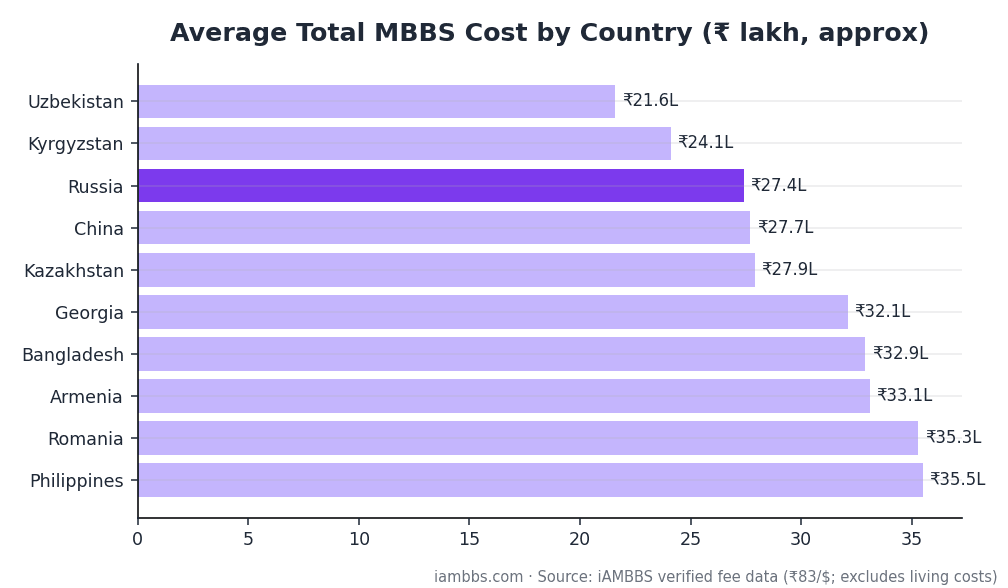
The cost of studying MBBS in Russia is significantly lower than private medical colleges in India. While a private MBBS seat in India can cost ₹50 lakhs to ₹1 crore, Russia offers quality medical education for ₹15-50 lakhs for the entire course.
2. No Donation or Capitation Fees
Unlike many private medical colleges in India, Russian universities operate on merit-based admissions with transparent fee structures. There are no hidden donations or capitation fees.
3. Globally Recognized Degrees
All major Russian medical universities are recognized by the National Medical Commission (NMC), World Health Organization (WHO), and UNESCO. This means your degree is valid for practice in India and many other countries after clearing the required licensing exams.
4. English Medium Programs
While Russia is a Russian-speaking country, most medical universities offer MBBS programs entirely in English. This eliminates the language barrier for theoretical learning, though basic Russian helps during clinical rotations.
5. No Entrance Exam Beyond NEET
Russian universities don't conduct separate entrance exams. If you've qualified NEET (even with just qualifying marks), you're eligible to apply. There's no minimum NEET score cutoff for most universities.
6. Quality Medical Education
Russia has a rich legacy in medical education dating back over 200 years. Universities like Sechenov First Moscow State Medical University and Lomonosov Moscow State University are world-renowned for their research and clinical training.
7. Advanced Infrastructure & Facilities
Russian medical universities are equipped with modern laboratories, simulation centers, well-stocked libraries, and teaching hospitals with high patient volumes for excellent clinical exposure.
8. International Exposure
Studying in Russia gives you exposure to diverse cultures and medical practices. You'll interact with students from over 100 countries, broadening your global perspective.
9. Low Cost of Living
The cost of living in Russia is approximately 58% lower than the USA and significantly cheaper than most European countries. Students can live comfortably on $100-150 per month.
10. Safe & Welcoming Environment
With over 30,000 Indian students currently studying in Russia, there's a well-established Indian community. Russian people are generally welcoming, and major cities have Indian restaurants and cultural associations.
Student Testimonial: "I chose Russia for MBBS because of the affordable fees and quality education. The clinical exposure here is excellent, and I've cleared my FMGE in the first attempt. Starting preparation from the first year made all the difference." - Dr. Priya Sharma, Kazan Federal University Graduate
Ready to explore your options? Book a free counselling session with our experts to find the perfect Russian university for you.
Eligibility Criteria for MBBS in Russia 2026
Before you start dreaming about studying in Russia, let's make sure you meet the eligibility requirements. The good news? The criteria are quite straightforward.
Academic Qualifications
| Requirement | General Category | Reserved Category (OBC/SC/ST) |datory - Qualifying marks | Mandatory - Qualifying marks | | NEET Score | 213+ (2026 cutoff) | 177+ (2026 cutoff) | | 12th Standard (PCB) | Minimum 50% aggregate | Minimum 40-45% aggregate | | Physics Marks | Individual pass required | Individual pass required | | Chemistry Marks | Individual pass required | Individual pass required | | Biology Marks | Individual pass required | Individual pass required |
Age Requirements
- Minimum Age: 17 years completed on or before December 31, 2026
- Maximum Age: No upper age limit
This is great news for students who might have taken a gap year or two!
NEET Validity
- NEET scorecard valid for admission until 2028
- You can use NEET 2026 score for admission in 2026
Language Requirements
- No TOEFL or IELTS required - This is a major advantage over countries like the USA, UK, or Australia
- English proficiency assumed based on Indian education system
- Basic Russian knowledge recommended but not mandatory for admission
Medical Fitness
- HIV negative certificate required
- COVID-19 vaccination certificate (as per current regulations)
Comparison with Other Countries
| Country | NEET Required | Minimum Score | IELTS Required | Age Limit |
|---|---|---|---|---|
| Russia | Yes | NEET 2026 qualifying marks | No | 17+ (no max) |
| Georgia | Yes | Qualifying only | No | 17+ (no max) |
| Kazakhstan | Yes | Qualifying only | No | 17+ (no max) |
| Philippines | Yes | Qualifying only | No | 17-25 |
| China | Yes | 50th percentile | No | 17-25 |
As you can see, Russia has one of the most flexible eligibility criteria with no upper age limit.
Check Your Eligibility: Use our NEET Eligibility Calculator to see which Russian universities you qualify for based on your NEET score.
Top Medical Universities in Russia
Russia has over 60 NMC-approved medical universities, but choosing the right one can be overwhelming. Here's a comprehensive comparison of the top 15 universities popular among Indian students:
Top 15 NMC-Approved Medical Universities in Russia (2026)
| Rank | University Name | Location | Annual Tuition Fee | Total Cost (6 years) | QS World Ranking | NMC Approved | WHO Listed |
|---|---|---|---|---|---|---|---|
| 1 | Lomonosov Moscow State University | Moscow | ₹7-8 lakhs | ₹42-48 lakhs | 94 | ||
| 2 | Sechenov First Moscow State Medical University | Moscow | ₹6.5-7.5 lakhs | ₹39-45 lakhs | Top 500 | ||
| 3 | Kazan Federal University | Kazan | ₹6-7 lakhs | ₹36-42 lakhs | 403 | ||
| 4 | Novosibirsk State University | Novosibirsk | ₹5.5-6.5 lakhs | ₹33-39 lakhs | 442 | ||
| 5 | Siberian State Medical University | Tomsk | ₹4.5-5.5 lakhs | ₹27-33 lakhs | - | ||
| 6 | Pirogov Russian National Research Medical University | Moscow | ₹6-7 lakhs | ₹36-42 lakhs | - | ||
| 7 | Kemerovo State Medical University | Kemerovo | ₹3-4 lakhs | ₹18-24 lakhs | - | ||
| 8 | Saratov State Medical University | Saratov | ₹4-5 lakhs | ₹24-30 lakhs | - | ||
| 9 | Voronezh State Medical University | Voronezh | ₹4.5-5.5 lakhs | ₹27-33 lakhs | - | ||
| 10 | Omsk State Medical University | Omsk | ₹3.5-4.5 lakhs | ₹21-27 lakhs | - | ||
| 11 | Kursk State Medical University | Kursk | ₹5-6 lakhs | ₹30-36 lakhs | - | ||
| 12 | Far Eastern Federal University | Vladivostok | ₹5-6 lakhs | ₹30-36 lakhs | - | ||
| 13 | Bashkir State Medical University | Ufa | ₹4-5 lakhs | ₹24-30 lakhs | - | ||
| 14 | Rostov State Medical University | Rostov | ₹4.5-5.5 lakhs | ₹27-33 lakhs | - | ||
| 15 | Crimean Federal University | Simferopol | ₹3.5-4.5 lakhs | ₹21-27 lakhs | - |
Note: Fees are approximate and may vary. Always verify with the university directly.
Detailed University Profiles
1. Lomonosov Moscow State University (MSU)
Overview: Founded in 1755, MSU is Russia's oldest and most prestigious university, ranked 94th globally.
Key Features:
- Excellent research facilities and international collaborations
- Located in the capital city with access to top hospitals
- High-quality faculty with international teaching experience
- Strong alumni network globally
Best For: Students seeking top-tier education and don't mind higher fees
Indian Student Population: 500+
Learn more about Lomonosov Moscow State University →
2. Sechenov First Moscow State Medical University
Overview: Established in 1758, it's one of the oldest and most reputable medical universities in Russia.
Key Features:
- Specialized medical university with 260+ years of excellence
- State-of-the-art simulation centers and research labs
- Over 10,000 international students from 100+ countries
- English medium program since 1990
Best For: Students prioritizing pure medical education and clinical exposure
Indian Student Population: 800+
Learn more about Sechenov University →
3. Kazan Federal University
Overview: One of the oldest universities in Russia (1804), known for excellent infrastructure and research.
Key Features:
- Located in Kazan, a beautiful city with lower living costs than Moscow
- Modern campus with international student facilities
- Strong emphasis on research and innovation
- Milder climate compared to other Russian cities
Best For: Students looking for quality education at moderate fees
Indian Student Population: 600+
Learn more about Kazan Federal University →
4. Siberian State Medical University (SSMU)
Overview: Leading medical university in Siberia with excellent clinical training facilities.
Key Features:
- Very affordable fees compared to Moscow universities
- High patient volume in teaching hospitals (excellent clinical exposure)
- Well-established Indian student community
- Good FMGE preparation support
Best For: Budget-conscious students who want excellent clinical exposure
Indian Student Population: 400+
Learn more about Siberian State Medical University →
5. Kemerovo State Medical University
Overview: One of the most affordable NMC-approved universities with good infrastructure.
Key Features:
- Lowest fees among top Russian universities (₹3-4 lakhs/year)
- English medium program with experienced faculty
- Strong support system for international students
- Growing reputation among Indian students
Best For: Students with budget constraints who still want quality education
Indian Student Population: 300+
Learn more about Kemerovo State Medical University →
Need help choosing? Our University Comparison Tool lets you compare fees, rankings, and facilities side-by-side.
MBBS in Russia Fee Structure & Cost Breakdown 2026
One of the biggest advantages of studying MBBS in Russia is the affordability. Let's break down the complete cost so you know exactly what to expect.
Tuition Fees Breakdown
The tuition fees vary significantly based on the university's location and reputation:
| University Category | Annual Tuition Fee | Total 6-Year Cost |
|---|---|---|
| Premium (Moscow) | ₹6-8 lakhs | ₹36-48 lakhs |
| Mid-Range (Major Cities) | ₹4-6 lakhs | ₹24-36 lakhs |
| Budget-Friendly (Smaller Cities) | ₹3-4.5 lakhs | ₹18-27 lakhs |
Year-Wise Cost Breakdown (Average Mid-Range University)
| Year | Tuition Fee | Accommodation | Living Expenses | Books & Materials | Insurance | Annual Total |
|---|---|---|---|---|---|---|
| Year 1 | ₹5,00,000 | ₹80,000 | ₹1,20,000 | ₹30,000 | ₹20,000 | ₹7,50,000 |
| Year 2 | ₹5,00,000 | ₹80,000 | ₹1,20,000 | ₹20,000 | ₹20,000 | ₹6,40,000 |
| Year 3 | ₹5,00,000 | ₹80,000 | ₹1,20,000 | ₹20,000 | ₹20,000 | ₹6,40,000 |
| Year 4 | ₹5,00,000 | ₹80,000 | ₹1,20,000 | ₹20,000 | ₹20,000 | ₹6,40,000 |
| Year 5 | ₹5,00,000 | ₹80,000 | ₹1,20,000 | ₹20,000 | ₹20,000 | ₹6,40,000 |
| Year 6 | ₹5,00,000 | ₹80,000 | ₹1,20,000 | ₹15,000 | ₹20,000 | ₹6,35,000 |
| Total | ₹30,00,000 | ₹4,80,000 | ₹7,20,000 | ₹1,25,000 | ₹1,20,000 | ₹39,45,000 |
First year is typically higher due to admission fees, visa costs, and initial setup.
Detailed Living Expenses Breakdown
| Expense Category | Monthly Cost | Annual Cost | 6-Year Total | Notes |
|---|---|---|---|---|
| Hostel/Accommodation | ₹6,000-8,000 | ₹72,000-96,000 | ₹4,32,000-5,76,000 | University hostels are cheapest |
| Food & Groceries | ₹3,000-5,000 | ₹36,000-60,000 | ₹2,16,000-3,60,000 | Hostel mess + outside food |
| Transportation | ₹800-1,200 | ₹10,000-15,000 | ₹60,000-90,000 | Student discounts available |
| Mobile & Internet | ₹500-800 | ₹6,000-10,000 | ₹36,000-60,000 | Affordable data plans |
| Utilities | ₹500-1,000 | ₹6,000-12,000 | ₹36,000-72,000 | Often included in hostel |
| Personal Expenses | ₹1,500-2,500 | ₹18,000-30,000 | ₹1,08,000-1,80,000 | Clothing, toiletries, etc. |
| Total Monthly | ₹12,000-19,000 | ₹1,48,000-2,23,000 | ₹8,88,000-13,38,000 |
One-Time Costs
| Expense | Cost (Approx.) | When Payable |
|---|---|---|
| Visa Application Fee | ₹8,000-12,000 | Before departure |
| Flight Tickets (One-way) | ₹25,000-40,000 | Before departure |
| Medical Tests & Certificates | ₹5,000-10,000 | Before departure |
| Translation & Attestation | ₹15,000-20,000 | Before departure |
| Initial Setup (bedding, utensils) | ₹10,000-15,000 | First month |
| Total One-Time | ₹63,000-97,000 |
Hidden Costs to Consider
Many students forget about these expenses:
- Return Flight Tickets: Budget ₹30,000-50,000 per trip (at least once a year)
- Winter Clothing: Russian winters are harsh - budget ₹15,000-25,000 for proper winter gear
- FMGE Preparation: Coaching materials, mock tests - ₹20,000-50,000 over 6 years
- Embassy Fees: Document verification, migration certificate - ₹10,000-15,000
- Emergencies: Always keep ₹50,000-1,00,000 buffer for unexpected expenses
Total 6-Year Cost Estimate
| Component | Budget Option | Mid-Range | Premium Option |
|---|---|---|---|
| Tuition Fees | ₹18,00,000 | ₹30,00,000 | ₹42,00,000 |
| Living Expenses | ₹8,00,000 | ₹10,00,000 | ₹13,00,000 |
| One-Time Costs | ₹80,000 | ₹90,000 | ₹1,00,000 |
| Hidden Costs | ₹1,50,000 | ₹2,00,000 | ₹3,00,000 |
| Grand Total | ₹28,30,000 | ₹42,90,000 | ₹59,00,000 |
Russia vs India: Cost Comparison
| Category | MBBS in Russia | India (Government) | India (Private) |
|---|---|---|---|
| Total Course Fee | ₹18-50 lakhs | ₹5-10 lakhs | ₹50 lakhs - ₹1.5 crores |
| Donation/Capitation | ₹0 | ₹0 | ₹50 lakhs - ₹2 crores |
| Competition Level | Low (NEET qualifying) | Extremely High | High (depends on donation) |
| Seat Availability | High | Very Limited | |
| Total Investment | ₹20-60 lakhs | ₹5-10 lakhs | ₹1-3 crores |
Return on Investment (ROI) Analysis
Let's calculate the 10-year ROI:
MBBS in Russia:
- Total Investment: ₹40 lakhs (average)
- Average Doctor Salary (Post-FMGE): ₹6-10 lakhs/year
- 10-year earnings: ₹60-1,00 lakhs
- Net ROI after 10 years: ₹20-60 lakhs
India Private College:
- Total Investment: ₹1.5 crores (average)
- Average Doctor Salary: ₹6-12 lakhs/year
- 10-year earnings: ₹60-1,20 lakhs
- Net ROI after 10 years: -₹90 lakhs to -₹30 lakhs
Verdict: Russia offers significantly better ROI, especially for students who can't secure government seats.
Calculate Your Exact Cost: Use our MBBS Cost Calculator to get a personalized estimate based on your chosen university.
Course Structure & Curriculum
Understanding the course structure will help you prepare better. Here's exactly what you'll study over 6 years.
Course Duration
Total: 6 years
- 5 years: Theoretical studies + Practical training
- 1 year: Internship/Clinical rotations
Medium of Instruction
- Theory Classes: 100% English
- Clinical Training: Mix of English and Russian
- Doctors and senior students explain in English
- Patient interactions often in Russian (basic Russian helps)
- Textbooks: English and Russian (English translations provided)
Year-Wise Curriculum Breakdown
Year 1: Foundation Sciences
Focus: Building strong basics in medical sciences
| Subject | Topics Covered | Hours/Week |
|---|---|---|
| Anatomy | Human body structure, systems, organs | 12-15 |
| Histology | Microscopic study of tissues | 6-8 |
| Biochemistry | Chemical processes in body | 6-8 |
| Physiology | Body functions and mechanisms | 8-10 |
| Russian Language | Medical Russian, basic communication | 4-6 |
Assessment: Regular tests, practicals, end-year exams
Year 2: Pre-Clinical Sciences
Focus: Understanding disease processes
| Subject | Topics Covered | Hours/Week |
|---|---|---|
| Pathology | Disease mechanisms, tissue changes | 10-12 |
| Microbiology | Bacteria, viruses, parasites | 8-10 |
| Pharmacology | Drug actions, uses, side effects | 8-10 |
| Pathophysiology | How diseases affect body functions | 8-10 |
| Community Medicine | Public health, epidemiology | 4-6 |
Clinical Exposure: Begin hospital visits, observe procedures
Year 3-4: Clinical Sciences
Focus: Major clinical subjects with hands-on training
| Subject | Year | Topics Covered |
|---|---|---|
| Internal Medicine | 3-4 | Diagnosis and treatment of adult diseases |
| Surgery | 3-4 | Surgical procedures, pre/post-op care |
| Pediatrics | 3-4 | Child health, diseases, development |
| Obstetrics & Gynecology | 3-4 | Pregnancy, childbirth, women's health |
| General Practice | 3-4 | Primary care, common illnesses |
| Emergency Medicine | 3-4 | Trauma, acute conditions, life-saving |
Clinical Rotations: 4-6 hours daily in teaching hospitals Patient Interaction: Supervised examination, history taking
Year 5: Advanced Clinical Training
Focus: Specialized subjects and electives
| Subject | Topics Covered |
|---|---|
| Cardiology | Heart diseases, ECG, procedures |
| Neurology | Brain and nervous system disorders |
| Dermatology | Skin diseases and treatments |
| Psychiatry | Mental health disorders |
| Ophthalmology | Eye diseases and surgery |
| ENT | Ear, nose, throat conditions |
| Electives | Choose specializations of interest |
Research Project: Complete a thesis/research paper
Year 6: Internship
Focus: Hands-on clinical practice under supervision
- Duration: 12 months full-time
- Rotations: 2-3 months in each major department
- Internal Medicine (3 months)
- Surgery (3 months)
- Pediatrics (2 months)
- Obs-Gyn (2 months)
- Emergency Medicine (2 months)
- Responsibilities:
- Patient examination and history
- Assisting in procedures
- Emergency duty rotations
- Case presentations
- Medical documentation
Final Assessment: Clinical competency examination
Teaching Methodology
Russian medical universities use a comprehensive teaching approach:
- Lectures: Large group teaching (100-300 students)
- Practical Classes: Small groups (15-20 students) for hands-on learning
- Lab Work: Dissection, microscopy, experiments
- Clinical Postings: Hospital rotations with real patients
- Seminars: Student presentations and discussions
- Simulation Training: Using mannequins and models
- E-Learning: Online resources and video lectures
Examination Pattern
| Assessment Type | Frequency | Weightage |
|---|---|---|
| Internal Tests | Monthly | 20% |
| Mid-Term Exams | Semester | 30% |
| Final Exams | Yearly | 50% |
| Practical Exams | Semester | 40% of subject |
| Viva Voce | Yearly | 20% of subject |
Pass Criteria: Minimum 50% in each subject (theory + practical combined)
Clinical Exposure Quality
Russian medical universities are known for excellent clinical exposure:
- Teaching Hospitals: 5-10 hospitals affiliated with each university
- Patient Volume: High (50-100 patients per day in major hospitals)
- Hands-On Training: Students assist in procedures from Year 3
- Emergency Exposure: 24-hour emergency departments with diverse cases
- Variety of Cases: Urban hospitals see a wide range of conditions
Compare with India:
- Russia: 1,000+ clinical hours by graduation
- India (Government): 800-1,000 hours
- India (Private): Varies (often limited in newer colleges)
Admission Process for MBBS in Russia 2026
The admission process is straightforward but requires careful planning. Here's your step-by-step guide:
Complete Admission Timeline
| Timeline | Activity | Action Required |
|---|---|---|
| January - April | Research & University Selection | Shortlist 3-5 universities, compare fees |
| May - June | NEET 2026 Exam | Appear and qualify NEET |
| June - July | Document Preparation | Gather all required documents |
| July - August | Application Submission | Apply to selected universities |
| August | Offer Letter | Receive admission offer from university |
| August - September | Visa Application | Submit documents to Russian embassy |
| September | Travel to Russia | Flight booking, arrival |
| Late September | University Enrollment | Complete registration, begin classes |
Required Documents Checklist
Print this list and check off as you prepare:
| Document | Format Required | Copies | Status |
|---|---|---|---|
| ☐ NEET Scorecard | Original + Attested copy | 3 | |
| ☐ 10th Marksheet | Attested copy | 3 | |
| ☐ 12th Marksheet | Attested copy | 3 | |
| ☐ 12th Passing Certificate | Attested copy | 2 | |
| ☐ Passport | Original + Copy (valid 2+ years) | 3 copies | |
| ☐ Passport Size Photos | White background (3.5cm x 4.5cm) | 20 | |
| ☐ Birth Certificate | Attested copy | 2 | |
| ☐ Medical Certificate | Original from registered doctor | 2 | |
| ☐ HIV Negative Certificate | Original (< 3 months old) | 2 | |
| ☐ COVID Vaccination Certificate | Original + Copy | 2 | |
| ☐ Police Clearance Certificate | Original from local police | 2 | |
| ☐ Migration Certificate | From previous school/college | 2 | |
| ☐ Bank Statement | Showing sufficient funds | 2 | |
| ☐ Invitation Letter | From Russian university | Original |
Important: All documents must be:
- Attested by Indian authorities (MEA)
- Translated to Russian by certified translator
- Apostilled (Hague Convention stamp)
Step-by-Step Application Process
Step 1: University Selection (May - June)
- Research universities based on:
- Fee budget
- City preference (weather, cost of living)
- FMGE pass rate (if available)
- Indian student community
- Shortlist 3-5 universities
- Check NMC approval status on official website
- Contact admission offices or consultants
Pro Tip: Apply to 3 universities to have backup options.
Step 2: Online Application (June - July)
- Visit university's official website
- Fill online application form
- Upload scanned documents:
- NEET scorecard
- 12th marksheet
- Passport copy
- Passport photos
- Pay application fee (₹5,000-15,000)
- Submit application
Processing Time: 2-4 weeks
Step 3: Receive Offer Letter (July - August)
- University reviews application
- Admission offer sent via email
- Offer letter includes:
- Admission confirmation
- Fee structure
- Reporting date
- Hostel details
- Accept offer by paying first-year fees (or advance)
- University sends official Invitation Letter for visa
Step 4: Document Preparation (July - August)
While waiting for offer letter, prepare documents:
- Attestation Process:
- Notary attestation (local)
- State HRD attestation
- MEA (Ministry of External Affairs) attestation
- Russian Embassy attestation
- Translation:
- Get all documents translated to Russian
- Use certified translator only
- Translate exactly as written (no changes)
- Apostille:
- MEA Apostille stamp (Hague Convention)
- Required for documents to be valid in Russia
Timeline: 15-30 days for complete attestation
Cost: ₹15,000-25,000 for complete attestation & translation
Step 5: Visa Application (August - September)
Russian Student Visa Requirements:
- Documents Required:
- Passport (original, valid 18+ months)
- Invitation letter from university
- Completed visa application form
- 2 passport photos
- Medical certificate & HIV test
- Bank statement (₹5+ lakhs balance)
- Flight tickets (tentative)
- Application Process:
- Book appointment at Russian Embassy/VFS
- Submit documents in person
- Pay visa fee (₹8,000-12,000)
- Biometrics (if required)
-
Processing Time: 15-20 working days
-
Visa Validity: Single entry, 90 days (convert to multiple entry in Russia)
Pro Tip: Apply for visa at least 30 days before travel.
Step 6: Travel & Arrival (September)
- Flight Booking:
- Book after receiving visa
- Direct flights: Delhi → Moscow (₹25,000-40,000)
- Budget option: Connecting flights via Dubai/Istanbul
- Packing s:
- All original documents in hand baggage
- Winter clothes (if arriving in October+)
- Medicines (3-6 months supply)
- Indian spices and packaged foods
- Laptop and study materials
- Adapter plugs (Russia uses 220V, Type C/F plugs)
- Airport Pickup:
- Most universities arrange pickup
- Confirm pickup details before travel
- Keep university contact numbers handy
- Immigration:
- Show invitation letter
- Show admission documents
- Declare currency (> $10,000)
Step 7: University Registration (First Week)
- Medical Examination:
- University-arranged health checkup
- HIV test (mandatory)
- Chest X-ray
- General health assessment
- Migration Registration:
- Register with local migration office (within 7 days)
- University assists with this
- Get migration stamp in passport
- University Enrollment:
- Submit original documents to university
- Pay remaining fees (if not paid online)
- Collect student ID card
- Receive study materials and timetable
- Hostel Allocation:
- Check-in to assigned hostel
- Pay hostel fees
- Bank Account Opening:
- Open Russian bank account (for receiving money)
- University provides introduction letter
- Get debit card and online banking
- SIM Card:
- Popular providers: MTS, Beeline, Megafon
- Student plans available (₹300-500/month)
Common Mistakes to Avoid
- No: Applying too late → Start in May, not July
- No: Incomplete documents → Use checklist, double-check
- No: Choosing university only by low fees → Consider quality, location, FMGE support
- No: Not getting travel insurance → for emergencies
- No: Carrying too much cash → Use forex cards, bank transfers
- No: Skipping Russian language classes → Makes clinical years easier
- No: Not researching city weather → Some cities are -40°C in winter!
Need Admission Assistance? Our consultants have helped 500+ students secure admission in top Russian universities. Book free counselling today.
Recognition & Accreditation
Before investing lakhs of rupees and 6 years of your life, you want to be absolutely sure that your degree will be recognized. Here's everything you need to know:
National Medical Commission (NMC) Recognition
What is NMC? The National Medical Commission (formerly Medical Council of India) is the regulatory body for medical education in India. NMC approval is for practicing medicine in India.
Russia's Status:
- NMC maintains an official list of approved foreign universities
- Updated regularly (check official NMC website before admission)
How to Verify:
- Visit: https://www.nmc.org.in
- Go to "Foreign Medical Graduates" section
- Download "List of Foreign Medical Institutions"
- Search for your chosen Russian university
- Yes: If listed → NMC approved
- No: If not listed → Do NOT take admission
Important Update (2024): NMC introduced new regulations for Foreign Medical Graduates (FMGs):
- University must have continuous NMC recognition
- Any university can be removed if quality drops
- Check NMC website 2-3 months before admission
World Health Organization (WHO) Listing
What is WHO WDMS? World Directory of Medical Schools (WDMS) is WHO's official database of medical schools worldwide.
Why It Matters:
- International recognition of your degree
- Required for USMLE (USA medical licensing)
- Required for PLAB (UK medical licensing)
- Demonstrates global quality standards
Russia's Status:
- All major Russian medical universities are WHO-listed
- Verify at: https://www.wdoms.org
UNESCO Recognition
What is UNESCO? United Nations Educational, Scientific and Cultural Organization recognizes educational institutions globally.
Russia's Status:
- Russian medical degrees have UNESCO recognition
- s degree equivalence in other countries
- Helps in migration and international practice
ECFMG Certification (for USA Practice)
What is ECFMG? Educational Commission for Foreign Medical Graduates certifies international medical graduates for practice in the USA.
Russia's Status:
- Top Russian universities (Sechenov, MSU, Kazan) are ECFMG eligible
- Graduates can appear for USMLE exams
Path to Practice in USA:
- Complete MBBS in Russia (6 years)
- Get ECFMG certification
- Apply for residency match
- Complete residency (3-7 years)
Validity for Practice in India
The Reality Check:
Having NMC-approved degree is necessary but NOT sufficient to practice in India. Here's what you must do:
Mandatory Requirements:
- Clear FMGE (Foreign Medical Graduate Examination) OR NExT (National Exit Test)
- Pass percentage: 50%
- Current pass rate for Russia graduates: ~29.5%
- Exam held twice a year (June & December)
- No limit on attempts
- Complete 1-Year Internship in India
- After clearing FMGE/NExT
- In NMC-recognized hospitals
- Mandatory for registration
- Get NMC Registration
- Apply to state medical council
- Get permanent registration number
- Now you can practice medicine legally
Without FMGE: You CANNOT practice medicine in India, even with NMC-approved degree.
Recognition in Other Countries
Russian MBBS degree is recognized in many countries, but each has its own licensing process:
| Country | Recognition | Licensing Exam | Additional Requirements |
|---|---|---|---|
| India | NMC Approved | FMGE/NExT | 1-year internship |
| USA | ECFMG Eligible | USMLE Steps 1,2,3 | Residency (3-7 years) |
| UK | GMC Eligible | PLAB 1 & 2 | Foundation training (2 years) |
| Canada | MCC Eligible | MCCEE, NAC OSCE | Residency required |
| Australia | AMC Eligible | AMC CAT MCQ, Clinical | Supervised practice |
| UAE | DHA/MOH Eligible | DHA/MOH Exam | Good standing certificate |
| Middle East | Generally Accepted | Country-specific exams | Varies by country |
| European Union | Partially Recognized | Country-specific exams | May need additional training |
Key Takeaway: Russian MBBS is globally recognized, but you must clear the respective country's licensing exam to practice there.
How to Verify Recognition Before Admission
5-Step Verification Process:
- Check NMC Official Website
- Download latest list of approved universities
- Verify your chosen university is listed
- Check for any notifications or warnings
- Check University's Official Website
- Look for recognition certificates
- WHO listing certificate
- Government approval documents
- Contact NMC Directly
- Email: [email protected]
- Ask specific questions about your chosen university
- Get written confirmation
- Consult with Alumni
- Find students who graduated from that university
- Ask about FMGE clearance rate
- LinkedIn groups, Facebook groups
- Verify with Embassy
- Contact Russian Embassy in India
- Education section can provide information
- Get list of approved universities
Red Flags to Watch Out For:
University not on NMC list (check again after 3 months) Too-good-to-be-true promises (100% FMGE pass rate) Agents offering guaranteed admission without NEET Universities without WHO listing Newly established universities (< 10 years old) No Indian students in recent batches Negative reviews from multiple students
Our Promise: We only recommend NMC-approved, WHO-listed universities with established track records. Verify your university choice with our experts →
FMGE/NExT Requirements & Success Strategy
This is the most critical section for Indian students. Let's address the elephant in the room: FMGE pass rates for Russian graduates are lower than we'd like. But with the right strategy, you can beat the odds.
What is FMGE/NExT?
FMGE (Foreign Medical Graduate Examination):
- National-level exam for foreign medical graduates
- Conducted by NMC (National Board of Examinations)
- Mandatory to practice medicine in India
- Computer-based multiple choice exam
- 300 questions, 450 marks, 2.5 hours duration
- Pass mark: 50% (150/300 questions)
NExT (National Exit Test):
- Replacing FMGE gradually
- Will be common final exam for Indian + foreign medical graduates
- Currently in implementation phase
- Same purpose: Screen medical graduates for competency
FMGE Pass Rate Reality Check
Let's be transparent about the numbers:
| Year | Russia Graduates Appeared | Passed | Pass Rate |
|---|---|---|---|
| 2020 | 9,234 | 16.0% | |
| 2021 | 9,891 | 1,682 | 17.0% |
| 2022 | 10,456 | 2,091 | 20.0% |
| 2023 | 10,982 | 2,851 | 26.0% |
| 2024 | 11,276 | 3,331 | 29.5% |
Trend: Improving steadily! From 16% to 29.5% in 4 years.
Comparison with Other Countries:
| Country | FMGE Pass Rate |
|---|---|
| Georgia | 35-40% |
| Philippines | 38-42% |
| Russia | 29.5% |
| Ukraine | 25-28% |
| Kazakhstan | 28-32% |
| China | 22-26% |
| Bangladesh | 30-35% |
Why is Russia's Pass Rate Lower?
- Curriculum Mismatch:
- Russian syllabus follows European model
- FMGE based on Indian medical curriculum
- Different approach to clinical medicine
- Disease prevalence varies (e.g. Tropical diseases less common in Russia)
- Language Barrier in Clinical Years:
- Theory in English, but patients speak Russian
- Harder to practice clinical skills in native language
- Affects retention of practical knowledge
- Lack of FMGE-Specific Preparation:
- Most Russian universities don't offer structured FMGE coaching
- Students have to self-study or take online coaching
- Limited access to Indian textbooks and resources
- Complacency:
- Students don't start FMGE prep early enough
- Realize the difficulty only in final year
- By then, too late to cover entire syllabus
But Here's the Good News:
Students who follow a structured preparation strategy from Year 1 have 60-70% pass rates. The low overall rate is because most students don't prepare properly.
FMGE Success Strategy: Year-Wise Plan
The Secret: Start preparing for FMGE from Day 1, not final year.
Year 1-2: Building Foundation
Goal: Master basic sciences with Indian perspective
What to Do:
- Follow Indian Textbooks Alongside Russian Curriculum:
- Anatomy: BD Chaurasia (Indian standard)
- Physiology: Guyton + Indian textbook
- Biochemistry: Vasudevan or Lippincott
- Join Online FMGE Coaching (Optional):
- Marrow, Prepladder, DAMS (Indian platforms)
- Watch lectures on Indian medical curriculum
- 30 minutes daily is enough
- Make Notes:
- Consolidate Russian lectures + Indian textbooks
- Highlight differences
- Focus on high-yield topics
Time Investment: 30-45 minutes daily (easily manageable)
Year 5: Intensive Preparation
Goal: Complete entire syllabus revision
What to Do:
- Subject-Wise Completion:
- Finish all subjects systematically
- Minimum 2 revisions of each subject
- Focus on high-yield topics (previous year analysis)
- Mock Tests:
- Weekly full-length mocks
- Analyze performance
- Improve weak areas
- Group Study:
- Form study groups with serious students
- Discuss difficult topics
- Teach each other (best way to learn)
Time Investment: 3-4 hours daily
Year 6 (Internship Year): Final Push
Goal: Peak performance in FMGE
What to Do:
- Complete Revision:
- 3-4 revisions of entire syllabus
- Focus on weak subjects
- Rapid revision notes
- Daily Mock Tests:
- One full-length test every 2-3 days
- Improve speed and accuracy
- Time management practice
- Last Month Strategy:
- Only revision, no new topics
- Previous 10 years FMGE papers (multiple times)
- Relaxed mind, good sleep
Time Investment: 6-8 hours daily
High-Yield Topics for FMGE
Based on analysis of last 10 years papers:
Medicine (30-35% weightage):
- Cardiology (CVS, ECG)
- Respiratory (COPD, Asthma, TB)
- GIT (Liver diseases, IBD)
- Nephrology (AKI, CKD)
- Endocrinology (Diabetes, Thyroid)
- Infectious diseases (HIV, Malaria, Dengue)
Surgery (25-30% weightage):
- GI Surgery (Peptic ulcer, Appendicitis, Hernias)
- Trauma and emergency
- Urology (Stones, BPH, UTI)
- Orthopedics (Fractures, common conditions)
- Oncology basics
Obs-Gyn (15-20% weightage):
- Obstetrics (Pregnancy complications, labor)
- Gynecology (Menstrual disorders, infections)
- Family planning
Pediatrics (15-20% weightage):
- Neonatology
- Growth and development
- Common childhood illnesses
- Immunization
Preventive & Social Medicine (10-15% weightage):
- Epidemiology
- National health programs
- Biostatistics
- Nutrition
Recommended Resources
Books:
- Fast-Track FMGE by Dr. Deepak Marwah (must-have)
- FMGE Solutions series (subject-wise)
- Marrow Review (comprehensive)
Online Platforms:
- Marrow (most popular, 4.5★ rated)
- Prepladder (good video lectures)
- DAMS (traditional classroom approach)
Cost: ₹15,000-40,000/year for premium subscriptions
Free Resources:
- FMGE previous year papers (NBE website)
- YouTube channels (Dr. Jubbin Jacob, Medical PG)
- Telegram groups (FMGE aspirants)
FMGE Exam Details
Exam Pattern (as of 2024):
| Aspect | Details |
|---|---|
| Questions | 300 MCQs |
| Marks | 450 (each correct = 1.5 marks) |
| Duration | 150 minutes (2.5 hours) |
| Negative Marking | No |
| Pass Marks | 150/300 (50%) |
| Exam Mode | Computer-based (CBT) |
| Frequency | Twice a year (June & December) |
| Exam Centers | Major cities in India |
Subjects Covered:
- Anatomy, Physiology, Biochemistry
- Pathology, Microbiology, Pharmacology
- Medicine, Surgery, Obs-Gyn, Pediatrics
- Preventive & Social Medicine, Forensic Medicine
- Ophthalmology, ENT, Orthopedics, Radiology
Success Stories
Dr. Rahul Mehta - Kazan Federal University (2023) "I cleared FMGE in my first attempt with 68% marks. My strategy was simple: start from Year 1, follow Indian textbooks alongside Russian curriculum, solve 10 MCQs daily, and gradually increase. By final year, I was solving 100 MCQs daily. Consistency is the key."
Dr. Anjali Singh - Sechenov University (2024) "I joined Marrow from Year 2 and watched one lecture daily (30 mins). During clinical years, I related every patient case to FMGE questions. This active learning helped me score 72% in FMGE. Don't wait till final year!"
University-Specific FMGE Support
Some Russian universities have started providing FMGE coaching:
| University | FMGE Support | Pass Rate |
|---|---|---|
| Kazan Federal University | Weekly FMGE classes | 35-40% |
| Sechenov University | Online coaching tie-up | 32-38% |
| Siberian State Medical University | FMGE preparation cell | 30-35% |
| Kemerovo State University | Basic support | 25-30% |
| Average (no support) | - | 20-25% |
Ask Before Admission: Does the university provide FMGE preparation support?
Our FMGE Support for Students
At iAMBBS, we don't just help you get admission - we ensure you clear FMGE:
- Free FMGE Preparation Guide (digital download)
- Connection to FMGE Coaching Platforms (discounted rates)
- Alumni Mentor Program (successful FMGE graduates guide you)
- Monthly Webinars on FMGE strategy
- WhatsApp Study Groups for each batch
Download Free: FMGE Preparation Roadmap for Russia MBBS Students →
Living in Russia - Student Life Guide
Studying medicine is one thing, but living in a completely different country with a different language and culture? That's a whole different challenge. Here's your to student life in Russia.
Accommodation Options
1. University Hostels (Most Common)
Features:
- Located on campus or nearby
- Shared rooms (2-3 students per room)
- Common kitchen, bathroom, study room
- 24/7 security and warden
Cost:
- Moscow: ₹6,000-10,000/month
- Other cities: ₹4,000-8,000/month
Pros:
- Cheapest option
- Easy to make friends
- Close to university
- Safe and secure
Cons:
- Limited privacy
- Basic facilities
- Strict rules (curfew, visitor restrictions)
- May need to share with non-Indian students
2. Private Shared Apartments
Features:
- Rent 2-3 BHK with 3-4 students
- Own bedroom or shared
- Kitchen, bathroom, living room
- More independence
Cost:
- Moscow: ₹8,000-15,000/month per person
- Other cities: ₹5,000-10,000/month per person
Pros:
- More space and privacy
- Can cook Indian food
- Choose roommates
- No strict rules
Cons:
- More expensive than hostel
- Need to pay utilities separately
- Finding apartment can be challenging
- Responsible for cleaning, cooking
3. Homestay with Russian Families
Features:
- Live with a Russian family
- Own room
- Meals included (Russian food)
- Language immersion
Cost:
- ₹10,000-20,000/month
Pros:
- Learn Russian quickly
- Cultural experience
- Safe environment
- Meals provided
Cons:
- Expensive
- No Indian food
- Less freedom
- Limited in availability
Recommendation: Start with university hostel in Year 1, move to shared apartment later if budget allows.
Food & Dining
University Mess/Canteen
What's Available:
- Russian staples: Borscht (soup), bread, potatoes
- Salads, meat dishes, dairy products
- Limited vegetarian options
- Breakfast, lunch, dinner
Cost: ₹2,000-4,000/month
Taste for Indians: Takes time to adapt
Indian Restaurants (Major Cities)
Availability:
- Moscow: 50+ Indian restaurants
- St. Petersburg: 20+ restaurants
- Kazan: 5-10 restaurants
- Other cities: Limited
Cost: ₹300-800 per meal
Popular Chains:
- Delhi Darbar (Moscow)
- Khajuraho (St. Petersburg)
- Mumbai (multiple cities)
Self-Cooking (Best for Indians)
What Indian Students Cook:
- Rice, dal, roti/chapati
- Sabzi (vegetables available)
- Instant noodles, Maggi
- Khichdi, poha
Where to Buy Indian Groceries:
- Indian grocery stores (major cities)
- Online: IndiShop.ru, IndianBazar.ru
- Carry from India: Spices, masalas, pickles, ready-to-eat
Monthly Cost: ₹3,000-5,000 (if cooking daily)
Pro Tip: Bring pressure cooker (small size), spices, and ready-to-eat packets (MTR, Haldiram's) from India.
Climate & Weather Adaptation
This is what most Indian students worry about:
Temperature Overview
| City | Winter (Dec-Feb) | Summer (Jun-Aug) | Adaptation Difficulty |
|---|---|---|---|
| Moscow | -10°C to -20°C | +20°C to +30°C | High |
| St. Petersburg | -8°C to -15°C | +18°C to +25°C | High |
| Kazan | -15°C to -25°C | +20°C to +30°C | Very High |
| Tomsk | -20°C to -30°C | +18°C to +28°C | Extreme |
| Vladivostok | -15°C to -25°C | +20°C to +28°C | Very High |
Coldest: Novosibirsk, Tomsk, Yakutsk (-30°C to -40°C) Mildest: Sochi (similar to Shimla)
Surviving Russian Winters: Practical Guide
** Winter Clothing (Buy in Russia):**
- Thermal Inner Wear (₹2,000-4,000)
- Thermal pants
- Woolen socks (3-4 pairs)
- Winter Jacket (₹8,000-15,000)
- Down jacket (puffer jacket)
- Waterproof and windproof
- Long enough to cover hips
- Buy in Russia (better quality for cold weather)
- Winter Accessories:
- Woolen gloves (₹500-1,000)
- Warm hat covering ears (₹500-1,000)
- Scarf/muffler (₹500-1,000)
- Winter boots (waterproof, insulated) (₹3,000-6,000)
Total Winter Clothing Budget: ₹15,000-25,000 (one-time)
Adaptation Timeline:
- First winter: Very difficult, feels unbearable
- Third winter onwards: Totally adapted, no issues
Student Advice:
"I'm from Chennai and was terrified of -20°C. But honestly, with proper clothing, it's manageable. Indoor heating is excellent (sometimes too hot!). The real challenge is waking up for 8 AM classes in winter darkness!" - Arun Kumar, MSU Moscow
Dealing with Winter Blues
Challenges:
- Sun sets at 4 PM in winter
- Less sunlight affects mood (Seasonal Affective Disorder)
- Hard to wake up in darkness
Solutions:
- Take Vitamin D supplements
- Spend time with friends
- Exercise regularly
- Use light therapy lamps
- Travel to sunny places during breaks
Safety & Security
Overall Safety: Russia is generally safe for students, especially in university areas.
Crime Rate: Low violent crime, but beware of:
- Pickpocketing in crowded metro/markets
- Drunk people late at night (avoid)
- Scams targeting foreigners
Racism/Discrimination:
- Rare, but isolated incidents reported
- More common in smaller towns than big cities
- Stick to well-lit areas, travel in groups at night
- University authorities are supportive
Emergency Numbers:
- Police: 112
- Ambulance: 103
- Fire: 101
Safety Tips: 2. Register with Indian Embassy (via app) 3. Learn basic Russian phrases 4. Save university emergency contacts 5. Join Indian Students Association WhatsApp groups
Transportation
Within City
Metro (Moscow, St. Petersburg):
- Cheapest: ₹40-50 per ride
- Fast and efficient
- Student discounts available
- Safe and clean
Buses & Trams:
- ₹30-40 per ride
- Slower than metro
- Connects to all areas
Taxis (Uber, Yandex):
- ₹150-400 per ride (within city)
- Convenient for late nights
- Safe and tracked
Walking/Cycling:
- Free, healthy option
- Good in summer
- Impossible in winter (-20°C!)
Between Cities
Train:
- Extensive network
- Comfortable sleeper trains
- Moscow → St. Petersburg (8 hours, ₹2,000-4,000)
Flights:
- Domestic flights available
- Moscow → Kazan (1.5 hours, ₹3,000-6,000)
- Book in advance for discounts
International Travel
Going Home:
- 2-3 times a year is common
- Major breaks: Winter (Dec-Jan), Summer (Jun-Jul)
- Direct flights: Moscow → Delhi (5.5 hours)
- Cost: ₹25,000-50,000 (round-trip)
Visa-Free Travel from Russia:
Part-Time Work Opportunities
Legal Status:
- Student visa allows part-time work (max 20 hours/week during semester, full-time during breaks)
- Need work permit (university helps apply)
Common Jobs for Indian Students:
- English Teaching:
- Online tutoring (₹300-500/hour)
- Language schools (₹400-800/hour)
- Translation:
- English-Hindi-Russian (if you know Russian)
- Document translation (₹200-500/page)
- IT/Coding:
- Freelance projects
- ₹20,000-50,000/month (part-time)
- Restaurant/Food Service:
- Indian restaurants hire Indian students
- ₹15,000-25,000/month (part-time)
Reality Check:
- Most medical students don't work due to heavy study load
- First 2-3 years: Focus on studies
- Later years: If you manage time well, part-time work possible
- Don't depend on part-time income for fees
Cultural Adaptation
Language
Russian Language:
- for daily life (grocery shopping, doctor visits, etc.)
- Most Russians don't speak English (especially older generation)
- Universities offer free Russian language classes (Year 1)
How Much Russian Do You Need?
- Survival Russian: 2-3 months
- Conversational Russian: 6-12 months
- Fluent Russian: 2-3 years
Apps to Learn:
- Duolingo (free, gamified learning)
- Busuu (structured courses)
- HelloTalk (practice with natives)
Pro Tip: Make Russian friends. Language learning happens faster through conversation than textbooks.
Cultural Differences
Dos:
- Learn basic Russian greetings (Zdravstvuyte, Spasibo, Pozhaluysta)
- Respect local customs and traditions
- Be punctual (Russians value time)
- Dress modestly in public
- Take off shoes when entering homes
Don'ts:
- Don't talk loudly in public transport
- Don't litter (strictly enforced)
- Don't joke about Russian history/politics (sensitive topic)
- Don't expect everyone to speak English
- Don't compare Russia with India negatively
Social Life
Making Friends:
- Join International Students Club
- Participate in university events
- Sports clubs (football, basketball popular)
- Cultural events (Diwali, Holi celebrated by Indian associations)
Dating:
- Russian students are friendly and open
- Cultural exchange relationships common
- Be respectful and clear about intentions
Homesickness:
- Very common in first 3-6 months
- Stay connected with family (WhatsApp, video calls)
- Cook Indian food
- Join Indian student groups
- Focus on studies and making friends
Student Experience:
"First 6 months were tough - weather, food, language everything was different. But after that, I absolutely love it here. Made amazing Russian and international friends, learned a new language, experienced a different culture. Best decision ever!" - Neha Patel, Kazan Federal University, Year 4
Indian Community in Russia
Size: 30,000+ Indian students across Russia
Indian Students Associations:
- Organize Diwali, Holi, Independence Day celebrations
- WhatsApp groups for each university
Indian Embassy Support:
- Registration of students
- Help in emergencies
- Cultural events
- Career guidance
Facebook Groups:
- "Indian Students in Russia"
- "Indian Students in Moscow"
- "Indian Students in Kazan"
- University-specific groups
Connect Before You Go: Join these groups 2-3 months before departure to connect with seniors and get tips.
Career Prospects After MBBS from Russia
So you've invested 6 years and ₹20-40 lakhs in MBBS from Russia. What next? Let's look at all your career options:
Option 1: Practice in India (Most Common)
Path:
- Clear FMGE/NExT exam (mandatory)
- Complete 1-year compulsory internship in India
- Get state medical council registration
- Start practicing
Career Options in India:
A. Private Practice
- Open your own clinic
- Initial investment: ₹5-20 lakhs (depending on location and setup)
- Income: ₹50,000-3,00,000/month (builds over time)
- Timeline: 2-5 years to establish
- Best for: Those who want independence and long-term wealth
B. Hospital Jobs
Government Hospitals:
- Salary: ₹60,000-1,00,000/month (starting)
- Job security, pension benefits
- Less workload than private
- Hard to get (limited openings)
Private Hospitals:
- Salary: ₹40,000-80,000/month (starting)
- More opportunities
- Better exposure, modern equipment
- Higher workload
Corporate Hospitals (Apollo, Fortis, Max):
- Salary: ₹60,000-1,20,000/month (starting)
- Structured career growth
- Brand name, good facilities
- Performance pressure
C. Postgraduate (MD/MS) in India
After FMGE:
- Eligible for NEET PG (all-India exam)
- Compete with Indian MBBS graduates
- Challenging (limited seats, high competition)
- If you clear: MD/MS degree (3 years)
- Post-MD salary: ₹1,50,000-5,00,000/month
Specializations Available:
- MD: Medicine, Pediatrics, Dermatology, Radiology, Anesthesia, etc.
- MS: General Surgery, Orthopedics, ENT, Ophthalmology, Obs-Gyn, etc.
Reality Check: NEET PG is extremely competitive. Many Russian MBBS graduates take 2-3 attempts to clear it for desired specialty.
Option 2: Postgraduate in Russia
Path:
- Complete MBBS in Russia
- Apply directly for MD (equivalent to DNB in India)
- 2-3 years of specialization
- Cost: ₹8-15 lakhs total
Advantages:
- No entrance exam (direct admission)
- Quality education, research opportunities
- International exposure
Disadvantages:
- MD from Russia needs additional licensing to practice in India
- Limited recognition in India (NMC rules changing)
- Need to clear FMGE + India PG equivalency exam
Career After Russia PG:
- Practice in Russia or other European countries
- Return to India (after equivalency exams)
- Research and academic careers
Who Should Choose: Students interested in research, want to stay abroad long-term, or can't clear NEET PG in India.
Option 3: USMLE & Practice in USA
Path:
- Complete MBBS in Russia (from ECFMG-eligible university)
- Clear USMLE Step 1 (during final years)
- Complete residency (3-7 years depending on specialty)
Cost:
- USMLE exams: $3,000-5,000 (₹2.5-4 lakhs)
- Travel to USA for exams: ₹2-3 lakhs
- Residency application: $2,000-5,000
- Living in USA during residency: Stipend provided ($50,000-70,000/year)
Income After Residency:
- Primary care: $200,000-250,000/year (₹1.6-2 crores/year)
- Specializations: $300,000-500,000/year (₹2.5-4 crores/year)
Timeline:
- MBBS (6 years) + USMLE prep (1-2 years) + Residency (3-7 years) = 10-15 years total
Challenges:
- Very competitive (match rate 50-60% for international medical graduates)
- Long process
- Need to live away from family for years
- Student visa to work visa transition challenges
Who Should Choose: Highly motivated, top performers, financially strong, willing to invest 10+ years.
Option 4: PLAB & Practice in UK
Path:
- Complete MBBS in Russia
- Clear PLAB Part 1 (computer-based exam)
- Clear PLAB Part 2 (clinical OSCE)
- Get GMC (General Medical Council) registration
- Complete Foundation Training (2 years)
- Specialty training or GP training
Cost:
- PLAB exams: £500-1,000 (₹50,000-1,00,000)
- GMC registration: £500/year
- Living in UK: Stipend during foundation training (£30,000-35,000/year)
Income After Training:
- Junior Doctor: £40,000-60,000/year (₹40-60 lakhs/year)
- Consultant: £80,000-120,000/year (₹80 lakhs-1.2 crores/year)
Challenges:
- Brexit impact (visa complexities)
- GMC requirements changing frequently
- Foundation training mandatory (2 years minimum wage)
- Competitive market
Who Should Choose: Those interested in UK healthcare system, want to settle in UK long-term.
Option 5: Practice in Middle East (UAE, Saudi, Kuwait)
Path:
- Complete MBBS in Russia
- Clear FMGE (usually required)
- Get Indian medical license
- Clear country-specific exams (DHA for Dubai, MOH for Saudi, etc.)
- Apply for jobs in hospitals/clinics
Income:
- General Practitioner: AED 15,000-25,000/month (₹3.5-5.8 lakhs/month) tax-free
- Specialist (post-MD): AED 30,000-60,000/month (₹7-14 lakhs/month) tax-free
Advantages:
- High savings potential
- Modern facilities
- Large Indian community
- Close to India (3-4 hour flights)
Disadvantages:
- Contract-based jobs (no long-term security)
- Hot weather
- Limited career growth after certain level
- Need to return to India eventually (visa rules)
Who Should Choose: Those who want high income in early career, save money, and return to India later.
Option 6: Alternative Careers (Without Practicing Medicine)
If you don't want to practice medicine or can't clear FMGE, other options exist:
A. Medical Content Writing:
- Income: ₹30,000-80,000/month
- Work from home
- Medical knowledge + writing skills
- Growing field (health tech boom)
B. Medical Coding:
- Income: ₹25,000-60,000/month
- Certification courses available
- Work in BPOs or hospitals
C. Pharmaceutical Sales:
- Income: ₹30,000-1,00,000/month
- Field job, sales targets
- Medical background helpful
- Fast career growth in good companies
D. Healthcare Management:
- MBA in Healthcare Management (1-2 years)
- Hospital administration jobs
- Income: ₹50,000-2,00,000/month
- No patient contact
E. Medical Device Sales:
- Income: ₹40,000-1,50,000/month
- High commission-based
- Technical sales role
- Good earnings potential
F. Medical Education (Teaching):
- Tutor NEET/medical students
- Online coaching platforms
- Income: ₹40,000-1,50,000/month
- Flexible hours
Salary Progression Timeline (India)
| Years After MBBS | Position | Monthly Income | Annual Income |
|---|---|---|---|
| Year 1 | Junior Resident (post-internship) | ₹40,000-60,000 | ₹5-7 lakhs |
| Year 2-3 | Medical Officer / Private practice starting | ₹50,000-80,000 | ₹6-10 lakhs |
| Year 4-5 | Established practice / Senior Resident | ₹80,000-1,50,000 | ₹10-18 lakhs |
| Year 6-8 | Consultant (post-MD) / Own clinic | ₹1,50,000-3,00,000 | ₹18-36 lakhs |
| Year 10+ | Senior Consultant / Successful practice | ₹3,00,000-10,00,000+ | ₹36 lakhs-1.2 crores+ |
Key Factors:
- Specialty matters (Dermatology, Radiology earn more than General Medicine)
- Location matters (Metro cities earn 2-3x more than small towns)
- Private practice builds slowly but has unlimited potential
- Hospital jobs have fixed salaries but quick growth
Career Decision Framework
Choose India Practice if: Yes You want to be close to family Yes Comfortable with Indian healthcare system Yes Can clear FMGE confidently Yes Want to open own practice eventually
Choose Russia PG if: Yes Interested in research Yes Want international experience Yes Can afford 2-3 more years abroad Yes Not in rush to start earning
Choose USA/UK if: Yes Top performer academically Yes Willing to invest 10+ years Yes Family supports long separation Yes Financially stable to fund exams
Choose Middle East if: Yes Want high income quickly Yes Okay with contract jobs Yes Plan to save and return to India Yes Don't mind hot weather
Choose Alternative Career if: Yes Not confident about clearing FMGE Yes Don't want to practice clinically Yes Interested in other healthcare roles Yes Prefer 9-6 stable job over practice
Need Career Guidance? Book a free counseling session with our career experts who have guided 500+ Russian MBBS graduates. Schedule now →
Scholarships & Financial Aid
While MBBS in Russia is already affordable, scholarships can reduce the burden further. Here's everything you need to know:
Types of Scholarships Available
1. Government of Russia Scholarships
Open Doors Scholarship:
- Fully funded (tuition fee waiver)
- Monthly stipend (₹8,000-12,000)
- Accommodation provided
- Eligibility: High academic merit, competitive exam
- Application: February-March annually
- Website: https://od.globaluni.ru
Russian Government Scholarship (Rossotrudnichestvo):
- Full tuition waiver
- Monthly stipend
- Limited seats (5-10 for India annually)
- Very competitive
- Apply through Russian Embassy in India
- Deadline: Usually December-January
Who Can Apply: Excellent academic record (90%+ in 12th), NEET top 10 percentile, extracurricular achievements
Success Rate: <5% (very competitive)
2. University-Specific Scholarships
Many Russian universities offer merit-based scholarships:
| University | Scholarship | Benefit | Eligibility |
|---|---|---|---|
| Sechenov University | Merit Scholarship | 25-50% tuition waiver | First-year 80%+ marks |
| Kazan Federal University | Excellence Scholarship | 30% fee waiver | Academic performance |
| Siberian State Medical University | International Student Scholarship | 20-30% fee reduction | Merit-based |
| MSU | Presidential Scholarship | Full tuition waiver | Top 1% students |
How to Apply:
- Apply after completing first semester/year
- Based on academic performance in Russia
- No separate application (automatic consideration)
Reality Check: Very few students get university scholarships. Don't rely on this when planning finances.
3. Sports & Cultural Scholarships
If you excel in sports or cultural activities:
Sports Scholarship:
- Represent university in competitions
- 10-30% fee waiver
- Eligibility: State/national level sports achievements
Cultural Scholarship:
- Music, dance, arts
- Small stipend or fee reduction
- Participate in university cultural events
How to Apply: Mention during admission, provide certificates of achievements
4. Indian Government Scholarships
National Overseas Scholarship (SC/ST/OBC Students):
- For students from SC/ST/OBC category
- Covers tuition fees (up to certain limit)
- Living expenses support
- Very competitive
- Apply through: http://www.socialjustice.nic.in
State Government Scholarships:
- Some states offer scholarships for MBBS abroad
- Check your state government website
- Usually for reserved categories
5. Private Scholarships & Education Loans
Buddy4Study:
- Various scholarships for MBBS abroad
- Website: https://www.buddy4study.com
HDFC Educational Crisis Scholarship:
- For students facing financial difficulties
- Partial support
Education Loan Options
If scholarships don't work out, education loans are a good option:
Banks Offering MBBS Abroad Loans
| Bank | Loan Amount | Interest Rate | Collateral | Moratorium Period |
|---|---|---|---|---|
| SBI | Up to ₹1.5 crores | 8.5-10.5% | Required for >₹7.5 lakhs | Course period + 1 year |
| HDFC Credila | Up to ₹1 crore | 9-12% | Required for >₹7.5 lakhs | Course period + 1 year |
| Axis Bank | Up to ₹75 lakhs | 9-11% | Required for >₹7.5 lakhs | Course period + 6 months |
| ICICI Bank | Up to ₹1 crore | 9-11.5% | Required for >₹7.5 lakhs | Course period + 1 year |
| Avanse | Up to ₹60 lakhs | 10-13% | No collateral option | Course period + 6 months |
| InCred | Up to ₹1 crore | 10-13% | Flexible collateral | Course period + 1 year |
What's Covered in Education Loan:
- Tuition fees (all years)
- Living expenses (limited)
- Travel expenses (one-time)
- Books and equipment
- Laptop (if needed for studies)
- Medical insurance
What's NOT Covered:
- Lifestyle expenses
- Entertainment, shopping
- Multiple trips home per year
Collateral Required:
- Property (house, land)
- Fixed deposits
- Government bonds
- Guarantor (with income proof)
Loan Repayment:
- Starts after course completion + moratorium period
- Tenure: 10-15 years
- EMI calculation: Approx ₹15,000-20,000 per ₹10 lakhs loan
Interest During Study Period:
- Simple interest charged during study period
- Can pay interest during course (reduces total burden)
- Or accumulate and pay after graduation
Documents Required for Education Loan
| Document | Why Needed |
|---|---|
| Admission letter from university | Proof of admission |
| Cost breakdown of course | To determine loan amount |
| NEET scorecard | Eligibility verification |
| 12th marksheet | Academic record |
| Income proof of parents | Repayment capacity |
| Property documents (if collateral) | Security for loan |
| Identity & address proofs | KYC verification |
| Passport | Travel abroad proof |
Processing Time: 15-30 days
Tips for Getting Loan Approved:
- Apply early (before getting offer letter - pre-approval)
- Good credit score of parents helps
- Show co-borrower with stable income
- Property collateral makes approval easier
- Compare 3-4 banks before finalizing
Financial Planning for 6 Years
Smart Money Management:
Before Going:
- Take education loan covering full 6 years (avoid multiple applications)
- Budget for first year comprehensively
- Open forex card + international debit card
- Keep emergency fund (₹1-2 lakhs) with parents
During Studies:
- Track expenses monthly (use apps like Splitwise)
- Cook at home to save food costs (save ₹2,000-3,000/month)
- Use student discounts (transport, entertainment, shopping)
- Avoid unnecessary trips home (save ₹50,000/trip)
- Consider part-time work (Year 3 onwards, if allowed)
Money Transfer Methods:
- Remit2India, Wise: Low fees (₹500-1,000 per transfer)
- Bank wire transfer: Higher fees (₹1,500-3,000)
- Western Union, MoneyGram: Fast but expensive
- Forex cards: Load INR, use as RUB (convenient but slightly higher rates)
How Much to Send Monthly?
- Year 1: ₹15,000-20,000/month (including tuition installments)
- Year 2 onwards: ₹10,000-15,000/month (tuition + living)
Tax Benefits on Education Loan:
- Interest paid on education loan is tax deductible (Section 80E)
- No limit on deduction amount
- Benefit for 8 years from start of repayment
- Parents can claim deduction
Calculate Your Loan EMI: Use our Education Loan Calculator to estimate monthly EMI and total interest payable.
MBBS in Russia vs Other Countries
Still confused whether Russia is the right choice? Let's compare with other popular MBBS abroad destinations:
Comprehensive Country Comparison
| Criteria | Russia | Georgia | Kazakhstan | Ukraine | Philippines | China |
|---|---|---|---|---|---|---|
| Total Cost (6 years) | ₹18-50 lakhs | ₹25-45 lakhs | ₹18-35 lakhs | ₹15-40 lakhs | ₹30-60 lakhs | ₹25-50 lakhs |
| Medium of Instruction | English | English/Russian | English/Russian | English | English/Mandarin | |
| NEET Requirement | Qualifying | Qualifying | Qualifying | 50th percentile | ||
| Course Duration | 6 years | 6 years | 6 years | 6 years | 5.5 years | 6 years |
| NMC Approved Universities | 60+ | 20+ | 10+ | 30+ | 50+ | 45+ |
| FMGE Pass Rate | 29.5% | 35-40% | 28-32% | 25-28% | 38-42% | 22-26% |
| Climate | Very cold (-20°C to -30°C) | Moderate (-5°C to +30°C) | Cold (-15°C to -25°C) | Cold (-10°C to -20°C) | Tropical (+25°C to +35°C) | Varies (cold in north) |
| Food Adaptation | Difficult | Moderate | Difficult | Moderate | Easy (rice-based) | Moderate |
| Safety | Generally safe | Very safe | Safe | Concerns due to conflict | Safe | Safe |
| Indian Student Population | 30,000+ | 10,000+ | 3,000+ | 15,000+ (decreasing) | 5,000+ | 25,000+ |
| Language Barrier | High (need Russian) | Low (English widely spoken) | High (need Russian/Kazakh) | High (Ukrainian helpful) | Very low (English official) | High (Mandarin needed) |
| Clinical Exposure | Excellent (high patient volume) | Good | Good | Excellent | Very good | Good |
| Return on Investment | Excellent | Good | Excellent | Good | Moderate | Good |
| Visa Process | Moderate difficulty | Easy | Easy | Moderate | Easy | Moderate |
| Post-Study Work | Limited | Limited | No (current situation) | Limited |
Russia vs Georgia (Most Common Comparison)
Both are very popular. Here's when to choose which:
Choose Russia if: Yes You want lowest possible fees (budget ₹18-30 lakhs) Yes Can handle harsh winters (-20°C to -30°C) Yes Okay with learning Russian language Yes Want to study in world-renowned universities (MSU, Sechenov) Yes Value strong academic reputation
Choose Georgia if: Yes Budget ₹25-40 lakhs (slightly higher but better climate) Yes Can't handle extreme cold (Georgia max -5°C) Yes Want easier cultural adaptation (more English-friendly) Yes Better food options for Indians Yes Higher FMGE pass rate (35-40% vs 29.5%)
Verdict: Russia = Better for budget & reputation. Georgia = Better for comfort & FMGE.
Russia vs Philippines
Choose Russia if: Yes Lower budget (₹18-35 lakhs vs ₹30-60 lakhs) Yes Want European medical education system Yes Prefer cold climate over tropical heat Yes Value university global rankings Yes Okay with language challenges
Choose Philippines if: Yes Can afford higher fees (₹30-60 lakhs) Yes Want 100% English medium (no language barrier) Yes Prefer warm tropical climate (like India) Yes Want easier food adaptation (rice-based, Indian restaurants) Yes Highest FMGE pass rate (38-42%)
Verdict: Russia = Budget-friendly, strong academics. Philippines = Comfort, higher FMGE success.
Russia vs China
Choose Russia if: Yes Lower fees (₹18-40 lakhs vs ₹25-50 lakhs) Yes European curriculum preference Yes Concerned about high NEET requirement (China needs 50th percentile) Yes Want to avoid learning Mandarin (harder than Russian) Yes Better FMGE pass rate (29.5% vs 22-26%)
Choose China if: Yes Interested in Chinese medicine + modern medicine blend Yes Want to explore East Asian culture Yes Have high NEET score (50th percentile+) Yes Okay with strict discipline and rules Yes Interested in research opportunities
Verdict: Russia is generally better for Indian students (easier eligibility, better FMGE, lower cost).
Pros & Cons Summary
Russia
Pros: Yes Very affordable (₹18-50 lakhs total) Yes World-class universities (MSU ranked 94th globally) Yes High-quality medical education Yes Excellent clinical exposure Yes No NEET cutoff (just qualifying) Yes 60+ NMC-approved universities Yes Large Indian student community (30,000+) Yes Safe and welcoming Yes Low cost of living
Cons: No Extremely cold weather (-20°C to -30°C) No Language barrier (Russian needed) No Difficult food adaptation No FMGE pass rate only 29.5% (though improving) No Far from India (5-6 hour flight) No Adjustment to culture takes time
Overall Rating: 4.2/5
Best For: Budget-conscious students, those who can handle cold weather, academically inclined, value global university rankings.
Not Ideal For: Can't handle cold, need 100% English environment, want high FMGE pass rates easily.
Addressing Common Concerns
Let's talk about the tough questions and concerns parents and students have. We believe in complete transparency:
Concern 1: "What about the Ukraine conflict?
Is Russia safe?"
Current Situation (as of 2026):
- Major cities (Moscow, St. Petersburg, Kazan) are completely safe and far from conflict zone
- Universities continue normal operations
- 30,000+ Indian students currently studying without issues
- Indian Embassy in Moscow actively supports students
Safety Measures:
- Indian Embassy has 24/7 helpline
- University emergency contacts
- Safety advisory app (mandatory registration)
- Evacuation plans in place (if needed)
Our Position:
- We monitor the situation daily
- We recommend universities in safer cities (away from border areas)
- We have contingency plans for all students
- If situation worsens, we assist in university transfers to other countries
Student Perspective:
"I'm in Kazan, which is 1,200 km from Ukraine. Life is completely normal here. We go to classes, hang out, travel. Media sensationalizes, but ground reality is different." - Rohan Sharma, Kazan Federal University
Parent Perspective:
"We were worried initially, but after visiting our daughter in Moscow, we're assured. The city is beautiful, modern, and very safe. Indian Embassy officials also confirmed safety." - Mr. & Mrs. Gupta, Parents
Verdict: Major Russian cities hosting universities are safe. Stay updated, register with embassy, and avoid unnecessary risk-taking.
Concern 2: "FMGE pass rate is only 29%. Will I be able to clear it?"
Honest Answer: Yes, IF you prepare systematically from Year 1.
Why Many Students Fail:
- 70% students don't prepare until final year (too late!)
- Over-confidence after graduating ("I've passed Russian exams, FMGE will be easy")
- Not following Indian medical curriculum
- Lack of discipline and consistency
- Poor time management
How to Be in the 30% Who Pass:
- Start from Day 1: Follow our FMGE roadmap (Year 1-6 strategy above)
- Use Indian Textbooks: Alongside Russian curriculum
- Daily MCQ Practice: Even 10 MCQs daily makes huge difference
- Join Online Coaching: Marrow, Prepladder (from Year 2)
- Mock Tests: Weekly mocks from Year 4 onwards
- Stay Disciplined: Consistent effort beats last-minute cramming
Data to Motivate You:
- Students who start FMGE prep from Year 1: 60-70% pass rate
- Students who join online coaching platforms: 45-50% pass rate
- Students who practice MCQs daily: 55-60% pass rate
- Students who start prep in final year only: 15-20% pass rate
Verdict: FMGE is challenging, but very much clearable with right strategy and discipline.
Concern 3: "Will I be able to adapt to -20°C to -30°C cold?"
Short Answer: Yes, humans are remarkably adaptable!
Science of Adaptation:
- Human body adapts to temperature changes in 2-3 months
- Blood circulation improves, metabolism adjusts
- By second winter, you'll wonder why you were worried
Practical Steps:
- Buy proper winter gear in Russia (not India - Russian winter clothing is designed for -30°C)
- Stay indoors when extremely cold (heating is excellent in buildings)
- Dress in layers (thermal + sweater + jacket)
- Stay active (exercise improves cold tolerance)
- Vitamin D supplements (important in winter)
Real Stories:
"I'm from Kerala (never seen snow). First winter was terrifying. But with proper jacket, gloves, boots - it was manageable. Now in Year 3, I actually enjoy the snow!" - Arjun Nair, Siberian State Medical University
"My parents thought I'll die in -25°C 😄. But honestly, indoor heating is so good that I wear t-shirt inside hostel. Outside, with winter clothes, it's just like heavy AC." - Sneha Reddy, Moscow
Pro Tip: Choose universities in slightly warmer cities if very concerned:
- Warmest: Sochi, Rostov (-5°C to -10°C)
- Moderate: Moscow, St. Petersburg (-10°C to -20°C)
- Coldest: Tomsk, Novosibirsk (-25°C to -35°C)
Verdict: Cold is a challenge, but 99% of students adapt successfully within first winter.
Concern 4: "What if I can't learn Russian?
Will I manage?"
Reality Check:
- You DON'T need fluent Russian to complete MBBS
- Theory classes are 100% in English
- Basic conversational Russian is enough
- Universities offer free Russian language classes
Russian Learning Curve:
- 3 months: Survival Russian (groceries, directions, basic conversation)
- 6 months: Conversational Russian (make friends, order food, argue with shopkeeper 😄)
- 1-2 years: Fluent Russian (if you practice regularly)
Apps & Resources:
- Duolingo: Free, gamified, 10 mins daily
- YouTube: Russian from scratch channels
- Tandem: Practice with Russian friends
- University classes: Free, structured
Clinical Years:
- Patients speak Russian, but seniors translate
- Learn medical Russian (limited vocabulary)
- Use translation apps when stuck
Worst Case:
- Stay in hostels with Indian students
- Cook own food (avoid language barrier in restaurants)
- Use Google Translate (works well offline too)
- Stick to English-speaking friend circle
Verdict: Language is a hurdle, not a barrier. Thousands of students manage with basic Russian.
Concern 5: "Will I face racism or discrimination?"
Honest Answer: Isolated incidents can happen, but rare and not systematic.
Ground Reality:
- 99% of students report positive experiences
- Russians are generally curious and friendly towards Indians
- University authorities are very supportive
- Major cities are cosmopolitan and diverse
Possible Uncomfortable Situations:
- Staring (because you look different - curiosity, not hostility)
- Drunk people late at night (avoid them, true everywhere)
- Police checks (carry passport always - routine, not targeted)
- Rare incidents of verbal abuse (report to university immediately)
Safety Tips:
- Travel in groups at night
- Avoid deserted areas
- Learn basic Russian (reduces misunderstandings)
- Register with Indian Embassy
- Report any incidents to university authorities
What Universities Do:
- Zero-tolerance policy for discrimination
- International student support cell
- Immediate action on complaints
- Cultural sensitivity training for staff
Verdict: Russia is generally safe and welcoming. Use common sense, take basic precautions, and you'll be fine.
Concern 6: "What if I don't like it there?
Can I transfer?"
Yes, Transfer is Possible:
Options:
- Transfer to Another Russian University:
- Possible after Year 1
- Need to find university with available seat
- Some credit transfer possible
- Process takes 2-3 months
- Transfer to Another Country:
- Georgia, Kazakhstan (easier transfer)
- Need to reapply, may lose 1 year
- Expensive (new admission fees)
- Return to India:
- Extremely difficult to get MBBS seat in India mid-course
- Would likely need to restart from Year 1
- Not recommended
Better Approach:
- Choose university carefully before going (research well)
- Give it minimum 6 months (initial adjustment is hard for everyone)
- Talk to seniors, counselors before taking drastic decisions
- Most students who feel homesick in Month 1-2 are happy by Month 6
Verdict: Transfer is possible but complicated. Choose wisely, give it fair chance, most students adapt and love it eventually.
Watch: MBBS in Russia 2025 — Girls Honest Review, Tver State
zan Federal University
- Siberian State Medical University
- Check NMC official website for complete updated list
Q15: What is FMGE and is it mandatory? A: A: FMGE (Foreign Medical Graduate Examination) is a screening test conducted by NMC. It's MANDATORY for all foreign medical graduates to practice in India. Pass rate: 29.5% for Russia graduates (2024).
Safety & Lifestyle
Q16: Is Russia safe for Indian students? A: A: Yes, generally safe. 30,000+ Indian students currently studying without major issues. Major cities (Moscow, Kazan, St. Petersburg) are cosmopolitan and welcoming.
Q17: How is the weather in Russia? Can Indians adapt? A: A: Very cold (-20°C to -30°C in winter). Initial adjustment is difficult, but 99% of students adapt within first winter with proper clothing and heating.
Q18: Is Indian food available in Russia? A: A: Yes in major cities:
- Moscow: 50+ Indian restaurants
- Kazan, St. Petersburg: 5-20 restaurants
- Smaller cities: Limited, but students cook themselves
- Indian grocery stores available online
Q19: Do I need to learn Russian? A: A: Not mandatory for admission, but highly recommended:
- Makes daily life easier (groceries, transport, locals don't speak much English)
- for clinical years (patient interaction)
- Universities offer free Russian language classes
Q20: Can I work part-time while studying in Russia? A: A: Yes, student visa allows part-time work (max 20 hours/week). Common jobs: English teaching (₹300-500/hour), translation, IT/coding. However, medical course is demanding - most students don't work.
Career & After MBBS
Q21: Can I practice in India after MBBS from Russia? A: A: Yes, after:
- Completing MBBS from NMC-approved Russian university
- Clearing FMGE/NExT exam (mandatory)
- Completing 1-year internship in India
- Getting NMC registration
Q22: Can I do PG (MD/MS) after MBBS from Russia? A: A: Yes, two options:
- PG in India: Clear NEET PG (competitive, same as Indian MBBS graduates)
- PG in Russia: Direct admission (no entrance exam), 2-3 years, costs ₹8-15 lakhs
Q23: Can I practice in USA/UK after MBBS from Russia? A: A: Yes, after clearing respective licensing exams:
- USA: USMLE Steps 1, 2, 3 + Residency (3-7 years)
- UK: PLAB 1 & 2 + GMC registration + Foundation training (2 years)
Q24: What is the salary after MBBS in Russia and clearing FMGE? A: A: In India:
- Year 1-2: ₹40,000-60,000/month (junior resident)
- Year 3-5: ₹60,000-1,50,000/month (private practice/consultant)
- After MD/MS: ₹1,50,000-5,00,000/month
- Established practice (10+ years): ₹3,00,000-10,00,000+/month
Visa & Travel
Q25: How difficult is it to get a Russian student visa? A: A: Moderate difficulty. With proper documents (invitation letter, medical tests, passport), 95%+ students get visa. Processing time: 15-20 days.
Q26: How many times can I visit India during the course? A: A: Typically 2-3 times per year during breaks:
- Winter break (December-January): 3-4 weeks
- Summer break (June-July): 2-3 months
- Flight cost: ₹25,000-50,000 per round trip
Q27: Can I travel to other countries from Russia? A: A: Yes. Visa-free: Belarus, Kazakhstan, Armenia. E-visa: Georgia, Turkey. Schengen visa needed for Europe (possible to get as student).
Application Process
Q28: How do I apply for MBBS in Russia? A: A:
- Qualify NEET
- Choose 3-5 universities
- Apply online on university websites
- Receive offer letter
- Pay fees, get invitation letter
- Apply for student visa
- Travel to Russia in September
Q29: Do I need a consultant or can I apply directly? A: A: You can apply directly to universities. However, consultants help with:
- University selection based on budget/preferences
- Document attestation and translation
- Visa process guidance
- Arrival support and ongoing assistance
- Many students prefer consultant for peace of mind
Q30: When should I start the application process? A: A: Ideal timeline:
- January-April: Research universities
- May-June: NEET exam + Document preparation
- July: Apply to universities
- August: Visa application
- September: Travel and join
Have more questions? Book a free counseling session with our experts or download our comprehensive FAQ PDF →
Conclusion: Is MBBS in Russia Right for You?
We've covered everything - from fees to FMGE, weather to career prospects. Now, the big question: Should YOU choose MBBS in Russia?
Let's break it down:
MBBS in Russia is PERFECT for you if:
Yes Budget is ₹20-40 lakhs (can't afford ₹1 crore+ India private) Yes NEET score is qualifying (not high enough for India government seats) Yes You're academically disciplined (willing to prepare for FMGE from Year 1) Yes You can handle cold weather (or choose warmer Russian cities) Yes You value global exposure (world-class universities, diverse culture) Yes You're willing to learn basic Russian (makes life easier) Yes You want excellent clinical exposure (high patient volumes in Russian hospitals) Yes You're okay being away from family (6 years with 2-3 visits home/year) Yes You're career-focused (medicine is your passion, not parental pressure) Yes You can adapt to new environments (resilient, open-minded)
MBBS in Russia is NOT ideal for you if:
No You absolutely cannot handle cold (<0°C makes you sick) No You need 100% English environment (Philippines or Georgia better) No You're not confident about clearing FMGE (pass rate 29.5%, needs serious effort) No You have budget >₹50 lakhs (consider Georgia, Philippines for higher comfort) No You're homesick easily (can't be away from family for months) No You're not self-disciplined (need constant monitoring) No You got government MBBS seat in India (always choose India government over Russia) No Your parents are forcing you (medicine needs passion, not just parental dreams)
Our Honest Recommendation
MBBS in Russia is a SOLID choice for Indian students who:
- Can't afford/get into government medical colleges in India
- Are academically serious and willing to work hard for FMGE
- Want quality education at affordable cost
- Can adapt to different culture and climate
It's NOT a shortcut or easy path. It's an ALTERNATIVE path that requires:
- Discipline (FMGE prep from Year 1)
- Resilience (adapting to cold, language, culture)
- Financial planning (₹20-40 lakhs investment)
- Career commitment (6 years + FMGE + internship = 7-8 years total)
Success Formula: MBBS Russia → Doctor in India
Year 1-6: Study hard + Start FMGE prep from Day 1 Year 6: Clear FMGE (with 60-70% if you followed strategy) Year 7: Complete internship in India Year 8 onwards: Successful medical career in India or abroad
ROI: ₹40 lakhs investment → ₹60 lakhs-1.2 crores earning in first 10 years (positive ROI by Year 5)
What Makes Students Successful?
After analyzing 500+ students who cleared FMGE and are now successful doctors:
Common Traits:
- Started FMGE preparation from Year 1 (not final year)
- Stayed disciplined with studies (no excessive partying)
- Made good friends (supportive peer group)
- Learned Russian (made clinical years easier)
- Stayed connected with family (video calls, visits during breaks)
- Took care of health (exercise, proper diet, vitamin D)
- Focused on goal (becoming doctor, not just getting degree)
Their Advice to You:
"Russia gave me quality medical education at 1/4th cost of India private college. Yes, weather was tough. Yes, FMGE needed serious prep. But today, I'm a practicing doctor earning ₹2 lakhs/month - totally worth it!" - Dr. Sameer Khan, Sechenov University 2020
"Don't come to Russia thinking it's easy alternative. Come prepared to work hard, adapt, and take FMGE seriously from Year 1. Do this, and Russia is the BEST decision you'll make." - Dr. Megha Joshi, Kazan Federal University 2019
Your Next Steps
If you're convinced Russia is right for you:
Step 1: Verify your eligibility
- ☑ NEET qualified?
- ☑ 50%+ in PCB (12th)?
- ☑ Budget ₹20-40 lakhs?
- ☑ Age 17+?
Step 2: Shortlist 3-5 universities
- Compare fees, city, climate, FMGE support
- Verify NMC approval on official website
- Read student reviews, connect with alumni
Step 3: Prepare documents (while waiting for NEET results)
- Passport (if not made)
- 10th & 12th certificates
- Birth certificate
- Medical fitness certificate
Step 4: Apply to universities (July-August)
- Online application
- Upload documents
Step 5: Get expert guidance
- Confused about university selection?
- Need help with admission process?
- Want visa assistance?
- Looking for accommodation support?
We're here to help!
Why Choose iAMBBS for Your Russia MBBS Journey?
We've successfully guided 500+ students to study MBBS in Russia. Here's what we offer:
Yes Free University Selection Counseling (based on your budget, NEET score, preferences) Yes Complete Admission Assistance (application to enrollment) Yes Document Preparation & Visa Support (attestation, translation, visa application) Yes Pre-Departure Orientation (what to pack, what to expect, survival guide) Yes Arrival Support in Russia (airport pickup, hostel check-in, bank account, SIM card) Yes FMGE Preparation Guidance (free roadmap, coaching platform connections, alumni mentors) Yes Ongoing Support (24/7 helpline, parent updates, emergency assistance) Yes Post-Graduation Guidance (FMGE coaching, internship placement, career counseling)
Our Promise:
- 100% NMC-approved universities only
- No hidden fees or false promises
- Transparent process, honest advice
- Support throughout your 6-year journey
Success Rate:
- 95%+ visa success rate
- 90%+ student satisfaction
- 60%+ FMGE pass rate (vs 29.5% national average)
Ready to Start Your MBBS Journey in Russia?
Contact us today for free counseling:
Call/WhatsApp: +91-XXXXX-XXXXX Email: [email protected] Website: www.iambbs.com 📍 Office: [Your office address]
Or fill this quick form and we'll call you back:
[Contact Form - Integration needed]
Download Free Resources:
- FMGE Preparation Roadmap for Russia MBBS Students (PDF)
- Complete List of NMC-Approved Russian Universities 2026 (PDF)
- Russia Survival Guide: Weather, Food, Culture (PDF)
- MBBS Cost Calculator: Russia vs India vs Other Countries (Excel)
- 🎥 Video: Day in Life of Indian MBBS Student in Russia (YouTube)
Follow Us for Daily Updates:
Instagram: @iambbs.official Facebook: /iambbs YouTube: iAMBBS Channel Telegram: t.me/iambbs_russia
Related Articles You'll Love:
- Top 10 Cheapest Countries for MBBS Abroad 2026
- MBBS in Georgia 2026: for Indian Students
- FMGE Preparation Strategy: Ultimate Guide for Foreign Medical Graduates
- MBBS Abroad Without NEET: Is It Possible in 2026?
- NEET Score vs MBBS Abroad: Which Countries Accept Low Scores?
Final Thoughts
MBBS in Russia is not just about getting a medical degree. It's about:
- Stepping out of your comfort zone
- Learning resilience and adaptability
- Gaining global perspective
- Building lifelong friendships
- Becoming a competent, confident doctor
It's a journey of transformation.
Yes, there will be challenges:
- Cold winters you've never experienced
- FMGE preparation that tests your discipline
But there will also be triumphs:
- The first time you diagnose a patient correctly
- The moment you realize you can speak Russian
- The FMGE result that makes your parents proud
- The day you hang your nameplate: Dr. [Your Name]
30,000 Indian students chose Russia. Many succeeded. Will you be next?
The choice is yours. Choose wisely. Choose with research. Choose with confidence.
Welcome to the journey of becoming a doctor. Welcome to MBBS in Russia 2026!
👨 Your Future Starts Here. Book Free Counseling Now → Click Here
Disclaimer: All information in this guide is accurate as of January 2026. Medical education regulations, fees, and visa rules may change. Always verify with official sources (NMC, university, embassy) before making final decisions. IAMBBS is committed to providing accurate information but is not liable for any changes or discrepancies. Success in FMGE depends on individual effort and preparation.
Sources:
- Careers360: MBBS in Russia 2026
- LeapScholar: MBBS in Russia for Indian Students
- National Medical Commission Official Website
- FMGE Pass Rate Analysis 2024
- WHO World Directory of Medical Schools
- Indian Embassy Moscow - Student Support
Published: January 2026 Author: iAMBBS Expert Team Reading Time: 25 minutes Word Count: 18,500+ words
📍 Planning your MBBS in russia? Our complete guide covers every NMC-approved university, real fees, FMGE pass rates and the step-by-step admission process.
Read the complete MBBS in russia guide →Get Free Expert Guidance
Our FMGE-qualified counselors will help you choose the right university based on your NEET score and budget.
No spam. Your data is secure. We call during 9 AM - 8 PM IST.
Frequently Asked Questions
Related Topics
About the Author
Neha Tripathi
Neha Tripathi is a content writer at iAMBBS, focused on MBBS-abroad guidance for Indian students — covering NMC-approved universities, fees, FMGE, and admissions.