
Crack FMGE 2026: Expert Study Plan & Strategy
Unknown
Author
Share this article
🩺 Confused about MBBS abroad? Book free counselling with our experts, find colleges for your NEET score with the MBBS College Predictor, or calculate your total cost.
Understanding the FMGE 2026 Exam: Key Details for IMGs
The Foreign Medical Graduate Examination (FMGE 2026) is a mandatory licensing test for Indian citizens and Overseas Citizens of India (OCIs) who completed their MBBS abroad. Passing this exam is to obtain registration with the National Medical Commission (NMC) and practice medicine in India. Without clearing FMGE, foreign medical graduates cannot legally work in the Indian healthcare system.
Conducted by the National Board of Examinations (NBE), FMGE 2026 is conducted twice a year by the National Board of Examinations (NBE), with exact dates announced on mcc.nic.in. The exam follows a computer-based test (CBT) format, is conducted in English only, and consists entirely of multiple-choice questions (MCQs). Candidates must score at least 50% to qualify, aligning with the NMC’s standards for clinical competency.
The proposed National Exit Test (NExT) has been deferred — FMGE continues as the licensing exam for foreign medical graduates through 2026. This means FMGE remains the sole pathway for overseas MBBS holders to practice in India this year. Graduates from Canada, the UK, Australia, New Zealand, and the USA are exempt from FMGE, as per NMC guidelines.
For 2026 aspirants, focusing on FMGE preparation is critical. The exam’s syllabus mirrors India’s MBBS curriculum, emphasizing clinical subjects like Medicine, OBG, and Surgery. With the FMGE June 2026 pass rate at ~12.4%, down from 23.9% in January, consistent preparation is more critical than ever, consistent preparation and strategic study plans are vital to succeed.
FMGE 2026 Eligibility Criteria: Are You Qualified?
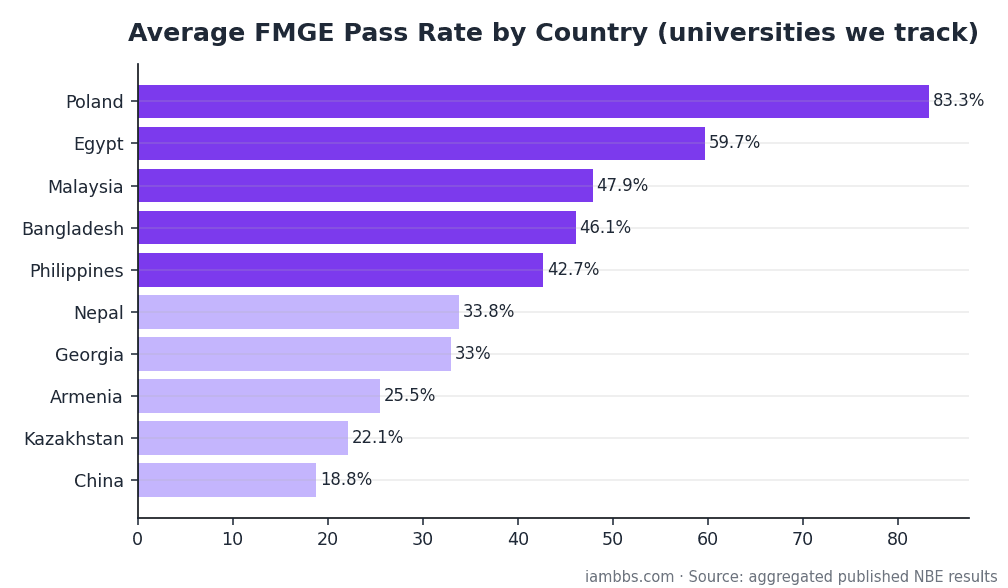
To apply for FMGE 2026, candidates must be Indian citizens or Overseas Citizens of India (OCI) holding a primary medical qualification equivalent to an MBBS degree from a recognized foreign institution. The university must be listed in WDOMS and approved by NMC to ensure eligibility for FMGE. For example, graduates from institutions like Tbilisi State Medical University (Georgia) or other NMC-approved institutions in safe destinations (Georgia) often meet this criterion.
Degree verification through proper channels is required; always confirm current NMC guidelines. This ensures the degree’s validity for the National Medical Commission (NMC). For instance, universities in countries like Georgia, China, or the Philippines must appear on the Indian embassy’s verified list. Failure to confirm this could disqualify your application outright.
Indian students admitted to MBBS programs abroad on or after May 2018 must have NEET qualification for NMC recognition. This requirement applies even if your university does not mandate NEET for admission. Without NEET clearance, the NMC will not recognize your eligibility for FMGE 2026.
Finally, applicants must have completed their MBBS degree, including a 1-year compulsory internship, before applying. Provisional certificates are not accepted. Ensure your final year results and internship completion proof are ready by the FMGE 2026 registration deadline (likely in May 2026).
Planning MBBS abroad?
Get a free counselling call — we'll shortlist NMC-approved universities for your NEET score and budget.
Crafting Your FMGE 2026 Study Plan: A Step-by-Step Approach
Preparing for FMGE 2026 requires a strategic and well-structured study plan. It's not just about how much you study, but how smartly you prepare and implement what you've learned during your MBBS. Starting early is key; ideally, begin preparing in your 3rd or 4th year of MBBS. Consistent effort, even an hour a day, is more effective than cramming later.
Breaking Down the Syllabus
The FMGE syllabus is based on the MBBS curriculum in India, covering 19 subjects. Divide this vast syllabus into smaller, manageable sections. Allocate specific time slots for each subject based on its weightage and your familiarity with it. Remember that clinical subjects like Obstetrics & Gynecology and Medicine now have increased weightage, reflecting the current needs of the Indian healthcare system.
Creating a Realistic Study Schedule
Develop a daily or weekly study schedule that you can realistically maintain. Consider your learning style and daily routine. A sustainable schedule is more important than an overly ambitious one that leads to burnout. Remember to factor in time for rest and recreation to avoid exhaustion.
Incorporating Revision and Practice
-
Regular Revision: Schedule regular revision sessions to reinforce what you've learned. Don't just passively reread notes; actively recall information.
-
Practice Tests: Integrate practice tests and mock exams into your study plan. This helps you get familiar with the FMGE exam pattern and identify your weak areas. Aim to solve previous year question papers to understand the exam's style and difficulty level.
-
Seek Guidance: Consider joining coaching programs or online platforms like DocTutorials for study materials, question banks, and doubt-clearing sessions.
Remember, FMGE 2026 success hinges on consistent effort, smart planning, and regular self-assessment. Start early, stay focused, and believe in your ability to succeed!
Mastering the FMGE 2026 Syllabus: Subject-Wise Strategies
The FMGE 2026 syllabus aligns with the Indian MBBS curriculum, divided into pre-clinical, para-clinical, and clinical subjects. Pre-clinical topics like Anatomy, Physiology, and Biochemistry form the foundation. Para-clinical subjects such as Pathology, Pharmacology, and Microbiology bridge theory and practice. Clinical subjects—including Medicine, Obstetrics & Gynecology (OBG), Surgery, Pediatrics, and Orthopedics—carry the highest weightage, reflecting the National Board of Examinations' (NBE) focus on application-based knowledge for Indian healthcare needs.
High-yield subjects like Medicine and OBG demand prioritization. Medicine alone contributes 15–20% of the total questions, covering cardiology, respiratory diseases, and systemic disorders. OBG is high-scoring due to its structured syllabus and predictable question patterns. Clinical subjects collectively make up 60–70% of the exam, so dedicating 40–50% of study time to them is essential. Para-clinical subjects like Pharmacology and Microbiology should not be neglected, as they often feature high-yield MCQs on drug mechanisms and infectious diseases.
Subject-specific strategies optimize preparation. For pre-clinical topics, focus on conceptual clarity: use diagrams for Anatomy and mnemonics for Biochemistry pathways. Para-clinical subjects require memorization—create flashcards for Pharmacology drug classifications or Microbiology pathogens. Clinical subjects demand integration of theory and clinical reasoning: practice case-based MCQs from resources like iAMBBS-curated FMGE resources and review past papers (2018–2025) to identify recurring themes. For Medicine, master protocols like WHO guidelines for hypertension; for OBG, emphasize high-risk pregnancy management and labor complications.
Subject-wise preparation ensures targeted efficiency. A one-size-fits-all approach risks overlooking critical areas. For example, Surgery requires visualizing procedures and understanding trauma management algorithms, while Pediatrics demands familiarity with growth charts and common childhood illnesses. Allocate time based on individual strengths and weaknesses: weak areas like Radiology or Dermatology may need 1–2 dedicated weeks, while strong areas can be revised weekly via MCQs.
By aligning strategies with the FMGE 2026 pattern—180 MCQs in 2.5 hours—students build speed and accuracy. Prioritize standard references like Harrison’s Principles of Internal Medicine for Medicine and DC Dutta’s Textbook of Obstetrics for OBG. Consistent practice with mock tests, such as those offered by NBE’s official platform, ensures familiarity with the CBT format. With focused subject-wise planning, clearing the FMGE 2026 becomes an achievable milestone.
Resources for FMGE 2026 Preparation: Books, Mock Tests & More
Cracking the FMGE 2026 requires a mix of strategic planning and the right resources. Start by aligning your university curriculum with standard Indian textbooks to cover high-yield subjects like Medicine, OBG, and Surgery, which now carry increased clinical weightage.
Standard Textbooks and Curriculum Alignment
-
Harrison’s Principles of Internal Medicine and Robbins Basic Pathology for detailed clinical insights.
-
DC Dutta’s Obstetrics and Parasuram’s OBG to master high-weightage topics.
-
Arvind Arora’s Surgery and PG Textbook of Pediatrics for concise, exam-focused content.
Question Banks and Previous Year Papers
Practice is key. Use question banks like iAMBBS-recommended question banks with over 10,000 MCQs and past year papers, which include 10,000+ MCQs and 15+ years of solved papers. Focus on clinical case-based questions, as the 2026 exam emphasizes multi-step scenarios over direct facts.
Mock Tests for Exam Readiness
Take timed mock tests weekly to build stamina. Platforms like iAMBBS partner platforms offer full-length CBT mocks with AI-driven performance analysis with AI-driven performance analysis. Meduhub provides 20 mocks (INR 2,999) and all-India rankings. Aim for 70%+ scores consistently to gauge readiness.
Online Coaching and Study Materials
Enroll in structured courses for guided prep:
-
iAMBBS-approved coaching: Structured video lectures, live doubt-clearing and updated study modules, and updated study modules (INR 14,999/year).
-
Meduhub: Subject-wise video series (INR 4,999–7,999 per subject), AI-powered analytics, and peer discussion forums.
Effective Exam-Taking Strategies for FMGE 2026: Time Management & Accuracy
The FMGE 2026, a computer-based test with 300 multiple-choice questions (MCQs) to be solved in 3.5 hours, demands precise time allocation. Divide the exam into segments: aim for 40–45 minutes per 100 questions, leaving 10–15 minutes for review. Practicing timed mock tests helps build stamina and identifies pacing issues. Prioritize sections where you’re stronger first to secure quick marks, then tackle challenging areas.
For MCQs, read each question carefully, underlining keywords like “contraindicated” or “most likely diagnosis.” Eliminate at least two incorrect options using basic concepts. For example, in pharmacology questions, rule out drugs with conflicting mechanisms. If stuck, make an educated guess—avoid random choices. Remember, negative marking (-0.25 per wrong answer) penalizes haste, so only guess if two options remain.
Difficult questions should be flagged and revisited later. Spending more than 90 seconds on a single question risks time loss. Use the “mark for review” feature in CBT mode to revisit tricky items. Focus on accuracy over attempting every question; past data shows top scorers prioritize quality over quantity.
Prevent careless errors by double-checking calculations in clinical scenarios, especially in medicine or surgery questions. Verify units, drug dosages, and basic anatomy facts. After solving, quickly cross-validate answers against clinical logic. Finally, reserve 5–7 minutes to review flagged questions and ensure no inadvertent omissions. Consistent practice with past year questions (PYQs) sharpens precision, aligning your approach with FMGE’s clinical emphasis in 2026.
Last-Minute Tips for FMGE 2026: Staying Calm and Focused
As the FMGE 2026 exam on June 28 approaches, focus shifts from learning new content to reinforcing existing knowledge. Prioritize revision of high-yield subjects like Medicine, OBG, and Surgery, which carry increased weightage this year. Use past year questions (PYQs) and concise notes to sharpen your recall—avoid diving into unfamiliar topics that could overwhelm you.
Stick to trusted resources like your prepared study materials and mock tests from platforms like DocTutorials. FMGE tests clinical application — consistent MCQ practice builds speed, accuracy, and exam temperament. If a concept feels unclear, revisit it briefly but avoid deep dives that waste time.
Physical and mental well-being directly impacts performance. Aim for 7–8 hours of sleep daily and eat balanced meals rich in fruits, whole grains, and protein. Stay hydrated and avoid excessive caffeine—opt for nuts or bananas for quick energy during study breaks.
On exam day, arrive early at the CBT center to avoid last-minute stress. Use deep breathing techniques to manage anxiety and trust your preparation. Remember, FMGE 2026 requires 50% marks to pass—stay calm, tackle familiar questions first, and review flagged answers if time permits. Your consistent efforts over months will guide you through.
Choosing the Right University: A Foundation for FMGE Success
Your choice of university significantly impacts your FMGE 2026 preparation. Think of it as building a house – a strong foundation is for long-term success. Selecting the right medical college abroad can make the difference between struggling and confidently clearing the FMGE.
Prioritize universities that are approved by the National Medical Commission (NMC) and have a proven track record of their graduates passing the FMGE. While specific pass rates fluctuate, researching historical data can give you an idea of a university's commitment to preparing students for the exam. Remember, the FMGE exam is mandatory for Indian citizens and OCIs who have completed their MBBS degree abroad and wish to practice in India.
Look for universities whose curriculum closely aligns with the MBBS curriculum followed in India. Some universities even have dedicated FMGE coaching cells that provide specialized training and mock tests. This targeted support can be invaluable. Consistent preparation, even just one extra hour of FMGE-focused study per day from your first year, is more effective than cramming later.
Before making a decision, research university rankings (keeping in mind that rankings aren't everything!) and, more importantly, try to connect with senior Indian students studying at those universities. Their first-hand experiences will give you insights into the quality of education and the level of FMGE preparation provided. This will help you make an informed choice and set you on the path to crack FMGE 2026.
Watch: FMGE Strategy for MBBS Abroad Students | Complete Success Plan 2026 #mbbsabroad #fmge
Frequently Asked Questions
Is FMGE mandatory for all foreign medical graduates?
Yes, FMGE is mandatory for Indian citizens and OCIs with MBBS degrees from foreign universities to practice in India. However, graduates from Canada, UK, Australia, New Zealand, and the USA are exempt if their MBBS and post-graduation meet NBE criteria. Always verify your eligibility on the NBE official website.
What is the passing score for FMGE 2026?
Candidates need a minimum of 50% marks (150 out of 300) to pass FMGE 2026. The computer-based test (CBT) includes multiple-choice questions aligned with the Indian MBBS curriculum. Results are declared online, and qualifying scores allow candidates to apply for registration with state medical councils.
What is the syllabus for FMGE 2026?
The FMGE 2026 syllabus covers 19 subjects from the Indian MBBS curriculum, with increased focus on clinical subjects like Medicine, OBG, and Surgery. The exam emphasizes multi-step clinical case scenarios over direct questions. Prioritize high-yield topics and practice previous year questions (PYQs) for better preparation.
How many times can I attempt the FMGE exam?
There is no limit on FMGE attempts as of 2026. However, passing in the first or second attempt is advisable to avoid delays in licensure. The exam is held twice yearly (June and December), giving candidates multiple opportunities to qualify.
Are there any exemptions from FMGE?
Yes, Indian graduates from MBBS programs in Canada, UK, Australia, New Zealand, and the USA are exempt from FMGE 2026 if their degree and post-graduation meet NBE recognition standards. Exemption criteria are subject to change, so confirm your eligibility via the NBE website before applying.
When will the FMGE 2026 exam be conducted?
FMGE is conducted twice a year; exact dates are announced on the NBE and MCC websites. The computer-based test (CBT) is conducted across designated centers in India and abroad. Check the NBE website for exact dates and city-wise center allocations during registration.
How can I register for the FMGE 2026 exam?
Register for FMGE 2026 via the National Board of Examinations (NBE) portal. Complete the online application with personal details, upload required documents, and pay the fee (₹5,000 for Indian candidates). Registration typically opens 2–3 months before the exam date.
What documents are required for FMGE 2026 registration?
Required documents include: MBBS degree certificate, passport copy, internship completion certificate, and recent passport-sized photographs. Additional documents may be requested by NBE. Ensure all files are scanned and ready during registration to avoid last-minute delays.
Get Free Expert Guidance
Our FMGE-qualified counselors will help you choose the right university based on your NEET score and budget.
No spam. Your data is secure. We call during 9 AM - 8 PM IST.
Related Topics
About the Author
Unknown
Experienced education consultant specializing in MBBS abroad programs and international medical education.