
NEET 2026 Exam: Dates, Pattern, Cutoffs & Tips
Neha Tripathi
Author
Share this article
NEET 2026 — Exam Overview
NEET 2026 is the gateway for over 18 lakh students aiming to secure 1 lakh+ MBBS seats and thousands of BDS, AYUSH, and BSc Nursing seats across India. Conducted by the National Testing Agency (NTA), the re-conducted NEET 2026 exam took place on 21 June 2026 in offline mode with 180 questions across Physics, Chemistry, and Biology — Biology holding 50% weightage.
| Parameter | Details |
|---|---|
| Exam Name | NEET 2026 |
| Exam Date | June 21, 2026 |
| Conducting Body | National Testing Agency (NTA) |
| Mode of Exam | Offline (Pen and Paper) |
| Total Questions | 180 |
| Subjects Covered | Physics, Chemistry, Biology (Botany + Zoology) |
| Biology Weightage | 50% (90 Questions) |
| Exam Timing | 2:00 PM to 5:00 PM (3 hours) |
| Courses Offered Through NEET | MBBS, BDS, AYUSH, BVSc & AH, BSc Nursing |
| Total Seats Available Nationwide | Over 1 lakh MBBS seats |
The high number of applicants versus limited medical seats makes NEET strategy . Biology's significant weightage means aspirants scoring above 340 in this section often secure a competitive edge. The exam's offline mode and strict timing further demand strong mock test practice.
Disclaimer: This information is sourced from official websites and may vary.
NEET 2026 Exam Pattern: What is the structure of the NEET 2026 exam?
NEET 2026 follows a structured pattern with a total of 180 multiple-choice questions (MCQs) divided across four sections — Physics, Chemistry, Botany, and Zoology (combined as Biology). Each question carries 4 marks, making the total score out of 720 marks. The exam duration is 3 hours and 20 minutes, giving aspirants limited time to manage accuracy and speed effectively.
| Section | No. Of Questions | Marks per Question | Total Marks | Duration |
|---|---|---|---|---|
| Physics | 45 | 4 | 180 | 3 hours 20 minutes |
| Chemistry | 45 | 4 | 180 | 3 hours 20 minutes |
| Botany | 45 | 4 | 180 | 3 hours 20 minutes |
| Zoology | 45 | 4 | 180 | 3 hours 20 minutes |
| Biology (Botany + Zoology) | 90 | 4 | 360 | 3 hours 20 minutes |
The Biology section holds the highest weightage with 90 questions and contributes to half of the total marks (360/720), making it for scoring above 600.
Note: Negative marking applies — (-1) for every incorrect answer. Time management across sections is critical to avoid rushing in the final hour.
Planning MBBS abroad?
Get a free counselling call — we'll shortlist NMC-approved universities for your NEET score and budget.
NEET 2026 Syllabus
Most students assume NEET 2026 syllabus is evenly distributed, but Biology alone carries 50% weightage with 90 questions, making it the highest-scoring section. Physics and Chemistry each contribute 45 questions, emphasizing conceptual clarity and formula application. The total 180 multiple-choice questions span NCERT Class 11 and 12 syllabi, demanding focused revision on high-weightage topics to score 600+ marks.
| Section | Key Topics | Approximate Weightage (%) | Difficulty Level |
|---|---|---|---|
| Biology | Botany: Plant Physiology, Morphology, Diversity; Zoology: Human Physiology, Genetics, Ecology | 50% | Moderate |
| Physics | Mechanics, Thermodynamics, Optics, Electromagnetism, Modern Physics | 25% | High |
| Chemistry | Organic Reactions, Chemical Bonding, Thermodynamics, Equilibrium, Redox Reactions | 25% | Moderate to High |
| Biology (Cell Biology) | Cell Structure, Mitosis/Meiosis, Biomolecules, Enzymes | 8% | Moderate |
| Biology (Genetics & Evolution) | Mendelian Laws, DNA Replication, Evolution Theories | 6% | Moderate |
| Physics (Mechanics) | Laws of Motion, Rotational Dynamics, Gravitation | 10% | High |
| Chemistry (Physical Chemistry) | Solutions, Electrochemistry, Chemical Kinetics | 9% | Moderate to HighThe Biology section dominates the NEET 2026 syllabus with over half the total weightage. Physics and Chemistry require deeper conceptual understanding despite lower question counts. Prioritizing high-weightage chapters like Mechanics and Physical Chemistry can significantly boost your score.Disclaimer: This information is sourced from official websites and may vary. |
NEET 2026 Important Dates
In 2026, NEET UG 2026 was re-conducted on June 21, 2026, as confirmed by the National Testing Agency (NTA). The exam is a critical gateway for students aiming to score 600+ marks and secure admissions in top medical colleges across India. The official timeline includes key milestones such as application submission, admit card release, result declaration, and counseling schedules.
| Event | Date/Tentative Date | Remarks |
|---|---|---|
| Application form release | November 15, 2025 | Available on the official NTA website |
| Last date to submit application | December 31, 2025 | Extended deadline for final submissions |
| Admit card release | April 10, 2026 | Download from NTA NEET portal using application number and password |
| NEET UG exam date | June 21, 2026 | Offline mode across designated centers in India and abroad |
| Answer key release (provisional) | May 10, 2026 | Candidates can challenge objections within a specified window |
| Final answer key and result declaration | July 16, 2026 | - |
Cutoff percentile and All India Rank (AIR) included in result PDF.
NEET Important Dates Table Continued
Date/Tentative Date
Remarks
| Event |
|---|
The NEET UG exam was re-conducted on June 21, with results declared on July 16, 2026. Aspirants aiming for a score of over 600 must stay updated with these timelines to ensure smooth participation in the examination and subsequent counseling rounds. Disclaimer: This information is sourced from official websites and may vary.
Preparation Tips for NEET 2026
Scoring 600+ marks in NEET 2026 requires a focused and strategic preparation plan. Based on the latest exam pattern, aspirants must prioritize NCERT books, especially for Biology which accounts for 50% of the total questions. Practicing mock tests and revising high-weightage chapters in Physics and Chemistry are equally critical to achieving a top score.
- Master NCERT Biology: Focus on Class 11 and 12 NCERT textbooks as they cover nearly all Biology questions; aim for at least 85 correct answers out of 90 questions in this section.
- Revise High-Weightage Physics Chapters: Target topics like Thermodynamics, Motion in a Plane, and Electrostatics — these typically contribute to at least 40% of the Physics section.
- Strengthen Chemistry Concepts: Prioritize Organic Chemistry (especially named reactions) and Physical Chemistry formulas; these areas contribute to around 50% of the Chemistry section.
- Attempt Mock Tests Weekly: Take at least one full-length NEET mock test every week starting from January 2026 to build speed, accuracy, and exam temperament.
- Track Accuracy Rate: Aim for at least 90% accuracy in Biology and 80% in Physics & Chemistry to minimize negative marking; avoid guessing randomly.
- Focus on Formula Revision: Keep a separate notebook for key Physics and Chemistry formulas; revise them daily during the last two months before NEET 2026.
- Use Flashcards for Biology Terms: Create flashcards for scientific names, definitions, and diagrams to revise quickly during the final days before the exam.
- Analyze Previous Years’ Papers: Solve at least five years of NEET question papers to understand the question pattern and identify recurring concepts.
By following these targeted strategies, you can significantly improve your chances of scoring over 600 marks in NEET 2026. Check the detailed preparation plan for NEET 2026 syllabus.
Exam Day Checklist
Only 18% of students clear NEET with 600+ marks, but a disciplined exam-day strategy can tilt the odds. For NEET 2026, scheduled on May 3, 2026, aspirants must follow a structured checklist to maximize accuracy and minimize negative marking across the 180-question paper.
- Reach the exam center by 8:00 AM — entry gates close at 9:30 AM sharp (as per NTA guidelines).
- Carry a printed NEET admit card 2026 and one valid ID proof (Aadhaar, PAN, or passport).
- Attempt Biology first — IT carries 50% weightage with 90 questions worth 360 marks.
- Limit Physics attempts to high-weightage chapters like Thermodynamics and Electrostatics for at least 60 marks.
- Maintain an accuracy rate above 90% — each incorrect answer deducts 1 mark under the NEET negative marking scheme.
- Use the rough sheet efficiently — jot down key formulas and calculations to avoid last-minute confusion.
- Allocate final 15 minutes strictly for review — prioritize rechecking calculation-heavy Physics and Chemistry answers.
Following this checklist can help aspirants cross the 600+ score threshold and secure a top All India Rank (AIR) for MBBS admissions.
Watch: MBBS Options After NEET — India vs Abroad Guide
Frequently Asked Questions (FAQs)
How many questions should I attempt in NEET 2026 to score 600+ marks?
Attempt at least 150-160 questions with high accuracy to score above 600 in NEET 2026. Focus on Biology (90 questions) for maximum accuracy, and aim to solve 45-50 in Physics and Chemistry combined.
Which chapters in Physics are most important for scoring 60+ in NEET 2026?
Focus on Mechanics, Electrodynamics, Modern Physics, Thermodynamics, and Optics for NEET Physics. These top 5 chapters can fetch up to 60 marks, as seen in previous NEET exam patterns.
What is the ideal time distribution per section in NEET 2026?
Allocate 90 minutes to Biology, 50 minutes to Chemistry, and 40 minutes to Physics during NEET 2026. This division allows focused attention on high-weightage sections like Biology with 90 questions.
How important is NCERT for scoring high in NEET Biology?
NCERT is the foundation of NEET Biology and contributes to around 85% of the questions. Mastering NCERT Books for Class XI and XII ensures accuracy in this high-scoring section worth 360 marks.
What are the safest colleges for a score above 600 in NEET UG?
For a score above 600 in NEET UG, consider top government colleges like B.J. Medical College Ahmedabad or SMS Medical College Jaipur. These colleges offer MBBS admissions under state quota seats with good cutoff scores.
When is the NEET UG exam scheduled for May or June?
What is the best way to revise?
NEET UG is scheduled for May 3, 2026; revise using mock tests and do-or-die chapters from Physics, Chemistry, and Biology. Focus on revision of NCERT notes and formula sheets two weeks before the exam.
What is the minimum cutoff percentile required to qualify NEET UG in different categories?
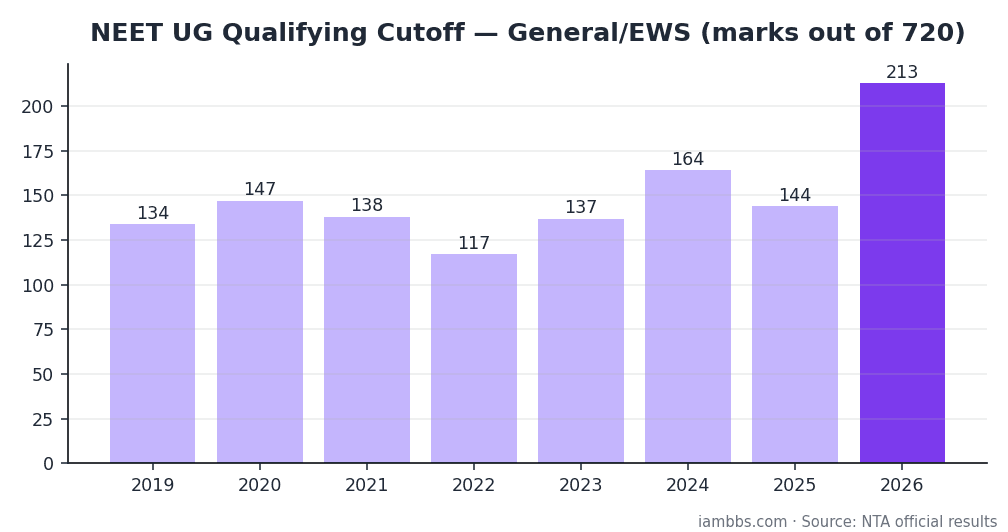
The minimum qualifying marks for NEET UG are: General/EWS — 213 (50th percentile), OBC/SC/ST — 177 (40th percentile). These cutoffs are based on previous years' data and may vary slightly depending on exam difficulty.
Get Free Expert Guidance
Our FMGE-qualified counselors will help you choose the right university based on your NEET score and budget.
No spam. Your data is secure. We call during 9 AM - 8 PM IST.
About the Author
Neha Tripathi
Neha Tripathi is a content writer at iAMBBS, focused on MBBS-abroad guidance for Indian students — covering NMC-approved universities, fees, FMGE, and admissions.