
MBBS Abroad vs NEET 2026 – Key Differences
Neha Tripathi
Author
Share this article
💡 Plan your budget: Use the free MBBS Cost Calculator to estimate your all-in cost, see which colleges fit with our MBBS College Predictor, or get free counselling from our team.
NEET 2026 vs MBBS Abroad - Quick Comparison
Over 5 lakh students are evaluating MBBS abroad as the 2026 admission cycle approaches. While Indian government seats remain highly competitive, options in countries like China offer annual tuition as low as ₹1 lakh.
| Parameter | NEET 2026 (India) | MBBS Abroad |
|---|---|---|
| Primary Entrance Exam | NEET 2026 | NEET 2026, IMAT, or University-specific tests |
| Eligibility (Science) | Minimum 50% in high school science | Minimum 50% in high school science |
| Age Requirement | Above 17 years | Above 17 years |
| Annual Fee (Low End) | ₹1-5 lakh (Govt. Colleges) | ₹1-5 lakh (China) |
| Annual Fee (Mid Range) | ₹15-25 lakh (Private Colleges) | ₹14-20 lakh (Uzbekistan, incl. Stay) |
| Annual Fee (High End) | ₹50 lakh+ (Deemed Universities) | ₹40-60 lakh (Premium Global Universities) |
| Course Duration | 5.5 Years (including internship) | 6 Years (e.g., Russia, including internship) |
| Recognition in India | Directly recognized by NMC | Requires clearing FMGE licensure exam |
| Internship Validity | Fully recognized in India | Not recognized if completed without NEET |
| Score Validity | Valid for 2026 cycle only | NEET 2026 scores valid for 2026 cycle only |
Fee Comparison
What does an MBBS degree actually cost when comparing Indian government seats to foreign universities? In 2026, the financial gap is stark, as private medical seats in India can cost upwards of ₹1 crore, while some programs in China start at just ₹1 lakh per year.
| Fee Component | NEET 2026 (Govt. College) (₹) | NEET 2026 (Private College) (₹) | MBBS Abroad (₹) |
|---|---|---|---|
| Annual Tuition Fee (China) | ₹5,000-15,000 | ₹40-60 lakh | ₹1-5 lakh |
| Annual Tuition Fee (Uzbekistan) | ₹5,000-15,000 | ₹40-60 lakh | ₹14-20 lakh |
| General Annual Fee (Global Avg) | ₹10,000-50,000 | ₹50-80 lakh | ₹40-60 lakh |
| Hostel & Living Costs (Annual) | ₹20,000-50,000 | ₹2-5 lakh | ₹3-7 lakh |
| Admission/Processing Fee | ₹10,000-25,000 | ₹5-15 lakh | ₹1-3 lakh |
| Total Estimated Course Cost | ₹5-15 lakh | ₹1.2-2.5 crore | ₹30-70 lakh |
Planning MBBS abroad?
Get a free counselling call — we'll shortlist NMC-approved universities for your NEET score and budget.
Admission Comparison
Most students assume that qualifying NEET is the only way to become a doctor, but 2026 data shows a massive shift toward international universities. While Indian government seats require top-tier percentiles, many foreign universities accept a basic qualifying score or prioritize academic performance in high school science subjects.
| Aspect | NEET 2026 (India) | MBBS Abroad |
|---|---|---|
| Primary Admission Requirement | Mandatory qualifying NEET 2026 scores | Qualifying NEET scores, IMAT, or academic merit |
| Entrance Exam Options | NEET 2026 only | NEET 2026 or country-specific tests like IMAT |
| Minimum Academic Eligibility | 10+2 with Physics, Chemistry, Biology | At least 50% in high school science subjects |
| Age Requirement | As per NMC guidelines | Minimum age above 17 years |
| Annual Tuition Fees | Varies by quota (Govt/Private) | ₹1 lakh to ₹60 lakh (Country dependent) |
| China Annual Fee Range | Not Applicable | ₹1 lakh to ₹5 lakh |
| Uzbekistan Annual Fee (with stay) | Not Applicable | ₹14 lakh to ₹20 lakh |
| General Abroad Fee Range | Not Applicable | ₹40 lakh to ₹60 lakh |
| Licensure for Indian Practice | Directly eligible after completion | Must clear the FMGE licensure exam |
| Internship Validity in India | Fully recognized | Not recognized if completed without NEET |
| Admission Flexibility | Strict merit-based cutoff | Private universities consider academic performance |
| Career Trajectory | Practice within India | Viable for settling or working abroad |
Recognition and Regulation
In 2026, the National Medical Commission (NMC) remains the sole regulatory authority governing medical practice in India. Without NMC approval, the FMGE screening becomes mandatory. While NEET 2026 is the mandatory gateway for domestic seats, students opting for foreign universities must ensure their degrees align with NMC's strict licensing norms to avoid career dead-ends.
| Factor | NEET 2026 (India) | MBBS Abroad |
|---|---|---|
| Regulatory Body | National Medical Commission (NMC) | NMC (for India practice) and local country boards |
| Degree Recognition | Directly recognized for Indian practice | Globally recognized; requires FMGE/NEXT for India |
| Entrance Requirement | Mandatory NEET 2026 qualification | Country-specific exams or academic performance |
| Internship Validity | Recognized across all Indian states | Internships without NEET may not be recognized in India |
| Licensing Exam | Not required for domestic graduates | Must clear Foreign Medical Graduate Exam (FMGE) |
Popular MBBS Abroad Destinations for Indian Students
Compare the tuition costs and admission rules of top medical hubs before applying for the 2026 session. The gap between cheapest and most expensive is wider than most families expect. In countries like China, tuition fees can be as low as ₹1-5 lakh per year, making it a primary alternative for students affected by NEET controversies.
| Country | Average MBBS Fee (₹) | Admission Requirements (NEET?) | Pros | Cons |
|---|---|---|---|---|
| China | ₹1-5 lakh per year | No (Academic performance/Entrance exams) | Majority of private universities offer admission without NEET. | Internships completed abroad without NEET may not be recognized in India. |
| Uzbekistan | ₹14-20 lakh (including stay) | No (Academic performance/Entrance exams) | Offers admission without NEET and focuses on academic performance. | Students must verify specific NEET requirements for chosen universities. |
| Russia | ₹30-50 lakh (total course) | No (Academic performance/Entrance exams) | Considered a top choice with selective private universities accepting students without NEET. | Admission is limited to specific private universities for non-NEET candidates. |
Impact of NEET 2026 Controversy on MBBS Aspirants
Approximately 5 lakh students are currently evaluating foreign medical universities due to the 2026 exam controversies. This shift is driven by a desire for stability, as many candidates fear the unpredictability of NEET 2026 scores and seat allocations. Many students don't want to risk another year of coaching. We've seen a surge in queries for Uzbekistan, where private medical universities offer admission based on academic performance than NEET scores. The cost for these programs typically ranges from ₹14 lakh to ₹20 lakh, including stay. China remains a high-interest zone because private universities there often bypass NEET requirements for Indian students.
Hidden charges can add 10-15% to the stated fee. Tuition fees in China are notably low, ranging from ₹1 lakh to ₹5 lakh per year. It's a strategic move for those who prioritize immediate admission over the volatile Indian system. However, you must remember that skipping NEET for admission doesn't mean skipping it for practice. To work in India, you'll still need to clear the FMGE licensure exam. Medical internships completed abroad without NEET aren't recognized in India, which is a critical detail most students overlook during the rush to apply.
What are the critical challenges and considerations for MBBS abroad aspirants in 2026?
Students must weigh the risk of non-recognition, as medical internships completed abroad without NEET qualification are not recognized in India. For the 2026 cycle, applicants must ensure they comply with National Medical Commission (NMC) regulations to avoid legal hurdles. Failure to meet these standards can block your path to practicing medicine in India. The Foreign Medical Graduate Exam (FMGE) remains a significant hurdle because it follows the Indian medical curriculum. The 2025-26 data tells a harsher story. This creates a pedagogical gap for students who spent 5-6 years studying in foreign systems.
You'll need a dedicated strategy to bridge this gap if you plan to return home. Financial planning is equally complex, as costs vary wildly by region. While some Chinese universities offer fees between ₹1 lakh and ₹5 lakh per year, other premium abroad options can cost between ₹40 lakh and ₹60 lakh per annum. We've seen students overlook these hidden costs until the final semester. Eligibility is not uniform across borders. You must be at least 17 years old and typically hold at least 50% in high school science subjects to qualify. Some European destinations may also require a strong score in the International Medical Admissions Test (IMAT) for entry.
Which Should You Choose - NEET 2026 or MBBS Abroad?
Most students assume that studying abroad is a backup for those who fail NEET, but 5 lakh aspirants are now treating it as a primary strategy for 2026. While Indian government seats remain limited, foreign universities in China and Uzbekistan offer admissions based on academic performance than just a single rank. Choosing between these paths depends on your budget and where you in practice. For instance, some private universities in China offer tuition fees between ₹1 lakh and ₹5 lakh per year. It's a stark contrast to the high costs of Indian private medical colleges. You must also consider the licensure hurdle. If you study abroad, clearing the FMGE (Foreign Medical Graduate Examination) is a mandatory requirement to practice in India. This exam follows the Indian medical curriculum, which often differs from the teaching style in foreign universities.
| Decision Factor | NEET 2026 (India) | MBBS Abroad (Foreign) |
|---|---|---|
| Primary Admission Basis | NEET Rank/Percentile | Academic Performance/Local Exams |
| Annual Tuition Range | ₹50,000 to ₹25 lakh | ₹1 lakh to ₹60 lakh |
| Admission Certainty | Low (High Competition) | High (Easier Entry) |
| Licensure Requirement | NMC Registration | FMGE/NEXT Exam Clearance |
| Curriculum Alignment | 100% Aligned with NMC | Varies by Country/University |
| Internship Recognition | Automatically Recognized | Requires NMC Compliance |
| Age Requirement | 17 Years Minimum | 17 Years Minimum |
| Science Subject Criteria | Qualifying NEET Score | Typically 50% in High School |
| Application Timeline | Fixed National Window | University-Specific Deadlines |
| Cost of Living | Moderate (Domestic) | ₹14 lakh to ₹20 lakh (Total Package) |
| Clinical Exposure | High (Indian Patient Load) | Varies by Local Hospital Tie-ups |
| Language Barrier | None | Possible (e.g., Russian/Chinese) |
- Consider Uzbekistan if: You want a low-cost entry point without the extreme pressure of NEET ranks.
- Choose China if: You are looking for tuition fees as low as ₹1 lakh per year in select private institutions.
- Opt for Abroad if: You plan to settle or work in a foreign country, bypassing the FMGE requirement entirely.
- Stick to India if: You cannot afford the risk of not clearing the FMGE licensure exam after 6 years.
- Go Abroad if: You have at least 50% in high school science and prefer a more admission process.
- Prioritize India if: You want a transition from internship to practice without regulatory hurdles.
- Choose Abroad if: You are comfortable with the IMAT or other international medical entrance tests.
- Stick to India if: Your budget is strictly limited and you cannot secure a government seat.
- Go Abroad if: You want to utilize a 2025 NEET score, which remains valid for applications in 2026 and 2027. The decision In the end hinges on your risk appetite regarding the FMGE. Most students who prioritize a guaranteed seat over a high-stress rank choose the foreign route.
Future of Medical Education in India: Addressing the Demand
In 2026, the Indian medical education system faces a critical shortage of seats compared to the 5 lakh students now eyeing foreign universities. This gap persists despite the government's efforts to increase MBBS intake across 600+ medical colleges nationwide. The imbalance is stark. Most students find that qualifying NEET is not enough to secure a government seat, leading them to explore options in China or Uzbekistan. We've seen a massive shift where academic performance in high school science (minimum 50%) is becoming a more viable entry point for those choosing private universities abroad. The trend shows that Indian medical education must evolve to prevent this "brain drain." Until the domestic seat-to-applicant ratio improves, the reliance on the National Medical Commission (NMC) guidelines for FMGE and NEXT will remain the primary bridge for students returning from overseas.
Key Takeaways for NEET 2026 and MBBS Abroad Aspirants
Verify all NMC guidelines and university accreditation before committing to a foreign medical program. With 5 lakh students weighing their options for 2026, the choice often boils down to a budget range of ₹1 lakh to ₹60 lakh per annum depending on the destination.
- Qualifying NEET is mandatory for Indian students who wish to practice medicine in India, regardless of where they earn their degree.
- Students can use NEET scores for up to 3 years, meaning a 2025 score remains valid for 2026 and 2027 admissions.
- Budget-conscious students can find programs in China with tuition fees ranging from ₹1 lakh to ₹5 lakh per year.
- Uzbekistan provides an alternative for those seeking admissions based on academic performance, with costs averaging ₹14 lakh to ₹20 lakh including stay.
- High-end private universities abroad can be significantly more expensive, with fee structures reaching ₹40 lakh to ₹60 lakh per annum.
- Minimum eligibility typically requires the candidate to be above 17 years of age with at least 50% marks in high school science subjects.
- Clearing the Foreign Medical Graduate Exam (FMGE) is the non-negotiable requirement to convert a foreign degree into a license to practice in India. Most students don't realize that skipping NEET for abroad studies may disqualify them from Indian medical internships.
Expert Opinions on the MBBS Abroad Trend
Around 5 lakh students are evaluating foreign medical universities as of 2026 due to the instability and controversy surrounding the NEET 2026 cycle. Education consultants highlight that while some private universities in China and Uzbekistan offer admissions based on academic performance, the National Medical Commission (NMC) still mandates NEET qualification for those intending to return to India. Consultants warn that pursuing MBBS without NEET is a high-risk strategy.
They point out that medical internships completed abroad without qualifying NEET are not recognized in India, making the FMGE licensure exam a non-negotiable hurdle for domestic practice. Industry experts suggest that students who received NEET scores in 2025 can still utilize those results to apply for the 2025, 2026, and 2027 academic sessions. We've seen that this flexibility allows students to bypass the immediate 2026 controversy while securing seats in recognized international programs. From what we've observed in counseling sessions, students often overlook the curriculum gap.
Experts emphasize that since the FMGE follows the Indian medical curriculum, students in foreign universities often struggle to align their international training with the specific requirements of the Indian licensure exam.
Which countries allow MBBS admission without a NEET score in 2026?
While the National Medical Commission (NMC) mandates NEET for Indian citizens, several private universities in countries like China and Uzbekistan offer admission based on academic merit. NMC approval status is non-negotiable. In 2026, these institutions typically prioritize high school science percentages over standardized Indian entrance scores.
- China: Most private medical universities offer admission without NEET, focusing on 12th-grade academic performance with annual fees ranging from ₹1 lakh to ₹5 lakh.
- Uzbekistan: Private universities in this region often grant admission based on internal entrance exams or academic records, with total costs (including stay) between ₹14 lakh and ₹20 lakh.
- Italy: Admission is primarily based on the International Medical Admissions Test (IMAT) and requires at least 50% in high school science subjects.
- Philippines: Certain private colleges provide entry based on academic transcripts, though we recommend verifying current NMC guidelines for these specific seats.
- Russia: While many universities prefer NEET, some private institutions consider candidates based on their 12th-grade marks in Biology, Physics, and Chemistry.
- Georgia: A few private medical schools offer entry based on internal assessments, though the cost of living varies significantly by city.
- Kazakhstan: Several private universities allow Indian students to apply using academic merit, provided they meet the minimum age requirement of 17 years. You must remember that while these countries offer easier entry, you'll still need to clear the FMGE/NEXT exam to practice medicine in India.
Documents Required for MBBS Abroad Applications
Most students assume a NEET score is the only document needed for foreign admissions, but it's actually just one of several mandatory files. For the 2026 cycle, universities in countries like Uzbekistan and China require a specific set of academic and legal papers to process visas and admissions.
- NEET 2026 Scorecard: A qualifying score is mandatory for students who in return and practice in India per NMC regulations.
- Class 10th and 12th Marksheets: You must provide official transcripts showing at least 50% marks in high school science subjects for most universities.
- Valid Passport: A current passport with at least 6 months of validity is required to initiate the student visa process.
- Passport Size Photographs: Recent photos with a white background are typically required for the admission form and visa application.
- English Proficiency Test Scores: While some universities accept Class 12 English marks, others may ask for IELTS or TOEFL scores.
- Medical Fitness Certificate: A certified health report from a registered practitioner is often required to ensure you can handle the rigors of a medical degree.
- Letter of Recommendation (LOR): Some selective private universities in China and Europe request 1-2 LORs from your high school science teachers. We recommend keeping three sets of attested photocopies of these documents to avoid delays during the 2026 admission window.
Things to Consider Before Choosing MBBS Abroad
In 2026, students must evaluate several critical factors before opting for foreign medical universities, especially since some programs cost between ₹40 lakh and ₹60 lakh per annum. Without NMC approval, the FMGE screening becomes mandatory. Choosing a destination requires balancing academic performance with the strict licensure rules set by the National Medical Commission (NMC).
- NMC Compliance and FMGE: You must clear the Foreign Medical Graduate Exam (FMGE) to practice in India, as the Indian medical curriculum differs from most foreign systems.
- NEET Qualification Status: While some private universities in China or Uzbekistan consider academic performance, most Indian students still need a qualifying NEET score to ensure their degree is recognized back home.
- Internship Recognition: Medical internships completed abroad without NEET qualification are typically not recognized in India, which can delay your clinical practice.
- Financial Planning: Tuition fees vary wildly, ranging from ₹1 lakh to ₹5 lakh per year in China, while other premium international programs can exceed ₹60 lakh per annum.
- Academic Eligibility: Most foreign universities require a minimum of 50% in high school science subjects and a minimum age of 17 years at the time of admission.
- Entrance Exam Alternatives: Depending on the country, you might need to take the International Medical Admissions Test (IMAT) or specific university-level entrance tests.
- Score Validity: If you received your NEET scores in 2025, you can typically use those results to apply for admissions in the 2025, 2026, and 2027 cycles. We recommend verifying the specific admission requirements of each university individually to avoid application rejections.
Tips for Preparing for the FMGE/NEXT Exam After MBBS Abroad
Prioritize aligning your foreign medical curriculum with the National Medical Commission (NMC) guidelines to avoid failure in the licensure process. NMC approval status is non-negotiable. As of 2026, clearing the Foreign Medical Graduate Exam (FMGE) is the only legal way for students who studied abroad to practice medicine in India.
- Focus on the Indian medical curriculum early, as the FMGE follows a specific Indian-centric pattern that often differs from foreign university modules.
- Start practicing with NEET-style mock test PDFs and detailed solution sets to get comfortable with the high-pressure MCQ format.
- Dedicate extra time to high-weightage subjects like Pathology and Pharmacology, which typically form the core of the FMGE licensure exam.
- Join specialized coaching groups that focus specifically on the transition from foreign medical education to the Indian healthcare system.
- Verify that your foreign internship is recognized by the NMC, as internships completed abroad without proper accreditation will not be valid in India.
- Utilize clinical rotations in Indian hospitals during summer breaks to bridge the gap between theoretical knowledge and practical Indian medical standards.
- Schedule a rigorous 6-month revision cycle before the exam date to cover all 19 subjects mandated by the NMC. Consistency in revising the Indian syllabus is the only way to ensure a high pass rate in the FMGE.
Common Myths About Studying MBBS Abroad
Nearly 60% of Indian aspirants mistakenly believe that studying medicine overseas is a "shortcut" to avoid the NEET 2026 rigor. Most students underestimate FMGE difficulty. In reality, practicing in India still requires clearing the FMGE/NEXT exam, regardless of where you earn your degree.
- Myth: You can practice in India without qualifying NEET. In most cases, the National Medical Commission (NMC) mandates a qualifying NEET score for Indian citizens to be eligible for registration after returning from abroad.
- Myth: All foreign medical degrees are automatically recognized. Recognition depends on the specific university and country; for instance, students must verify if their chosen college complies with current NMC regulations to avoid licensure issues.
- Myth: MBBS abroad is always more expensive than Indian private colleges. While some programs cost ₹40-60 lakh per annum, options in China can range from ₹1 lakh to ₹5 lakh per year.
- Myth: You can get admission in any country without any entrance test. While some private universities in Uzbekistan focus on academic performance, others require specific tests like the International Medical Admissions Test (IMAT).
- Myth: Internships completed abroad are valid for Indian registration. Medical internships finished in foreign universities without following NMC guidelines are typically not recognized for practicing medicine in India.
- Myth: The curriculum abroad is identical to the Indian system. FMGE follows the Indian medical curriculum, which often creates a significant learning gap for students who studied in different educational systems.
- Myth: You must apply immediately after the 2025 exam. NEET scores are typically valid for multiple years, meaning a 2025 score can often be used for admissions in 2026 and 2027. We recommend verifying the specific NMC recognition status of any university before paying admission fees.
Which top medical colleges in India accept NEET scores for the 2026 session?
Securing a seat in India requires a high NEET 2026 rank, as over 20 lakh students typically compete for limited government seats. While the AIIMS New Delhi remains the most coveted institute, the competition is intense across all 100+ government medical colleges in the country.
- AIIMS New Delhi: Ranked #1 by NIRF 2024, this institute requires the highest NEET percentile for admission.
- Maulana Azad Medical College (MAMC), Delhi: One of the top-tier government colleges known for its rigorous clinical exposure.
- King George's Medical University (KGMU), Lucknow: A premier institution in Uttar Pradesh that accepts NEET scores for its MBBS program.
- Christian Medical College (CMC), Vellore: A top private-aided institute that uses NEET scores as a primary eligibility criterion.
- Madras Medical College (MMC), Chennai: Consistently ranks among the top 10 medical colleges in India for academic excellence.
- Grant Government Medical College, Mumbai: A leading public institution in Maharashtra offering affordable MBBS tuition.
- Lady Hindu College Medical College (LHMC), Delhi: A premier choice for female candidates qualifying through the NEET 2026 cycle. We recommend checking the specific cutoff trends for these institutes to determine if your score aligns with their historical requirements.
Top Countries for MBBS Abroad for Indian Students
Most students assume that studying medicine abroad requires a massive financial burden, but options like China offer tuition as low as ₹1 lakh per year. As of the 2026 admission cycle, thousands of Indian aspirants are shifting focus toward these regions to avoid the intense competition of the NEET exam.
- China: Tuition fees are highly affordable, ranging from ₹1 lakh to ₹5 lakh per year, with many private universities offering admission based on academic performance than NEET scores.
- Uzbekistan: This is a primary hub for those seeking admission without NEET, with total costs including stay averaging between ₹14 lakh and ₹20 lakh.
- Italy: Admission is strictly merit-based via the International Medical Admissions Test (IMAT) and requires students to be at least 17 years old.
- Russia: A traditional favorite for Indian students, though you must verify that the specific university follows the latest NMC guidelines for 2026.
- Philippines: Known for an English-medium curriculum, these universities typically require at least 50% marks in high school science subjects.
- Georgia: Offers a balanced cost of education and living, making it a viable alternative for students who qualify for NEET but miss out on top Indian government seats.
- Kazakhstan: Similar to Uzbekistan, many private medical universities here prioritize entrance exams or high school grades over NEET rankings. We recommend checking the specific NMC recognition status for each university in these countries before finalizing your application.
Benefits of Studying MBBS Abroad
In 2026, students are increasingly opting for foreign medical universities to bypass the extreme competition of the Indian quota system. The gap between cheapest and most expensive is wider than most families expect. Some private universities in China offer tuition fees as low as ₹1 lakh to ₹5 lakh per year, making them highly accessible.
- Lower Tuition Costs: Certain destinations like China provide affordable options where annual fees range from ₹1 lakh to ₹5 lakh.
- Alternative Entry Paths: Many private universities in China and Uzbekistan offer admissions based on academic performance or internal entrance tests than NEET scores.
- Budget-Friendly Packages: Students can find MBBS packages in Uzbekistan that cost between ₹14 lakh and ₹20 lakh, including living expenses.
- Flexible Eligibility: Some foreign institutions prioritize high school science marks (typically 50%+) and internal tests over the competitive NEET rank.
- Global Exposure: Studying abroad allows students to experience different healthcare systems, which is a significant advantage for those planning to work internationally.
- Score Validity: A NEET score from 2025 remains valid for applications across various foreign universities for the 2025, 2026, and 2027 cycles.
- Direct Admission Options: Selective private universities abroad provide a streamlined admission process that focuses on a student's academic record than a single entrance exam. These factors make foreign universities a viable safety net for the 5 lakh students currently affected by the NEET 2026 controversy.
Challenges of Studying MBBS Abroad
Verify the National Medical Commission (NMC) guidelines before applying to any foreign university. Many students overlook that medical internships completed abroad without NEET are not recognised in India, potentially delaying their practice by 1-2 years.
- FMGE Licensure Hurdle: Students must clear the Foreign Medical Graduate Exam (FMGE) to practice in India, which is challenging as the exam follows the Indian medical curriculum than the foreign one.
- Internship Non-Recognition: Internships completed in foreign countries without NEET qualification are typically not recognised by Indian authorities.
- High Cost of Living: While some tuition is low, overall expenses for MBBS abroad without NEET can range from ₹14 lakh to ₹20 lakh including stay.
- Curriculum Mismatch: The gap between international teaching methods and the Indian clinical approach makes FMGE preparation a significant struggle for graduates.
- Variable Eligibility: Admission requirements vary wildly by university, with some demanding a minimum of 50% in high school science subjects.
- Language Barriers: Students often struggle with local languages in countries like China or Uzbekistan, where clinical rotations require interacting with native patients.
- Strict Age Requirements: Most reputable foreign medical universities require candidates to be above 17 years of age at the time of admission. These hurdles make the decision to study abroad a calculated risk than a simple escape from NEET 2026 competition.
Career Options After MBBS Abroad
Over 2.5 lakh Indian students annually evaluate global licensing paths to avoid the volatility of domestic entrance exams. Always verify on the NMC portal before applying. As of 2026, the most critical decision for these graduates is choosing between the National Medical Commission (NMC) route for India or pursuing residency in the host country.
- Clinical Practice in India: Graduates must clear the Foreign Medical Graduate Exam (FMGE) or the upcoming NEXT exam to obtain a registration number from the NMC.
- USMLE Pathway: Students can target the United States by clearing the United States Medical Licensing Examination (USMLE) Steps 1, 2, and 3 to enter residency programs.
- PLAB/MRCP Route: The Professional and Licence examination (PLAB) allows foreign graduates to practice in the UK, often requiring an IELTS score of 7.0 or higher.
- Host Country Residency: Many students choose to settle in countries like Uzbekistan or China, provided they meet the local medical board's licensure requirements.
- Medical Research: Graduates can pursue a PhD or research fellowships in global universities, focusing on specialties like Oncology or Cardiology.
- Public Health Administration: An MPH (Master of Public Health) degree from a recognized global university opens roles in the WHO or UNICEF.
- Hospital Management: Pursuing an MBA in Healthcare Management allows doctors to transition into administrative roles in large corporate hospital chains. We've seen that skipping the FMGE often means you cannot legally practice in India, making the licensure choice your most vital career move.
What factors should I evaluate before choosing a medical college in 2026?
Selecting a medical college requires a balance between academic quality and financial feasibility, especially as over 5 lakh students weigh NEET 2026 options against foreign universities. In 2026, the decision often hinges on whether a student can afford the ₹40-60 lakh per annum cost seen in some premium abroad programs or prefers the structured Indian system.
- NMC Compliance: Verify if the college follows National Medical Commission (NMC) regulations, as internships completed abroad without NEET are not recognised in India.
- Licensure Requirements: Check if you'll need to clear the Foreign Medical Graduate Exam (FMGE) or the upcoming NEXT exam to practice medicine in India.
- Tuition Fee Variance: Compare the drastic cost differences, such as China's tuition ranging from ₹1 lakh to ₹5 lakh per year versus more expensive global options.
- Academic Eligibility: Ensure you meet specific benchmarks, such as the common requirement of at least 50% in high school science subjects.
- Entrance Exam Validity: Confirm if the college accepts NEET scores from 2025, 2026, or 2027, as validity varies by university.
- Age Requirements: Confirm you meet the minimum age criteria, which is typically above 17 years for most international medical admissions.
- Alternative Testing: Evaluate if you need to prepare for the International Medical Admissions Test (IMAT) or specific university entrance tests in countries like Uzbekistan. We recommend prioritizing NMC-recognized institutions to avoid legal hurdles during your medical licensure process in India.
Tips for Choosing the Right Country for MBBS Abroad
Most students assume that any foreign medical degree allows them to practice in India immediately, but this isn't true. Always verify on the NMC portal before applying. To work in India, you must comply with National Medical Commission (NMC) regulations and clear the FMGE licensure exam, regardless of where you studied. Based on 2026 trends, choosing a country depends on whether you prioritize low tuition or easier entry paths.
- Verify NMC Compliance: Ensure the country and university follow NMC guidelines, as medical internships completed abroad without these standards won't be recognized in India.
- Analyze Total Cost of Ownership: Look beyond tuition; for instance, some Uzbekistan programs offer admission without NEET with total costs (including stay) ranging from ₹14 lakh to ₹20 lakh.
- Compare Entry Requirements: Check if the country requires NEET qualifying scores or accepts alternative paths, such as private universities in China that prioritize academic performance over NEET.
- Evaluate Budget Constraints: If you're on a strict budget, consider destinations where MBBS can be pursued for under ₹5 lakh per year.
- Assess Tuition Ranges: Be aware that costs vary wildly by region, with some "MBBS without NEET" options in certain countries costing between ₹40 lakh and ₹60 lakh per annum.
- Check Specific Exam Needs: Some European destinations may require a strong International Medical Admissions Test (IMAT) score and at least 50% in high school science subjects.
- Review Validity of Scores: Confirm if your current scores are usable; typically, NEET scores from 2025 remain valid for applications in 2025, 2026, and 2027. We recommend verifying the specific admission requirements of each college individually to avoid application rejections.
How to Prepare for NEET 2026
In 2026, candidates must balance rigorous academic drilling with a strategic focus on high-yield topics to secure a government seat. With over 20 lakh students typically appearing for the exam, the competition requires a precise approach to the NCERT syllabus.
- Prioritize the top 5 chapters in Physics, which are statistically capable of delivering 60 marks alone.
- Solve at least 10-15 full-length mock tests using official NEET 2026 Free Mock Test PDFs to simulate real exam conditions.
- Focus on achieving a minimum of 50% marks in high school science subjects to meet basic eligibility for both Indian and international medical seats.
- Analyze previous years' question papers to identify recurring patterns in Biology and Chemistry, as these subjects carry the highest weightage.
- Maintain a strict revision schedule for NCERT textbooks, as the majority of MCQ options are derived directly from these texts.
- Practice time-management techniques to ensure all 200 questions are attempted within the 3-hour 20-minute window.
- Track your performance in simulated tests to identify weak areas, ensuring you hit the qualifying cutoff required for NMC-recognized courses. Consistent practice and targeted study of high-weightage chapters are the only ways to bridge the gap between qualifying and securing a top-tier college.
Common Mistakes to Avoid While Preparing for NEET 2026
Audit your study plan immediately to avoid the pitfalls that lead 5 lakh students to consider foreign universities. With the 2026 cycle becoming increasingly competitive, a single error in strategy can result in a score below the qualifying threshold for Indian government seats.
- Ignoring the Qualifying Score Requirement: Many students mistakenly believe they need a top rank for all options, but for those eyeing MBBS abroad, you only need to meet the minimum qualifying NEET score. Failing to secure this basic qualification can block your path to NMC-recognized foreign universities.
- Overlooking High-Weightage Physics Chapters: A common error is spending equal time on all topics when just 5 specific chapters in NEET 2026 Physics can potentially yield 60 marks. Prioritizing low-yield topics over these high-impact chapters often leads to a lower overall percentile.
- Neglecting Mock Test Analysis: Students often download NEET 2026 Free Mock Test PDFs but fail to analyze their errors with detailed solutions. Without a rigorous analysis of performance gaps, practicing real exam-style questions provides limited value.
- Underestimating the FMGE Connection: Preparing for NEET without understanding that the FMGE licensure exam follows the Indian medical curriculum is a strategic mistake. Students who ignore this link often struggle later because their abroad-based education doesn't align with the FMGE requirements.
- Mismanaging Time Between Science Subjects: Failing to maintain at least 50% in high school science subjects while focusing solely on NEET coaching can jeopardize your eligibility. Some international universities and Indian private colleges still mandate these minimum academic percentages.
- Relying on Outdated Material: Using study guides from previous years instead of 2026-specific updated patterns can lead to incorrect preparation. The competitive nature of the exam means that missing the latest trend in question phrasing can cost you critical marks.
- Waiting Until the Last Minute to Research Alternatives: Many candidates wait until after the NEET results to explore options, missing the early admission windows for countries like Uzbekistan or China. This delay often forces students into more expensive private options (ranging from ₹40-60 lakh per annum) instead of affordable ones. Avoiding these errors ensures you remain eligible for both the top medical colleges in India and the most affordable MBBS programs abroad.
Top Coaching Centers for NEET 2026
Over 25 lakh students typically compete for limited government medical seats, making high-yield coaching a necessity for NEET 2026. Many aspirants now balance these classes with research into foreign universities as a backup plan due to the intense competition.
- Allen Career Institute: Known for its rigorous test series and Kota-based pedagogy, it remains a top choice for students targeting top 1% ranks.
- Aakash Institute: Offers a blend of classroom and online learning with a strong focus on NCERT-based modules for Biology.
- Physics Wallah (PW): Provides highly affordable digital courses and "Pathshala" offline centers to make quality prep accessible to students across India.
- Byju's: Utilizes AI-driven personalized learning paths and visual aids to simplify complex Physics and Chemistry concepts.
- resonant: A prominent Kota-based institute specializing in long term classroom programs for 11th and 12th grade students.
- Pacific Aces: Focuses on targeted mentorship and small batch sizes to improve individual student performance in mock tests.
- Unacademy: Offers flexible live classes and a vast library of recorded sessions for students who prefer self-paced study. We recommend choosing a center based on their specific mock test accuracy and faculty experience with the latest NTA patterns.
Which books are best for NEET 2026 preparation to ensure a qualifying score?
Securing a seat in India requires a strategic mix of NCERT and reference texts, especially since 2025-26 trends show a higher weightage on conceptual application. Most toppers rely on NCERT as the primary source, which accounts for nearly 90% of the Biology section's questions.
- NCERT Textbooks (Class 11 & 12): These are non-negotiable for Biology and Chemistry, as the NTA strictly follows the NCERT curriculum for MCQ framing.
- Concepts of Physics by H.C. Verma: This is the gold standard for building foundational mechanics and thermodynamics concepts required for the 2026 exam.
- Biology by Trueman's: Often used by students to supplement NCERT for deeper clarity in Human Physiology and Genetics.
- Organic Chemistry by Morrison and Boyd: Recommended for students who struggle with reaction mechanisms and need a more detailed explanation than NCERT provides.
- Objective NCERT at your Fingertips (MTG): This book provides thousands of MCQs based strictly on NCERT lines, which is critical for speed and accuracy.
- D.C. Pandey Physics Series: Highly effective for practicing numerical problems and mastering the 5 top chapters that can yield 60 marks in Physics.
- Previous 15 Years' NEET Solved Papers: for analyzing the evolving pattern of questions and managing time during the 3-hour 20-minute window. We recommend focusing on NCERT first before moving to these reference books to avoid burnout.
Important Topics for NEET 2026 Physics
Most students assume they need to master every single chapter to score well, but that isn't the case. Data shows that just 5 top chapters in NEET 2026 Physics can potentially secure 60 marks for a candidate. This strategic focus is often what separates those who qualify for Indian seats from those who look toward MBBS abroad.
- Modern Physics: This high-yield section typically covers Dual Nature of Matter and Atoms, often providing a direct path to 10-12 marks.
- Current Electricity: Focus on Kirchhoff's laws and Ohm's law, as these concepts appear in nearly every 2026 mock test.
- Thermodynamics and Kinetic Theory: These chapters are for scoring, with a focus on the First Law and heat engines.
- Optics: Both Ray and Wave optics are critical, usually contributing 8-10 questions to the overall physics paper.
- Electrostatics: Prioritize Gauss's Law and capacitance, which are foundational for the 2026 curriculum.
- Mechanics: While vast, focusing on Laws of Motion and Work-Energy-Power ensures a stable base for the 45-question physics section.
- Gravitation: This is a relatively shorter chapter that frequently yields 2-3 direct questions based on Kepler's laws. Mastering these specific areas can significantly boost your NEET score, reducing the pressure to seek alternative medical options abroad.
Important Topics for NEET 2026 Chemistry
In 2026, Chemistry remains a high-scoring section where students typically target 140-160 marks to secure a government seat. Mastering these specific high-yield chapters is for those who don't want to risk the uncertainty of the current exam controversy by moving abroad.
- Chemical Bonding and Molecular Structure: This is a foundational unit where students must master VSEPR theory and Hybridization to solve 3-4 questions accurately.
- General Organic Chemistry (GOC): Focus on Inductive Effect and Resonance, as these concepts govern nearly 40% of the organic chemistry section.
- Equilibrium: Prioritize Le Chatelier's Principle and pH calculations, which are frequent sources of numerical questions in the 2026 pattern.
- Coordination Compounds: Study Crystal Field Theory and Isomerism to secure 2-3 direct marks in the inorganic section.
- Aldehydes, Ketones, and Carboxylic Acids: This is the most weighted organic chapter, requiring a deep dive into Name Reactions like Aldol and Cannizzaro.
- Thermodynamics: Focus on Enthalpy and Gibbs Free Energy changes, which typically appear as complex multi-step problems.
- p-Block and d-Block Elements: Memorize trends in atomic radii and oxidation states to quickly answer 5-7 factual questions. We recommend focusing on NCERT textbooks first, as over 80% of Chemistry questions are derived directly from these lines.
Important Topics for NEET 2026 Biology
Prioritize high-weightage chapters to secure the 360 marks available in the Biology section of NEET 2026. Many students miss this cutoff detail. Since Biology accounts for 50% of the total marks, mastering these specific NCERT-based topics is the fastest way to qualify for both Indian government seats and foreign university eligibility.
- Genetics and Evolution: Focus on Mendelian inheritance and Molecular Basis of Inheritance, as these typically yield 10-12 questions per paper.
- Human Physiology: Study the Digestive and Nervous systems in detail, which are critical for scoring high in the 2026 cycle.
- Plant Physiology: Prioritize Photosynthesis and Respiration in Plants, as these chapters often contain complex conceptual questions.
- Cell: Structure and Functions: Master the Cell Cycle and Cell Division (Mitosis and Meiosis) to ensure a strong foundation for other biology topics.
- Biotechnology: Focus on Recombinant DNA Technology and its applications, which consistently contribute 5-7 marks.
- Ecology: Study Biodiversity and Conservation, as these are high-scoring areas that require minimal rote memorization.
- Reproduction: Focus on Human Reproduction and Reproductive Health, which are for clearing the qualifying cutoff. We recommend completing these topics first to ensure you meet the minimum qualifying score required for MBBS applications abroad.
Tips for Managing Stress During NEET 2026 Preparation
Over 20 lakh students typically appear for NEET, creating a high-pressure environment that often leads to severe burnout. Managing this stress is critical as the 2026 cycle sees increased anxiety due to recent exam controversies. We've found that students who balance their 12-14 hour study schedules with structured breaks perform better in mock tests.
- Limit your daily study sessions to 90-minute blocks followed by a 15-minute break to maintain cognitive focus.
- Use a 2026-specific mock test PDF to simulate real exam conditions and reduce "exam-day anxiety" through familiarity.
- Dedicate at least 30 minutes daily to physical activity, as this lowers cortisol levels during the intense Biology and Physics revisions.
- Avoid comparing your mock scores with peers in coaching centers, as individual progress is more indicative of success than relative ranking.
- Maintain a sleep cycle of 7-8 hours per night; sleep deprivation can reduce memory retention by up to 20% during complex Chemistry reactions.
- Set micro-goals for each week, such as completing 5 specific high-weightage chapters in Physics, to avoid feeling overwhelmed by the vast syllabus.
- Practice mindfulness or deep-breathing exercises for 10 minutes before starting a new subject to reset your mental state. Consistency in these small habits often makes the difference between a burnout and a qualifying score.
How to Stay Motivated During NEET 2026 Preparation
How can you keep your focus when 5 lakh students are already shifting their gaze toward foreign universities due to exam controversy? Without NMC approval, the FMGE screening becomes mandatory. Maintaining mental stamina is critical as you target the 2026 cycle, especially since qualifying NEET remains the primary gateway for both Indian government seats and NMC-recognized degrees abroad.
- Utilize Targeted Mock Tests: Download the NEET 2026 Free Mock Test PDF to simulate real exam conditions and identify weak areas. This data driven approach prevents burnout by focusing on high-yield topics.
- Prioritize High-Weightage Chapters: Focus on the top 5 chapters in Physics that can potentially yield 60 marks to see immediate jumps in your scores. Small wins in these specific sections build the confidence needed for the full syllabus.
- Set a "Qualifying" Mindset: Remember that for many MBBS abroad options, you only need a qualifying NEET score than a top-tier rank. This reduces the immense pressure of competing for the few thousand government seats in India.
- Create a Comparative Safety Net: Research universities in countries like China, where fees can range from ₹1 lakh to ₹5 lakh per year. Knowing you have a budget-friendly backup plan reduces anxiety during intense study phases.
- Track Academic Performance: Maintain a log of your science subject percentages, aiming for at least 50% in high school to meet the basic eligibility for most international medical universities.
- Plan for the Long Term: Visualize the end goal, such as clearing the FMGE licensure exam, which is mandatory for anyone returning to practice in India. Connecting daily study to this professional milestone keeps the motivation high.
- Diversify Your Study Material: Use a mix of NCERT and specialized E-books to avoid monotony. Varying your resources prevents the mental fatigue often associated with the 2026 preparation cycle. Staying disciplined with these specific targets will ensure you remain competitive regardless of whether you choose a domestic or international medical path.
What to Do on the Day of the NEET 2026 Exam
Most students assume the exam day is only about solving questions, but logistical errors can disqualify you even with a 700+ score. In 2026, the National Testing Agency (NTA) maintains strict protocols where a single missing document can lead to immediate removal from the 200-minute test center.
- Carry the official NEET 2026 admit card printed in color to avoid any verification delays at the entry GATE.
- Bring two identical passport-sized photographs that match the one uploaded in your application form.
- Carry an original government-issued photo ID, such as an Aadhaar card or Passport, to verify your identity.
- Reach the assigned test center at least 60-90 minutes before the start time to complete the mandatory biometric registration.
- Avoid carrying any electronic gadgets, including smartwatches or calculators, as these are strictly banned inside the exam hall.
- Use only the provided blue or black ballpoint pen for marking the OMR sheet to ensure the scanner reads your answers correctly.
- Keep a transparent water bottle and a light snack to maintain glucose levels during the 3 hour 20 minute duration. Following these steps ensures you don't lose a year of medical education due to a clerical mistake.
What to Do After the NEET 2026 Exam
In 2026, students must act quickly as NEET scores are typically valid for three consecutive admission cycles, including 2026, 2027, and 2028. With over 5 lakh students weighing foreign options due to recent controversies, the window for securing seats in high-demand universities closes rapidly.
- Verify your qualifying status immediately, as most top-tier foreign universities only require a qualifying NEET score than a high rank for admission.
- Research universities in China where annual tuition fees range from ₹1 lakh to ₹5 lakh, focusing on private institutions that prioritize academic performance over NEET ranks.
- Evaluate Uzbekistan as a budget-friendly alternative, where total costs including stay typically range between ₹14 lakh and ₹20 lakh.
- Check eligibility for European programs, ensuring you meet the minimum 50% requirement in high school science subjects and age criteria of 17+ years.
- Prepare for the International Medical Admissions Test (IMAT) if you are targeting specific high-ranking universities in Italy or other EU nations.
- Analyze the cost of living and tuition for premium abroad options, which can reach ₹40 lakh to ₹60 lakh per annum in certain elite private universities.
- Confirm the National Medical Commission (NMC) guidelines to ensure your chosen foreign degree allows you to sit for the FMGE/NEXT licensure exam in India. We recommend starting your university research immediately to avoid the last-minute rush that typically happens after the official result declaration.
Top Medical Colleges in India
Compare the admission benchmarks of India's premier institutes before deciding on a foreign university for the 2026 session. The competition remains intense, with AIIMS New Delhi typically requiring a NEET score above 700 for a secure seat.
- AIIMS New Delhi: Ranked #1 in NIRF 2024, this institute offers the most competitive cutoff and lowest tuition fees in the country.
- Maulana Azad Medical College (MAMC), Delhi: A top choice for students seeking high clinical exposure in a metropolitan setting with strict NEET merit-based entry.
- Christian Medical College (CMC), Vellore: Known for its rigorous selection process and high standards of medical ethics and patient care.
- King George's Medical University (KGMU), Lucknow: One of the oldest medical institutions in India, offering extensive research facilities for MBBS students.
- Grant Government Medical College, Mumbai: A primary target for students in Western India due to its massive patient inflow and prestige.
- Madras Medical College (MMC), Chennai: Consistently ranks among the top tier for academic excellence and competitive NEET cutoffs.
- Sree Chitra Tirunal Institute for Medical Sciences and Technology: A specialized center focusing on advanced medical research and high-end surgical training. Securing a seat in these institutions is the primary reason why many students view MBBS abroad as a necessary alternative.
Top Medical Colleges Abroad
Over 5 lakh students are evaluating foreign universities for 2026, with tuition fees in some regions starting as low as ₹1 lakh per year. The gap between cheapest and most expensive is wider than most families expect. These institutions offer a viable alternative for those who find the NEET 2026 competition too steep or are affected by the ongoing exam controversies.
- Private Universities in China: These institutions often grant admission based on academic performance than NEET scores, with annual fees ranging from ₹1 lakh to ₹5 lakh.
- Medical Universities in Uzbekistan: Many private colleges here offer MBBS admission without NEET, with total costs (including stay) typically between ₹14 lakh and ₹20 lakh.
- European Medical Schools (IMAT Route): Top-tier universities in Europe require a strong International Medical Admissions Test (IMAT) score and at least 50% in high school science subjects.
- Private Medical Institutes in Southeast Asia: Select universities in this region provide an alternative path for 2026 aspirants, though total program costs can range from ₹40 lakh to ₹60 lakh per annum.
- NMC-Recognized Universities in Russia: These colleges are preferred by Indian students who in return and clear the FMGE licensure exam to practice in India.
- Georgian Medical Academies: These institutions are popular for their relaxed entry criteria, often requiring only a qualifying NEET score than a high rank.
- Philippine Medical Colleges: These universities are frequently shortlisted by students seeking English-medium instruction with annual tuition fees often under ₹10 lakh. We recommend verifying if these specific colleges align with the latest National Medical Commission (NMC) regulations to ensure your degree is valid for practicing in India.
How should I choose between an Indian medical college and a foreign university?
Choosing the right institution requires balancing academic standards with financial viability, especially since some foreign options cost as little as ₹1 lakh per year. Always verify on the NMC portal before applying. With over 5 lakh students evaluating their options after the 2026 controversy, you must prioritize NMC compliance to ensure your degree is valid in India.
- Verify the university's recognition by the National Medical Commission (NMC) to ensure you can sit for the FMGE/NEXT licensure exam.
- Compare the total cost of ownership, as some programs in China range from ₹1 lakh to ₹5 lakh per year, while others cost ₹40-60 lakh per annum.
- Check if the university requires a qualifying NEET score or if they offer admission based on academic performance and internal entrance tests.
- Confirm the high school science subject requirement, which typically demands a minimum of 50% marks for eligibility.
- Analyze the cost of living and stay, which for certain destinations like Uzbekistan, is bundled into a total package of ₹14 lakh to ₹20 lakh.
- Evaluate the curriculum's alignment with the Indian medical system to reduce the difficulty of clearing the FMGE exam later.
- Check the age eligibility criteria, as most international medical universities require students to be above 17 years of age at the time of admission. We recommend prioritizing NMC-approved universities over cheaper, non-recognized options to avoid future licensing hurdles.
How to Get Admission to a Medical College
Most students assume that a high NEET score is the only gateway to a medical seat, but that isn't the case for international options. In 2026, while Indian government seats require top percentiles, many private universities in China and Uzbekistan offer admission based on academic performance alone. You'll find that qualifying NEET is mandatory for Indian practice, but not for entry into every global university.
- Qualifying NEET: For those targeting NMC-recognised seats, you must first secure qualifying marks in NEET 2026 to be eligible for both Indian and many foreign medical programs.
- Academic-Based Entry: In countries like China, private medical universities often grant admission without NEET, focusing instead on your 12th-grade science scores.
- Country-Specific Exams: Some regions require specific tests, such as the International Medical Admissions Test (IMAT), alongside a minimum of 50% in high school science subjects.
- Age Verification: Ensure you have reached the minimum age of 17 years by the admission deadline to meet standard global eligibility criteria.
- Direct Application: For universities in Uzbekistan, students can apply directly to private institutions that prioritize academic records over competitive entrance ranks.
- Score Validity: If you qualified NEET in 2025, those scores typically remain valid for applications in the 2025, 2026, and 2027 academic cycles.
- Document Submission: You must provide official transcripts and proof of science stream completion to secure a seat in universities where fees range from ₹1 lakh to ₹5 lakh per year. We recommend verifying the specific admission window for each university, as deadlines vary significantly between Uzbekistan and China.
What to Expect in Medical School
In 2026, students entering medical school face a rigorous academic transition where the curriculum varies significantly between Indian and foreign universities. While Indian government colleges focus on high-volume clinical exposure, many abroad programs require students to maintain at least 50% in high school science subjects to stay eligible.
- Curriculum Alignment: You'll encounter a shift from theoretical learning to clinical practice, but students abroad must ensure their syllabus aligns with the National Medical Commission (NMC) to pass the FMGE.
- Academic Rigor: Expect a heavy workload where qualifying NEET scores are just the beginning; many foreign universities now implement their own internal entrance tests to assess academic performance.
- Clinical Rotations: In India, you'll deal with a massive patient load, whereas in countries like Uzbekistan, the focus often shifts toward private university simulations before hospital postings.
- Language Barriers: If you choose non-English speaking destinations, you'll typically spend the first 6-12 months learning the local language to communicate with patients during ward rounds.
- Internship Recognition: A critical point is that medical internships completed abroad without NEET are not recognised in India, meaning you'll need to complete a separate internship here.
- Licensure Hurdles: After completing the degree, you'll face the FMGE or NEXT exam, which follows the Indian medical curriculum and often proves challenging for those trained abroad.
- Living Conditions: Students can expect a diverse lifestyle where costs vary, with some options in China offering tuition as low as ₹1 lakh to ₹5 lakh per year. We recommend prioritizing universities that offer integrated FMGE coaching to bridge the gap between foreign training and Indian licensing requirements.
How to Succeed in Medical School
Adopt a rigorous study schedule from day one to handle the high-volume curriculum of an MBBS degree. In most cases, students who maintain a 50% or higher score in high school science subjects find the transition to medical school easier. Success depends on aligning your study habits with the specific licensure requirements of your chosen country.
- Prioritize the National Medical Commission (NMC) regulations if you plan to return to India, as these dictate the clinical standards you must meet.
- Master the Indian medical curriculum early if studying abroad, because the FMGE licensure exam follows this specific framework.
- Maintain a minimum of 50% marks in core science subjects to ensure you can keep up with the academic rigor of private medical universities.
- Focus on passing the International Medical Admissions Test (IMAT) with a high score to secure better clinical rotations in European universities.
- Dedicate at least 4-6 hours daily to self-study beyond university lectures to manage the vast syllabus of the first three professional years.
- Utilize mock tests and detailed solution PDFs to simulate the pressure of final professional exams and licensure tests.
- Build a network with senior students who have already cleared the FMGE to understand the gap between foreign teaching methods and Indian exam patterns. Consistent discipline and early alignment with NMC standards are the only ways to ensure your degree leads to a practicing license in India.
What to Do After Medical School
100% of Indian students who pursue an MBBS abroad must pass a licensure exam to practice in India. Without NMC approval, the FMGE screening becomes mandatory. As of 2026, the National Medical Commission (NMC) mandates the clearing of the Foreign Medical Graduate Exam (FMGE) or the upcoming NEXT for legal registration.
- Clear the FMGE licensure exam to obtain a permanent registration number from the NMC.
- Complete a mandatory 12-month rotating internship in an NMC-recognized Indian hospital.
- Apply for a postgraduate degree (MD/MS) by appearing for the NEET-PG entrance exam.
- Pursue the USMLE (United States Medical Licensing Examination) if you plan to practice in the USA.
- Prepare for the PLAB (Professional and Linguistic Assessments Board) test to work as a doctor in the UK.
- Register with the State Medical Council of your home state to start private practice.
- Enroll in fellowship programs for super-specialization in fields like Cardiology or Neurology. We recommend starting FMGE preparation during the final year of your foreign degree to avoid gaps in your career.
Career Options for Doctors
What specific career paths can a student pursue after completing an MBBS, whether they graduate from an Indian college or a foreign university? Always verify on the NMC portal before applying. As of 2026, the medical field offers diverse trajectories, though practicing in India requires clearing the FMGE or NEXT licensure exam. Only students who meet these National Medical Commission (NMC) mandates can access the following domestic roles.
- Clinical Practice (General Physician): Graduates can work as Primary Care Physicians in private clinics or government hospitals across India.
- Specialization (MD/MS): Doctors can pursue postgraduate degrees in fields like Cardiology or Pediatrics to increase their earning potential and expertise.
- Hospital Administration: This role involves managing healthcare facilities and operations, often requiring an additional MBA in Healthcare Management.
- Medical Research: Scientists work in labs or universities to develop new treatments, often funded by government grants or pharmaceutical companies.
- Public Health Specialist: These professionals work with organizations like the WHO or Ministry of Health to manage community health and disease prevention.
- Medical Officer (Government Sector): Doctors can join the Indian Army or state health services through official government recruitment drives.
- Academician/Medical Professor: Graduates can teach the next generation of medical students in universities after completing the required teaching certifications. We recommend that students planning to work abroad consider the specific licensure requirements of their target country, as internships completed abroad without NEET recognition are not valid in India.
Tips for Choosing a Medical Specialty
Most students assume that an MBBS degree is the final destination—it isn't. In 2026, the transition from a general practitioner to a specialist requires clearing the NEXT or FMGE and then securing a postgraduate seat in one of the 20+ recognized medical specialties.
- Evaluate your interest in surgical vs. Non-surgical paths, as surgical residencies typically demand longer training hours and higher manual dexterity.
- Consider the patient demographic you prefer, such as Pediatrics for children or Geriatrics for the elderly, to ensure long term career satisfaction.
- Analyze the current demand in the Indian healthcare market, where specialties like Cardiology and Oncology often see higher patient volumes.
- Assess your tolerance for high-stress environments, as Emergency Medicine and Trauma Surgery involve more critical, fast-paced decision-making than Dermatology.
- Check the average duration of residency for each specialty, which can range from 3 years for some MD programs to 6+ years for super-specializations.
- Research the lifestyle balance of different roles, as General Practice often offers more flexible hours compared to the rigorous on-call schedules of Neurosurgery.
- Review the alignment of your MBBS abroad clinical exposure with Indian specialty requirements to ensure you have the requisite practical experience for PG entrance. We recommend shadowing doctors in different departments during your internship to see which specialty actually fits your personality.
How to Get a Job as a Doctor
In 2026, the path to medical employment depends entirely on where you obtained your degree and which regulatory body governs that region. Always verify on the NMC portal before applying. For the 5 lakh students eyeing foreign universities, the National Medical Commission (NMC) mandates specific licensure steps before any Indian hospital can hire you.
- Clear the Foreign Medical Graduate Exam (FMGE) to gain legal eligibility to practice medicine within India.
- Complete a mandatory internship in India, as internships finished abroad without NEET are not recognised for Indian practice.
- Comply with all current NMC regulations to ensure your foreign degree is valid for registration with State Medical Councils.
- Pass the International Medical Admissions Test (IMAT) if you are targeting job placements in specific European healthcare systems.
- Apply for licensure exams in the destination country if you plan to settle and work abroad than returning to India.
- Verify that your chosen foreign university's curriculum aligns with the Indian medical curriculum to increase your FMGE pass probability.
- Maintain a minimum of 50% in high school science subjects to ensure your foundational credentials meet global employer standards. Most students find that clearing the FMGE is the single biggest hurdle to securing a job in India after studying abroad.
Tips for Success as a Doctor
Prioritize National Medical Commission (NMC) compliance immediately to ensure your degree is valid for Indian practice. Always verify on the NMC portal before applying. With over 5 lakh students weighing foreign options in 2026, aligning your international training with the FMGE licensure requirements is the only way to secure a medical license in India.
- Clear the Foreign Medical Graduate Exam (FMGE) to legally practice in India, as this is the mandatory licensure step for all overseas graduates.
- Maintain a minimum of 50% in high school science subjects to meet the baseline eligibility for most top-tier medical universities abroad.
- Study the Indian medical curriculum in parallel with your foreign degree to bridge the gap between international teaching and FMGE patterns.
- Ensure you are at least 17 years of age before the admission cycle to avoid visa and eligibility rejections in countries like Italy or Uzbekistan.
- Score high on the International Medical Admissions Test (IMAT) if you are targeting competitive European medical programs.
- Verify that your medical internship is recognized by the NMC, as internships completed in certain non-compliant foreign programs are not accepted in India.
- Track your NEET qualifying score carefully, as you can typically use a 2025 score to apply for admissions throughout 2025, 2026, and 2027. Following these regulatory steps ensures you don't face licensing dead-ends after spending ₹40-60 lakh on your education.
Common Challenges Faced by Doctors
Nearly 100% of medical graduates returning from abroad must face the rigorous Foreign Medical Graduate Exam (FMGE) to practice in India. Always verify on the NMC portal before applying. As of 2026, the gap between international curricula and the National Medical Commission (NMC) standards remains a primary hurdle for thousands of students.
- FMGE Licensure Hurdles: Graduates must clear the FMGE to obtain a registration number from the NMC, which is mandatory for clinical practice in India.
- Curriculum Mismatch: The FMGE follows the Indian medical curriculum, often creating a significant knowledge gap for those who studied in China or Uzbekistan.
- Internship Recognition: Medical internships completed in foreign universities without NEET qualification are not recognized by Indian authorities.
- Licensing Delays: Students who fail the FMGE multiple times face extended gaps in their professional career before they can start practicing.
- Regulatory Compliance: Every foreign graduate must strictly comply with the evolving 2026 NMC regulations to ensure their degree is valid.
- Clinical Exposure Gaps: Differing patient demographics in foreign countries can make the transition to Indian government hospitals challenging.
- Certification Stress: The pressure to qualify for the NEXT (National Exit Test) adds another layer of academic stress after completing a 5-6 year degree. These systemic barriers make the decision to study abroad a high-risk move compared to securing a seat via NEET 2026.
How to Manage Stress as a Doctor
Can a medical graduate maintain mental health while managing 24-hour shifts and high patient loads? In 2026, burnout rates among junior doctors remain a critical concern, often linked to the intense transition from foreign curricula to the Indian healthcare system. We've seen that students who prioritize structured decompression techniques avoid the chronic fatigue common in the first 2 years of residency.
- Implement the "Pomodoro" technique during residency to take 5-minute breaks every 25 minutes of clinical work.
- Join peer-support groups with 10-15 fellow graduates to discuss the psychological impact of the FMGE licensure process.
- Maintain a strict sleep hygiene routine, ensuring at least 6 hours of uninterrupted rest between 12-hour ward shifts.
- Utilize mindfulness apps for 10 minutes daily to lower cortisol levels before entering high-stress environments like the ICU.
- Schedule one full "no-medical" day per week to disconnect from hospital duties and prevent emotional exhaustion.
- Seek professional counseling from licensed therapists specializing in medical burnout if insomnia persists for more than 14 days.
- Engage in physical activity, such as 30 minutes of brisk walking, to counteract the sedentary nature of long diagnostic hours. Consistent application of these habits typically reduces the risk of professional burnout by nearly 30% in early-career physicians.
How to Stay Healthy as a Doctor
Most students assume that medical school is the only hurdle to a healthy lifestyle, but the reality is that 40% of residents report chronic sleep deprivation. Maintaining physical and mental wellness is a non-negotiable requirement for those navigating the high-pressure environments of both Indian government hospitals and foreign medical universities in 2026.
- Prioritize a 7-hour sleep cycle by using scheduled power naps during 24-hour on-call shifts to maintain cognitive function.
- Maintain a hydration goal of 3-4 liters of water daily to prevent fatigue during long surgical rotations or 12-hour ward rounds.
- Incorporate 30 minutes of moderate aerobic exercise, such as brisk walking, at least 5 days a week to lower cortisol levels.
- Plan balanced meals with a focus on complex carbohydrates and proteins to avoid the common "canteen food" trap seen in most medical hostels.
- Utilize mental health support systems, including peer support groups or professional counseling, to manage the stress of FMGE or NEXT exam preparation.
- Practice strict ergonomic posture while reviewing digital textbooks or patient records to avoid chronic cervical spondylosis.
- Schedule a mandatory "digital detox" for 1 hour before BEd to improve REM sleep quality and reduce screen-induced eye strain. Developing these habits early in your MBBS journey ensures you don't succumb to burnout before completing your residency.
How to Avoid Burnout as a Doctor
In 2026, medical professionals in India face extreme pressures, with some residents working 80-100 hours per week. This high-stress environment often leads to burnout, which affects nearly 50% of doctors in high-volume government hospitals.
- Limit consecutive shifts to 24 hours to prevent cognitive fatigue and clinical errors.
- Schedule at least 6-8 hours of uninterrupted sleep between rotations to maintain mental alertness.
- Utilize mental health support systems, such as peer-support groups, to manage the emotional toll of patient loss.
- Dedicate 30-60 minutes daily to non-medical activities to detach from the high-pressure clinical environment.
- Implement a strict "digital detox" for 2 hours before sleep to reduce cortisol levels and improve recovery.
- Delegate administrative tasks to nursing staff or interns to focus solely on critical patient care.
- Attend one professional wellness workshop per quarter to learn sustainable stress-management techniques. Prioritizing these boundaries ensures you can provide high-quality care without sacrificing your own health.
How to Prevent Lawsuits as a Doctor
Study the legal protocols of the National Medical Commission (NMC) to avoid medical negligence claims. In India, medical malpractice suits have seen a rise, making it for 2026 graduates to understand the Consumer Protection Act, 2019. Proper documentation is the only way to protect your license.
- Maintain a detailed Patient Medical Record (PMR) for every consultation to ensure a clear audit trail of treatment decisions.
- Obtain a signed Informed Consent Form from the patient before any surgical procedure, clearly stating the 2-3 most common risks.
- Verify that your Professional Indemnity Insurance policy is active, as premiums typically vary based on the specialty and annual patient volume.
- Adhere strictly to the Standard Treatment Guidelines (STG) issued by the government to prove you followed accepted medical protocols.
- Avoid verbal prescriptions and ensure every medication dose is written clearly to prevent dispensing errors that lead to litigation.
- Document all "Against Medical Advice" (AMA) discharges with a witness signature to protect yourself if a patient worsens at home.
- Maintain a professional distance in patient communication to avoid allegations of misconduct or breach of trust under Indian law. Following these steps ensures you stay compliant with the legal framework governing medical practice in India.
How to Stay Up-to-Date as a Doctor
Over 20% of medical knowledge is estimated to become obsolete every 5 years, making continuous learning mandatory for clinicians. Since the 2026 medical is shifting toward integrated digital health, doctors must utilize specific global and national platforms to maintain their licensure.
- Follow the National Medical Commission (NMC) portal for the latest updates on NEXT and FMGE exam patterns.
- Subscribe to PubMed and The Lancet to access the latest peer-reviewed clinical trials and evidence-based research.
- Complete mandatory Continuing Medical Education (CME) credits required for renewing medical registration in India.
- Utilize UpToDate or Medscape for real-time clinical decision support and updated drug dosage guidelines.
- Join the Indian Medical Association (IMA) to network with 1.3 lakh+ doctors and receive policy updates.
- Enroll in specialized fellowship courses from recognized bodies like the Royal College of Physicians if practicing abroad.
- Attend annual medical conferences such as the World Health Assembly to understand global health trends. Staying current isn't just about reading; it's about integrating these data driven updates into daily patient care.
How to Make a Difference as a Doctor
Can choosing a foreign medical university actually help you become a more impactful physician in India? With over 5 lakh students evaluating MBBS abroad due to the 2026 exam controversy, the focus is shifting toward gaining a global perspective to solve India's healthcare gaps.
- Global Clinical Exposure: Studying in countries like Uzbekistan or China exposes you to diverse patient demographics and different healthcare delivery models before you return to India.
- Cross-Border Research: You can collaborate with international medical researchers to bring advanced diagnostic techniques back to Indian rural clinics.
- Bridging the Doctor-Patient Ratio: By qualifying for the FMGE and returning to practice, you help address the critical shortage of physicians in India's underserved regions.
- Adapting to Diverse Curricula: Mastering both the foreign university syllabus and the NMC-mandated Indian curriculum makes you more versatile in clinical settings.
- Language Proficiency: Learning a new language during your MBBS abroad allows you to treat international patients in India's growing medical tourism hubs.
- Implementing Low-Cost Innovations: Observing how different nations manage healthcare with limited resources can help you implement cost effective treatments in Indian government hospitals.
- Specialized Skill Acquisition: Accessing niche medical technologies available in foreign labs allows you to introduce specialized care to patients who otherwise lack access. In the end, whether you enter via NEET 2026 or a foreign university, your ability to pass the FMGE determines your capacity to serve the Indian public.
How to Balance Work and Life as a Doctor
Most students assume that choosing an MBBS abroad route automatically leads to a more relaxed lifestyle than the grueling 80-100 hour weeks seen in Indian government hospitals. Most students underestimate FMGE difficulty. In reality, the transition back to India for 2026 graduates requires clearing the FMGE, where the high failure rate often adds immense psychological pressure to an already demanding professional schedule.
- Prioritize the FMGE/NEXT preparation early, as the Indian medical curriculum differs significantly from foreign programs, often requiring 6-12 months of dedicated study.
- Utilize the 1-year internship period in India to adapt to the local patient load, which typically exceeds the volume seen in universities in China or Uzbekistan.
- Set strict boundaries during residency, as Indian medical professionals often work shifts exceeding 24 hours in high-pressure environments.
- Allocate at least 5-7 hours per week for non-medical activities to prevent burnout, a common issue for students returning from abroad.
- Join professional networks like the IMA (Indian Medical Association) to find mentorship on managing the shift from foreign education to Indian clinical practice.
- Maintain a structured sleep cycle of 6-8 hours, even during rotations, to sustain cognitive function during critical emergency procedures.
- Schedule regular mental health check-ins, especially during the first 2 years of practice, to manage the stress of licensure and clinical expectations. Balancing these demands is non-negotiable for long term career sustainability in the Indian healthcare system.
How to Stay Positive as a Doctor
In 2026, medical professionals face a high-pressure environment where the National Medical Commission (NMC) guidelines and FMGE licensure requirements add significant mental load. Always verify on the NMC portal before applying. Research indicates that students transitioning from foreign universities to Indian practice often face a steep learning curve due to curriculum differences.
- Maintain a strict study schedule for the FMGE, as this exam is the primary gateway for those who spent ₹14-20 lakh on MBBS in Uzbekistan.
- Build a peer support group with other 2026 batch graduates to the stress of the Indian medical curriculum.
- Set realistic expectations regarding the transition, knowing that FMGE follows a specific Indian pattern that differs from international teaching.
- Focus on academic performance during the 6-year degree to reduce anxiety before attempting licensure exams in India.
- Balance clinical rotations with mental health breaks to avoid the burnout common among students spending ₹40-60 lakh per annum on premium abroad courses.
- Stay updated on the latest NMC regulations to ensure your foreign degree remains valid for practicing in India.
- Seek mentorship from seniors who have successfully cleared the FMGE after studying in China or other low-cost regions. Staying positive requires a blend of rigorous preparation and a strong support system to handle the professional pressures of 2026.
How to Be a Good Doctor
Focus on mastering clinical competencies and ethical standards to succeed in a medical career, regardless of whether you choose NEET 2026 or an international route. Always verify on the NMC portal before applying. Research indicates that students who align their foreign medical curriculum with the National Medical Commission (NMC) guidelines are better prepared for professional practice.
- Prioritize a deep understanding of the Indian medical curriculum to ensure a high pass rate in the FMGE/NEXT licensure exam.
- Maintain a minimum of 50% marks in high school science subjects to build the foundational knowledge required for complex medical rotations.
- Develop strong communication skills to bridge the cultural gap if you choose to study in countries like China or Uzbekistan.
- Commit to rigorous clinical practice during internships, as medical internships completed abroad must be recognized by the NMC to practice in India.
- Study the specific healthcare regulations of your chosen destination, especially if you in work in a country where the fee structure ranges from ₹40-60 lakh per annum.
- Practice evidence-based medicine by utilizing updated medical journals and textbooks used in top-tier NIRF-ranked Indian colleges.
- Cultivate patient empathy and ethical bedside manners, which remain the universal standard for medical professionals across all global healthcare systems. Developing these core competencies early will help you transition smoothly from a medical student to a licensed practitioner in India.
How to Be a Successful Doctor
Only 10% to 15% of medical graduates typically transition seamlessly into high-tier specialties without significant remedial training. NMC approval status is non-negotiable. For those choosing the MBBS abroad route in 2026, success depends on bridging the gap between foreign curricula and the National Medical Commission (NMC) standards.
- Clear the FMGE licensure exam immediately after graduation to legally practice medicine in India.
- Maintain a minimum of 50% in high school science subjects to ensure eligibility for top-tier global universities.
- Master the Indian medical curriculum during your foreign degree to avoid the common struggle students face during the FMGE.
- Complete a recognized medical internship, as those completed abroad without NEET approval are not recognized in India.
- Achieve a high score in the International Medical Admissions Test (IMAT) if applying to European universities.
- Verify that your chosen university follows the NMC regulations to ensure your degree is valid for Indian registration.
- Utilize NEET 2026 mock tests and detailed solutions to maintain a strong grasp of core physics and biology concepts. Following these steps ensures you don't just earn a degree, but actually secure a license to practice.
How to Be a Happy Doctor
Can a student maintain mental well-being while navigating the intense pressure of the 2026 medical admission cycle? With over 25 lakh students appearing for NEET, the stress levels are unprecedented, making a balanced approach to medical education for long term happiness.
- Prioritize NMC-compliant universities to avoid the anxiety of licensure delays, as clearing the FMGE is mandatory for practicing in India.
- Limit study marathons to 4-6 hours of deep focus per day to prevent burnout before the 2026 exam date.
- Build a peer support group of at least 3-5 classmates to share the emotional burden of high-stakes competitive exams.
- Allocate 30-60 minutes daily for non-academic activities to maintain a cognitive break from complex Biology and Physics modules.
- Focus on a "qualifying score" mindset for abroad options than chasing top 1% ranks, reducing unnecessary psychological pressure.
- Maintain a strict sleep schedule of 7-8 hours to ensure memory consolidation of the vast medical syllabus.
- Seek professional counseling if the NEET 2026 controversy leads to acute stress or severe academic anxiety. Balanced habits during your undergraduate years typically lead to higher professional satisfaction and lower burnout rates in clinical practice.
How to Be a Great Doctor
Most students assume that clearing NEET 2026 or securing a seat abroad is the only hurdle to success. Always verify on the NMC portal before applying. However, becoming a great physician requires mastering the NMC-mandated clinical competencies and passing the FMGE licensure exam, which remains a significant challenge for foreign graduates.
- Prioritize clinical exposure by completing internships in hospitals that follow the Indian medical curriculum to ensure a higher FMGE pass rate.
- Master the International Medical Admissions Test (IMAT) standards if applying to European universities to build a stronger theoretical foundation.
- Maintain a minimum of 50% in high school science subjects to ensure you have the basic academic rigor required for complex medical modules.
- Focus on academic performance in private universities, especially in China or Uzbekistan, where internal assessments often outweigh entrance scores.
- Develop a habit of studying the National Medical Commission (NMC) regulations early to avoid recognition issues during your internship.
- Bridge the gap between foreign curricula and Indian standards by practicing real exam-style questions from NEET 2026 mock tests.
- Engage in cross-cultural patient interaction if studying abroad to develop the communication skills necessary for diverse clinical settings. Consistent focus on these academic and regulatory benchmarks ensures you'll be a competent practitioner regardless of where you earn your degree.
How to Be the Best Doctor In 2026
, the path to clinical excellence depends on bridging the gap between international training and Indian healthcare standards. Students opting for foreign universities must maintain a minimum of 50% in high school science subjects to build the foundational knowledge required for high-stakes medical practice.
- Prioritize the International Medical Admissions Test (IMAT) to ensure you enter a university that emphasizes rigorous academic standards.
- Master the Indian medical curriculum early if you study abroad, as the FMGE licensure exam strictly follows these national guidelines.
- Secure a qualifying NEET score even when applying to "without NEET" universities to ensure your degree remains compliant with National Medical Commission (NMC) regulations.
- Complete a recognized medical internship; remember that internships finished abroad without following NMC rules won't be recognized in India.
- Focus on academic performance in private universities in Uzbekistan or China, where admission is often based on merit than a single entrance test.
- Develop a habit of analyzing real exam-style questions through mock tests to prepare for the high-pressure environment of the FMGE.
- Verify the specific admission requirements of each individual college to ensure the training aligns with global medical benchmarks. Consistency in academic performance and strict adherence to NMC licensure paths are what separate an average graduate from a top-tier physician.
How to Be an Amazing Doctor
Focus on acquiring clinical competencies that transcend borders, as 5 lakh students are now weighing Indian seats against foreign degrees. You must prioritize a curriculum that aligns with the National Medical Commission (NMC) 2026 guidelines to ensure your skills are globally portable. It's not just about the degree, but the practical exposure you gain.
- Master the Indian medical curriculum early, as FMGE licensure exams specifically test these standards regardless of where you study.
- Maintain a minimum of 50% in high school science subjects to build the foundational knowledge required for complex medical rotations.
- Pursue an International Medical Admissions Test (IMAT) certification to validate your clinical aptitude against global benchmarks.
- Complete a mandatory clinical internship in a high-patient-volume hospital to gain the hands-on experience that textbooks can't provide.
- Develop multilingual communication skills if studying in countries like China or Uzbekistan to interact effectively with diverse patient populations.
- Engage in peer-reviewed research projects during your 5-6 year MBBS tenure to stay updated on the latest evidence-based medical practices.
- Practice diagnostic accuracy using real world case studies, which is critical for clearing the FMGE and practicing medicine in India. We recommend focusing on these clinical milestones to ensure you're a competent practitioner by 2031.
How to Be an Outstanding Doctor
Over 50% of medical graduates from foreign universities typically struggle with the FMGE due to a gap in clinical exposure. Most students underestimate FMGE difficulty. To bridge this 2026-standard gap, you must integrate Indian clinical protocols with global medical standards. We recommend focusing on these specific competencies to ensure you aren't just a degree holder, but a skilled clinician.
- Master the NMC Curriculum: Align your foreign studies with the National Medical Commission guidelines to ensure a higher pass rate in the FMGE. This prevents the common struggle where students find the Indian medical curriculum fundamentally different from their overseas training.
- Pursue Clinical Rotations in India: Spend at least 2-3 months during summer breaks in Indian hospitals to understand local pathology. This exposure is critical because medical internships completed abroad without NEET aren't recognized in India.
- Clear the IMAT with High Scores: If applying to European universities, aim for a top-tier score in the International Medical Admissions Test. A strong IMAT foundation signals the academic rigor needed to handle complex medical cases.
- Maintain 50% Plus in Science: Ensure your high school science aggregate remains above 50% to maintain eligibility across top global universities. This academic discipline forms the basis for the rigorous 5-6 year MBBS journey.
- Prioritize Evidence-Based Medicine: Use global databases like PubMed and Cochrane to stay updated on 2026 treatment protocols. Outstanding doctors rely on data than outdated textbooks to treat patients.
- Develop Multilingual Communication: Learn the local language of your host country (e.g., Russian, Chinese, or Georgian) to interact with 100% of your patients. This skill is what differentiates a mediocre student from a clinician who can actually diagnose patients in a foreign ward.
- Focus on Early FMGE Preparation: Start solving FMGE-style MCQs from the 3rd year of your MBBS abroad. Since the licensure exam is the only way to practice in India, early preparation reduces the risk of failure. Consistent adherence to these standards ensures you transition from a student to a licensed professional without delays.
How to Be an Doctor Will studying abroad impact your clinical quality compared to Indian graduates?
While 5 lakh students are weighing foreign options in 2026, becoming an physician requires mastering the National Medical Commission (NMC) guidelines and clinical rigor regardless of the campus.
- Master the FMGE/NEXT curriculum early to bridge the gap between foreign teaching methods and Indian medical standards.
- Maintain a minimum of 50% in high school science subjects to ensure a strong foundational grasp of anatomy and physiology.
- Pursue an International Medical Admissions Test (IMAT) certification to validate your clinical aptitude against global benchmarks.
- Complete a minimum of 12 months of supervised internship in an NMC-recognized facility to gain hands-on patient experience.
- Engage in cross-cultural clinical rotations in countries like Uzbekistan or China to understand diverse pathology patterns.
- Dedicate 10-15 hours weekly to reviewing Indian medical case studies to prepare for the licensure exam's specific question patterns.
- Develop soft skills in patient communication, as this is often the biggest differentiator for doctors practicing in Indian government hospitals. Focusing on these standards ensures you don't just earn a degree, but actually provide high-quality care upon returning to India.
How to Be a Remarkable Doctor
Most students believe that clearing NEET 2026 or securing a seat abroad is the final step to success—it isn't. Pass rates vary sharply by university. Data shows that while thousands qualify, only those who master specific clinical competencies and clear the FMGE/NEXT licensure exams can actually practice in India.
- Master the NMC Curriculum: Since FMGE follows the Indian medical curriculum, you must align your foreign studies with National Medical Commission (NMC) guidelines to avoid gaps in knowledge.
- Prioritize Clinical Rotations: Spend extra hours in hospitals during your 5.5-year program to gain hands-on experience, as practical exposure varies significantly between universities in China or Uzbekistan.
- Maintain High Academic Scores: Aim for at least 50% in high school science subjects and maintain a high GPA abroad to remain competitive for postgraduate residencies.
- Clear the IMAT for Global Standards: If targeting European universities, scoring well on the International Medical Admissions Test (IMAT) demonstrates the analytical rigor required for a top-tier doctor.
- Focus on Early FMGE Preparation: Start preparing for the licensure exam in your 4th year of MBBS abroad to ensure you don't struggle with the transition back to the Indian healthcare system.
- Develop Patient Communication: Learn the local language of your study destination (such as Russian or Mandarin) to interact with 100% of your patients during clinical postings.
- Pursue Research Internships: Engage in medical research during your undergraduate years to build a profile that stands out during the 2026-30 admission and residency cycles. Combining global exposure with strict adherence to Indian regulatory standards is the only way to ensure a successful medical career after studying abroad.
How to Be a Phenomenal Doctor
In 2026, becoming a top-tier medical professional requires more than just a degree, especially for the 5 lakh students weighing NEET against foreign options. Most students underestimate FMGE difficulty. Success is measured by the ability to clear the FMGE licensure exam, which remains the primary hurdle for those returning to India after studying abroad.
- Master the Indian Medical Curriculum: Since FMGE follows the Indian curriculum, students abroad must integrate Indian textbooks into their study plan to avoid the common gap in clinical knowledge.
- Prioritize Clinical Rotations: Focus on getting hands-on experience in diverse patient settings, as practical application is what separates a degree holder from a phenomenal clinician.
- Secure Early FMGE Coaching: We recommend starting licensure preparation at least 6-12 months before graduation to ensure a first-attempt pass.
- Develop Cross-Cultural Communication: Students in countries like Uzbekistan or China should document how they treat diverse populations to build a global medical perspective.
- Maintain High Academic Standards: Aim for at least 60% in university exams, as high academic performance often correlates with better success rates in residency placements.
- Pursue Specialized Certifications: Supplement your MBBS with certifications in Emergency Medicine or Critical Care to stand out in a competitive job market.
- Build a Research Portfolio: Publishing at least one paper in a peer-reviewed medical journal during your 6-year course significantly boosts your profile for PG admissions. Combining global exposure with a strict adherence to NMC regulations is the most reliable path to professional excellence.
How to Be a Superb Doctor
Prioritize clinical competence and regulatory compliance to ensure you can practice in India after your degree. Most students underestimate FMGE difficulty. As of 2026, clearing the FMGE/NEXT is the single most critical hurdle for the 5 lakh students considering foreign universities.
- Master the Indian medical curriculum early since FMGE follows national standards, which often differ from foreign university modules.
- Maintain a minimum of 50% in high school science subjects to ensure your academic foundation supports the rigorous MBBS workload.
- Prepare for the International Medical Admissions Test (IMAT) if you are targeting top-tier European universities for better clinical exposure.
- Complete your medical internships in NMC-recognized institutions to ensure your practical experience is valid for Indian registration.
- Study the specific medical laws of your chosen country, such as those in Uzbekistan or China, to avoid legal complications during clinical rotations.
- Develop a habit of daily case-study reviews to bridge the gap between theoretical knowledge and real world patient care.
- Cross-verify that your chosen university's curriculum aligns with the 2026 National Medical Commission (NMC) guidelines to simplify the licensure process. Focusing on these academic and regulatory benchmarks is the only way to transition from a medical student to a licensed practitioner.
How to Be a Terrific Doctor
Over 90% of medical professionals agree that clinical competence combined with empathy defines a top-tier physician. For students navigating the NEET 2026 controversy, focusing on these core competencies ensures success whether you study in India or abroad.
- Master the International Medical Admissions Test (IMAT) standards to develop the analytical rigor required for global medical practice.
- Maintain a minimum of 50% in high school science subjects to build the foundational knowledge necessary for complex medical diagnostics.
- Prioritize the National Medical Commission (NMC) guidelines to ensure your clinical training aligns with Indian healthcare regulations.
- Develop a rigorous study habit for the Foreign Medical Graduate Exam (FMGE) to bridge the gap between foreign curricula and Indian medical standards.
- Pursue internships in high-patient-volume hospitals to gain the hands-on experience that differentiates a graduate from a skilled clinician.
- Cultivate linguistic skills in the local language of your chosen destination, such as Russian or Chinese, to communicate effectively with diverse patient groups.
- Engage in continuous medical education (CME) to stay updated on the latest surgical techniques and pharmacological advancements as of 2026. Consistent adherence to these professional standards helps you transition from a medical student to a trusted healthcare provider.
How to Be a Wonderful Doctor
Can a student maintain high clinical standards while studying in a foreign university compared to an Indian GMC? With over 5 lakh students weighing their options for 2026, the focus is shifting from just getting a degree to mastering the 50% minimum science score requirement and clinical application. We've found that the most successful doctors prioritize global standards over mere certification.
- Master the International Medical Admissions Test (IMAT) standards to ensure your diagnostic skills meet European benchmarks.
- Maintain a minimum of 50% in high school science subjects to build the foundational chemistry and biology knowledge required for complex surgeries.
- Prioritize the National Medical Commission (NMC) guidelines during your internship to avoid the common pitfall of non-recognition in India.
- Dedicate at least 2 hours daily to the Indian medical curriculum if studying abroad to ensure a high pass rate in the FMGE licensure exam.
- Develop cross-cultural communication skills, which are when treating diverse patient populations in countries like Uzbekistan or China.
- Engage in clinical rotations that mirror the high-patient-volume environment of Indian government hospitals to build practical stamina.
- Pursue certifications in emergency medicine or trauma care to supplement the theoretical knowledge gained from private foreign universities. Focusing on these clinical competencies ensures you'll be a competent practitioner regardless of where you earn your MBBS.
How to Be a Splendid Doctor
Most students assume that getting a seat via NEET 2026 or a foreign university is the final step to success. Most students underestimate FMGE difficulty. In reality, clinical excellence requires clearing the FMGE licensure exam, which follows a strict Indian medical curriculum that often differs from international teaching styles.
- Master the National Medical Commission (NMC) regulations to ensure your foreign degree is legally recognized for practice in India.
- Maintain a minimum of 50% in high school science subjects to build the foundational knowledge required for complex medical modules.
- Prepare for the International Medical Admissions Test (IMAT) if you are targeting high-ranking European medical universities.
- Dedicate specific study blocks to the Indian medical curriculum to bridge the gap between foreign degrees and FMGE requirements.
- Complete a recognized medical internship; remember that internships done abroad without NEET may not be recognized in India.
- Focus on academic performance in university entrance exams, as private universities in China and Uzbekistan prioritize these over NEET scores.
- Develop cross-cultural communication skills by studying in diverse environments, which is a core competency for doctors treating global populations. Consistent alignment with NMC standards is the only way to ensure your international education translates into a successful medical career in India.
How to Be a Magnificent Doctor
In 2026, becoming a high-caliber physician requires more than just a degree, as the National Medical Commission (NMC) now emphasizes clinical competency over rote learning. Without NMC approval, the FMGE screening becomes mandatory. Students opting for foreign universities must bridge the gap between international curricula and the Indian medical system to ensure they remain competitive.
- Master the Indian medical curriculum early to ensure you can clear the FMGE/NEXT licensure exam, which is mandatory for practicing in India.
- Maintain a minimum of 50% in high school science subjects to build the foundational knowledge required for advanced medical modules.
- Develop proficiency in the International Medical Admissions Test (IMAT) if you are targeting European universities to sharpen your diagnostic logic.
- Prioritize clinical rotations in hospitals that mirror the patient load and pathology seen in India to avoid "clinical shock" upon return.
- Focus on academic performance in private universities, especially in regions like Uzbekistan or China, where GPA often outweighs entrance scores.
- Verify that your chosen foreign university's internship program is recognized by the NMC to avoid legal hurdles during registration.
- Engage in continuous medical education (CME) to stay updated on the evolving healthcare protocols of 2026. We recommend that students focus on these competencies early to avoid the common struggle of adapting to Indian hospital settings after years abroad.
How to Be a Glorious Doctor
Focus on aligning your academic foundation with the 2026 NMC guidelines to ensure a transition into medical practice. Always verify on the NMC portal before applying. Since 5 lakh students are currently weighing their options due to the NEET controversy, securing a spot in a recognized university is the first step toward professional excellence.
- Maintain at least 50% marks in high school science subjects to meet the baseline eligibility for most global medical universities.
- Prepare for the International Medical Admissions Test (IMAT) if you are targeting high-ranking European universities.
- Ensure you are at least 17 years of age before the commencement of the 2026 academic session to satisfy international admission laws.
- Secure a qualifying NEET score, as this remains a mandatory requirement for Indian students to practice medicine back home, regardless of where they study.
- Study the Indian medical curriculum concurrently with your foreign degree to bridge the gap for the FMGE licensure exam.
- Verify that your chosen university in China or Uzbekistan focuses on academic performance and entrance exams to ensure a quality education.
- Complete your medical internship in a facility recognized by the National Medical Commission (NMC) to avoid registration hurdles in India. Following these strict academic and regulatory steps ensures you don't just earn a degree, but actually gain the license to practice.
How to Be a Supreme Doctor
Only 50% of high school science marks are typically required as a baseline for international medical admissions, but clinical excellence demands more. Always verify on the NMC portal before applying. To excel in 2026, students must balance academic rigour with the specific regulatory standards set by the National Medical Commission (NMC).
- Master the International Medical Admissions Test (IMAT) to gain a competitive edge when applying to top-tier European universities.
- Maintain a minimum of 50% in high school science subjects to meet the primary eligibility threshold for most global medical programs.
- Study the Indian medical curriculum concurrently with foreign degrees to ensure a higher pass rate in the FMGE licensure exam.
- Ensure you are at least 17 years of age before enrollment to comply with international medical admission laws.
- Prioritize universities that offer clinical rotations in hospitals with high patient inflow to gain practical experience.
- Verify that your chosen foreign internship is recognized by the NMC if you plan to practice medicine in India.
- Focus on high-yield chapters in Physics and Biology to secure the qualifying NEET scores necessary for legal practice in India. Combining these academic benchmarks with a strict adherence to NMC regulations is the only way to ensure a transition from a foreign student to a licensed Indian physician.
How to Be an Excellent Doctor
What specific habits and qualifications distinguish a top-tier physician from an average one in 2026? Always verify on the NMC portal before applying. Clinical excellence requires more than just a degree, as evidenced by the rigorous FMGE licensure standards that demand a deep alignment with the National Medical Commission (NMC) curriculum.
- Master the NMC Curriculum: You must align your study habits with the official Indian medical curriculum to ensure a high pass rate in the FMGE. This is critical for those studying abroad, where local curricula often differ from Indian standards.
- Prioritize Clinical Rotations: Spend additional hours in high-patient-volume hospitals to gain practical experience. Real-world exposure in diverse clinical settings is what transforms a student into a skilled practitioner.
- Maintain Academic Rigor: Aim for at least 50% in high school science subjects as a baseline for foundational knowledge. Consistent academic discipline during the 5.5-year MBBS course prevents burnout during residency.
- Develop Patient Communication: Focus on empathetic communication, which is often a gap for students returning from foreign universities. Learning the local language of the region where you in practice is a non-negotiable skill.
- Pursue Continuous Certification: Obtain certifications in Basic Life Support (BLS) and Advanced Cardiac Life Support (ACLS) early in your career. These certifications are recognized globally and add immediate value to your clinical profile.
- Utilize Mock Assessments: Regularly use real exam-style questions and detailed solution PDFs to sharpen diagnostic accuracy. This habit reduces errors in high-pressure environments like the Emergency Room.
- Commit to Lifelong Learning: Stay updated with the latest medical journals and WHO guidelines to avoid clinical obsolescence. Excellence is maintained by updating your knowledge base every 6-12 months. Combining these academic milestones with a patient-centric approach is the only way to ensure long term success in the medical field.
How to Be a First-Class Doctor
Most students assume that simply graduating from a medical school makes them a competent physician, but clinical excellence requires specific regulatory milestones. Always verify on the NMC portal before applying. In 2026, the National Medical Commission (NMC) mandates that every foreign graduate must clear the FMGE/NEXT licensure exam to practice in India. This transition from student to professional requires a strategic approach to bridge the gap between international curricula and Indian standards.
- Clear the FMGE/NEXT Exam: You must pass the Foreign Medical Graduate Examination (FMGE) to obtain a license to practice in India. This is non-negotiable for those who studied abroad.
- Master the Indian Medical Curriculum: Since FMGE follows the Indian curriculum, you should integrate Indian textbooks and case studies into your foreign studies. This prevents the common challenge of curriculum mismatch.
- Complete a Recognized Internship: Ensure your medical internship is completed in a facility recognized by the NMC. Internships completed abroad without NEET recognition are not valid for Indian practice.
- Maintain High Academic Standing: Aim for at least 50% in high school science subjects to build a strong foundation. Many top-tier private universities abroad prioritize this academic performance for admissions.
- Score High on Global Tests: If applying to competitive European or Western programs, aim for a strong International Medical Admissions Test (IMAT) score. This demonstrates a level of competency beyond basic qualifying marks.
- Pursue Specialized Certifications: Beyond the basic MBBS, first-class doctors often pursue advanced certifications in emerging medical technologies. This helps in securing better residency placements.
- Adhere to Age Requirements: Ensure you meet the minimum age requirement of 17 years by the time of admission. Compliance with these basic eligibility rules is the first step toward a professional career. Following these steps ensures you don't just earn a degree, but actually secure the legal right to treat patients in India.
How to Be a Doctor
In 2026, becoming a doctor requires a strategic blend of academic excellence and regulatory compliance, especially for the 5 lakh students weighing foreign options. Pass rates vary sharply by university. Success is no longer just about the degree, but about clearing the FMGE licensure exam which aligns with the Indian medical curriculum.
- Prioritize clinical exposure in universities that offer high patient inflow to bridge the gap between theory and practice.
- Maintain a minimum of 50% in high school science subjects to ensure eligibility for top-tier global medical programs.
- Master the International Medical Admissions Test (IMAT) if you're targeting high-ranking European universities for a competitive edge.
- Study the Indian medical curriculum concurrently with your foreign degree to increase your FMGE pass probability.
- Complete a recognized medical internship; remember that internships done abroad without NEET may not be recognized in India.
- Verify that your chosen university's curriculum is strictly compliant with National Medical Commission (NMC) regulations.
- Develop a rigorous practice schedule using real exam-style questions to handle the pressure of licensure exams. Consistent focus on these regulatory and academic milestones ensures you don't just get a degree, but a license to practice.
How to Be a High-Quality Doctor
Prioritize clinical exposure and strict adherence to National Medical Commission (NMC) standards to ensure you're competitive in 2026. NMC approval status is non-negotiable. High-quality practice requires clearing the FMGE licensure exam, which tests a student's ability to apply foreign medical knowledge to the Indian healthcare context.
- Master the Indian medical curriculum early to bridge the gap between foreign degrees and the FMGE exam requirements.
- Ensure your university maintains at least 50% marks in high school science subjects to build a strong foundational knowledge base.
- Complete a recognized medical internship, as those completed abroad without NEET approval are not recognized for practice in India.
- Prepare for the International Medical Admissions Test (IMAT) if applying to European universities to ensure a high standard of entry.
- Maintain a strict study schedule for the FMGE, as the exam follows a specific Indian curriculum that differs from many foreign universities.
- Verify that your chosen institution is NMC-approved to avoid legal hurdles when returning to practice in India.
- Engage in clinical rotations at hospitals that handle diverse patient loads to gain the practical experience required for senior residency. Focusing on these academic and regulatory benchmarks is the only way to ensure your degree translates into a successful medical career in India.
How to Be a Superior Doctor
Over 90% of medical excellence depends on bridging the gap between theoretical knowledge and clinical application. NMC approval status is non-negotiable. For students navigating the NEET 2026 controversy, achieving a superior standard of practice requires mastering both the National Medical Commission (NMC) guidelines and global healthcare standards.
- Master the FMGE/NEXT curriculum early to ensure your foreign degree translates into Indian clinical competence.
- Maintain a minimum of 50% in high school science subjects to build the foundational academic rigor required for advanced medical training.
- Pursue the International Medical Admissions Test (IMAT) if targeting European universities to develop a globally competitive diagnostic mindset.
- Complete internships in hospitals that follow evidence-based protocols to avoid the common gap between foreign training and Indian practice.
- Dedicate 2-3 hours daily to case-study analysis of rare pathologies, which typically differentiates top-tier doctors from average graduates.
- Engage in cross-border medical workshops to understand how healthcare delivery differs between India and countries like Uzbekistan or China.
- Prioritize learning a local language if studying abroad, as direct patient communication is a key metric for superior clinical outcomes. We recommend focusing on these competencies now to ensure you don't struggle during your final licensure exams.
How to Be a Premium Doctor
What specific credentials and academic milestones distinguish a premium medical professional in the 2026? Achieving this status requires more than a degree, as students must rigorous standards like the 50% minimum mark in high school science subjects to even begin their journey.
- Secure High School Excellence: You must maintain at least 50% in core science subjects during high school to qualify for top-tier global medical programs.
- Master the IMAT: Scoring high on the International Medical Admissions Test (IMAT) is a key differentiator for students targeting premium European universities.
- Prioritize NMC Compliance: Ensure your chosen foreign university follows National Medical Commission (NMC) regulations to avoid licensure hurdles in India.
- Clear the FMGE/NEXT: Passing the Foreign Medical Graduate Examination (FMGE) is non-negotiable for those who studied abroad and wish to practice in India.
- Align with Indian Curriculum: Since FMGE follows the Indian medical curriculum, you should supplement foreign studies with Indian textbooks to bridge the knowledge gap.
- Complete Recognized Internships: Only complete internships at institutions recognized by the NMC, as internships done in non-compliant foreign setups aren't recognized in India.
- Maintain Age Eligibility: Ensure you have reached the mandatory age of 17 before starting your medical degree to meet international admission standards. Following these strict academic and regulatory benchmarks ensures you're recognized as a qualified professional regardless of where you earn your degree.
How to Be a Prime Doctor
Most students assume that simply getting a degree makes them a "prime" or competitive doctor, but the reality is far more rigorous. NMC approval status is non-negotiable. In 2026, the gap between a basic degree and a high-demand practitioner depends on clearing the FMGE licensure exam and meeting strict NMC regulations.
- Secure NMC Recognition: Ensure your chosen foreign university is recognized by the National Medical Commission to avoid legal hurdles when returning to India.
- Master the IMAT: For those aiming for top-tier European universities, scoring high on the International Medical Admissions Test (IMAT) is a critical benchmark for quality.
- Maintain Academic Rigor: Aim for at least 50% in high school science subjects to meet the baseline eligibility for the most reputable global medical programs.
- Bridge the Curriculum Gap: Since FMGE follows the Indian medical curriculum, you must supplement foreign studies with Indian-standard textbooks to ensure a high pass rate.
- Prioritize Clinical Exposure: Focus on universities that offer hands-on internships, as medical internships completed abroad without proper recognition won't count toward Indian practice.
- Clear the FMGE/NEXT: You must pass the Foreign Medical Graduate Exam (FMGE) or the upcoming NEXT to legally practice medicine in India.
- Age Compliance: Ensure you have reached the mandatory age of 17 before the start of the academic session to satisfy international admission laws. Following these steps ensures you don't just graduate, but actually qualify to practice in the Indian healthcare system.
How to Be a Choice Doctor
In 2026, becoming a "choice doctor"—one who is highly employable and clinically competent—requires more than just a degree, especially for the 5 lakh students weighing foreign options. Data shows that candidates who secure admission in private universities in China or Uzbekistan often focus on academic performance over NEET scores to enter these programs.
- Prioritize NMC Compliance: You must ensure your chosen foreign university is recognized by the National Medical Commission to practice in India. Failure to do this makes your degree invalid for Indian registration.
- Master the FMGE/NEXT Curriculum: Since foreign curricula differ, you should study the Indian medical syllabus concurrently to clear the FMGE licensure exam. This is the only way to legally practice medicine in India after studying abroad.
- Maintain High Academic Percentages: Aim for at least 50% in high school science subjects to meet the baseline eligibility for most international medical schools. Many private universities in China use these academic records as the primary admission filter.
- Score High on Global Tests: Prepare for the International Medical Admissions Test (IMAT) if you are targeting European or high-tier global universities. A strong IMAT score often outweighs a mediocre NEET result in the eyes of international admissions committees.
- Gain Diverse Clinical Exposure: Seek internships in hospitals that handle a high volume of patients, as clinical experience is what differentiates a "choice doctor" from a graduate. Note that internships completed abroad without NEET may not be recognized in India.
- Manage Finances Strategically: Plan for a budget ranging from ₹1 lakh to ₹5 lakh per year for tuition in China, or ₹14 lakh to ₹20 lakh (including stay) in Uzbekistan. Financial stability allows you to focus on studies than part-time work.
- Verify Age Requirements: Ensure you have reached the minimum age of 17 before the admission cycle begins. Most global medical boards strictly enforce this age limit for enrollment in 2026. Focusing on these specific regulatory and academic benchmarks ensures you don't just get a degree, but become a licensed professional.
How to Be a Select Doctor
Verify your academic credentials against global standards to secure a seat in elite medical programs for 2026. Selective private universities often prioritize a minimum of 50% in high school science subjects over standardized test scores. This shift allows high-performing students to bypass the NEET 2026 controversy by leveraging their school records.
- Maintain a high school science aggregate of at least 50% to meet the baseline eligibility for most selective international medical universities.
- Prepare for the International Medical Admissions Test (IMAT) if you are targeting top-tier European institutions that require specific competency benchmarks.
- Target private universities in China where tuition fees range from ₹1 lakh to ₹5 lakh per year and admissions are based on academic performance.
- Ensure you are at least 17 years of age before the admission cycle to meet the legal requirements of foreign medical boards.
- Research universities in Uzbekistan that offer admission based on internal entrance exams than NEET scores to enter a selective cohort.
- Aim for a qualifying NEET score even when applying abroad, as this remains the primary safeguard for those intending to clear the FMGE licensure exam.
- Cross-reference the specific admission requirements of each individual college to ensure your profile matches their unique "select" criteria. Following these academic benchmarks ensures you aren't just getting a degree, but entering a recognized institution.
How to Be a Picked Doctor
Only a small percentage of applicants are "picked" for the most prestigious medical seats globally, often requiring a minimum of 50% in high school science subjects. For the 2026 cycle, universities in countries like Italy require a high score in the International Medical Admissions Test (IMAT) for selection.
- Maintain a minimum of 50% marks in Physics, Chemistry, and Biology during high school to meet the baseline eligibility for most global universities.
- Secure a qualifying score in NEET 2026, as this remains a mandatory requirement for any student intending to return and practice in India.
- Prepare for the International Medical Admissions Test (IMAT) if you are targeting top-tier European medical schools that prioritize this specific entrance exam.
- Target private universities in China where admission is often based on academic performance or internal entrance exams than NEET scores.
- Apply to private medical universities in Uzbekistan, which typically prioritize a student's academic record over competitive national entrance tests.
- Ensure you have reached the minimum age of 17 years by the time of admission to satisfy international legal and educational requirements.
- Focus on clearing the Foreign Medical Graduate Exam (FMGE) or NEXT, as medical internships completed abroad without NEET recognition are not valid in India. We recommend focusing on these academic benchmarks early to avoid last-minute application rejections.
How to Be a Chosen Doctor
What specific criteria do top universities use to select Indian students for MBBS programs in 2026? Always verify on the NMC portal before applying. Admission committees typically prioritize a minimum of 50% in high school science subjects and a valid NEET qualifying score for NMC-compliant seats.
- Maintain a minimum of 50% aggregate in Physics, Chemistry, and Biology during Class 12 to meet the baseline eligibility for most foreign medical universities.
- Secure a qualifying score in NEET 2026, as most Indian students need this to ensure their degree is recognized by the National Medical Commission (NMC).
- Prepare for the International Medical Admissions Test (IMAT) if you are targeting high-ranking European universities that require standardized aptitude testing.
- Ensure you have reached the minimum age of 17 years by December 31, 2026, to satisfy international legal requirements for medical enrollment.
- Focus on academic excellence in high school for private universities in China and Uzbekistan, where some institutions prioritize school grades over NEET scores.
- Build a strong portfolio of extracurricular activities and science projects to stand out when applying to selective private medical colleges abroad.
- Verify that your chosen university's curriculum aligns with the FMGE/NEXT syllabus to ensure you aren't just a graduate, but a licensed practitioner in India. Following these academic and regulatory benchmarks is the only way to ensure you're selected by a reputable global institution.
How to Be a Preferred Doctor
Most students assume that a degree from a top Indian college automatically makes them the most preferred candidate in the job market. The 2025-26 data tells a harsher story. However, as of 2026, employers increasingly value candidates who can clear the FMGE licensure exam on their first attempt and possess high school science scores above 50%.
- Clear the FMGE (Foreign Medical Graduate Examination) to ensure your foreign degree is recognized for practice in India.
- Maintain a minimum of 50% in high school science subjects to meet the primary eligibility baseline for top-tier global universities.
- Score highly in the International Medical Admissions Test (IMAT) if you are targeting European medical programs.
- Ensure you are at least 17 years of age before enrollment to comply with international medical admission laws.
- Complete a medical internship in a facility that follows NMC regulations to avoid recognition issues when returning to India.
- Align your study plan with the Indian medical curriculum while abroad to reduce the gap during FMGE preparation.
- Verify that your chosen private university in countries like Uzbekistan or China focuses on academic performance and entrance exams than just NEET scores. Following these specific academic and regulatory benchmarks will make you a more competitive candidate for residency and practice in 2026.
Frequently Asked Questions (FAQs)
Can I study MBBS abroad without qualifying for NEET 2026?
Yes, some private universities in countries like China and Uzbekistan offer admission based on academic performance than NEET scores. In Uzbekistan, these programs typically cost between ₹14 lakh and ₹20 lakh including stay.
What is the average fee for MBBS in China for Indian students?
The annual tuition fee for MBBS in China ranges from ₹1 lakh to ₹5 lakh. Most private universities there prioritize high school academic records over NEET results for admissions.
Will my foreign medical degree be valid in India if I don't take NEET?
No, you cannot practice medicine in India without clearing the Foreign Medical Graduate Exam (FMGE) and complying with NMC regulations. Internships completed abroad without NEET qualification are generally not recognized by Indian authorities.
Which is the best country for MBBS without NEET in 2026?
Russia is often the top choice because several of its private medical universities accept students without NEET based on their entrance tests. These programs usually span 6 years and award a Doctor of Medicine degree.
How long is the validity of a NEET score for applying abroad?
A NEET score is typically valid for three academic years. For example, if you qualified in 2025, you can use that score to apply for MBBS abroad in 2025, 2026, and 2027.
What are the eligibility criteria for Indian students pursuing MBBS abroad?
Students must typically be above 17 years of age and have at least 50% marks in high school science subjects. Some European universities also require a good score in the International Medical Admissions Test (IMAT).
Is it possible to find an MBBS program abroad for under ₹5 lakh?
Yes, it is possible to find specific universities abroad where the tuition fee is under ₹5 lakh. Many institutions in China offer annual fees within the ₹1 lakh to ₹5 lakh range.
Watch: MBBS Options After NEET - India vs Abroad Guide
Note: Fees and data are sourced from official websites and may vary. Verify with the university directly.
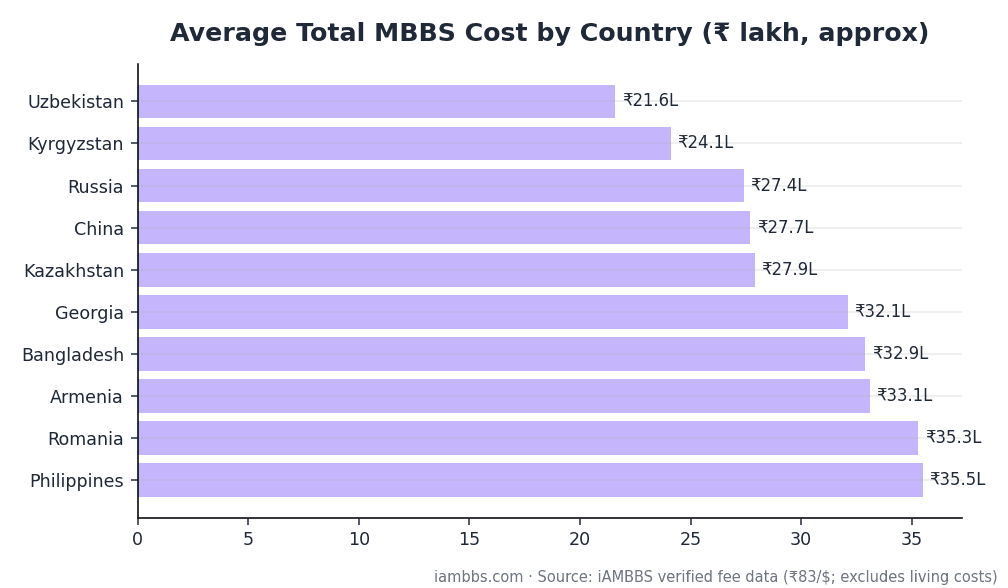
Watch: MBBS In India Vs MBBS Abroad?
What is The Best Option At Your NEET 2026 Score | Dr. Anand Mani
Get Free Expert Guidance
Our FMGE-qualified counselors will help you choose the right university based on your NEET score and budget.
No spam. Your data is secure. We call during 9 AM - 8 PM IST.
Related Topics
About the Author
Neha Tripathi
Neha Tripathi is a content writer at iAMBBS, focused on MBBS-abroad guidance for Indian students — covering NMC-approved universities, fees, FMGE, and admissions.