
MBBS in Georgia for Indian Students 2026: Fees, Universities, FMGE
Neha Tripathi
Author
Share this article

Image: Diego Delso, CC BY-SA 4.0 — via Wikimedia Commons
MBBS in Georgia is a genuinely sensible option for Indian students who want an English-medium, six-year medical degree with a realistic path back to practising in India — at a fraction of what a private seat costs at home. Between 2020 and 2024, 2,617 Georgia-trained graduates cleared the FMGE, India's licensing exam for foreign medical graduates, and thousands of Indian students are currently enrolled across Tbilisi, Batumi and Kutaisi. This guide covers eligibility, real universities, fees, the admission process, and — most importantly — what the FMGE data actually shows.
For a broader picture of the country, its climate and student life, see our full Georgia country guide.
🩺 Confused about MBBS abroad? Book free counselling with our experts, find colleges for your NEET score with the MBBS College Predictor, or calculate your total cost.
Why Indian Students Choose Georgia for MBBS
Georgia sits at the meeting point of Eastern Europe and West Asia, about five to six hours' flying time from Delhi. Over the last decade it has grown from a niche choice into one of the most popular MBBS destinations for Indians. Here is why:
- Fully English-medium programmes. Georgian universities run dedicated English-track MD programmes for international students. The MD awarded after six years is the primary medical qualification — the equivalent stage of training to MBBS — and is what you present when registering for the FMGE.
- No separate entrance exam at most universities. Admission is based on your 10+2 marks and NEET qualification. There is no additional university entrance test at most institutions.
- Six-year structure that fits NMC norms. The standard Georgian MD runs six years including clinical training, which aligns with the National Medical Commission's minimum-duration expectations for foreign degrees.
- Reasonable costs. Tuition at most universities falls in the US$4,000–8,000 per year (approx.) range — detailed below.
- A safe, student-friendly country. Georgia is widely regarded as safe, including for women students, and Tbilisi has an established Indian student community, Indian grocery stores and mess options.
- Straightforward paperwork. Indian students apply for a study visa and then a residence permit after arrival; the process is simpler than in many Western European countries.
Eligibility and NEET Requirement for MBBS in Georgia
The entry bar is deliberately accessible, but the non-negotiables come from Indian regulations, not Georgian ones:
- Age: at least 17 years old on or before 31 December of the admission year.
- Academics: 10+2 with Physics, Chemistry and Biology, with at least 50% in PCB (40% for reserved categories) — this mirrors the NMC's own norms for medical admission.
- NEET is mandatory. You must have qualified NEET-UG to be eligible, later on, for the FMGE and Indian registration. Your rank does not matter for Georgian admission — qualifying status does. Do not believe any agent who says NEET can be skipped.
- Documents: a valid passport, 10th and 12th mark sheets, NEET scorecard, and passport-size photographs. Universities may ask for notarised or apostilled copies at the enrolment stage.
If you qualified NEET but your rank will not fetch a government seat in India, Georgia is precisely the kind of option worth evaluating seriously rather than paying a large private-college fee at home.
Planning MBBS abroad?
Get a free counselling call — we'll shortlist NMC-approved universities for your NEET score and budget.
Top Medical Universities in Georgia (With Real FMGE Results)
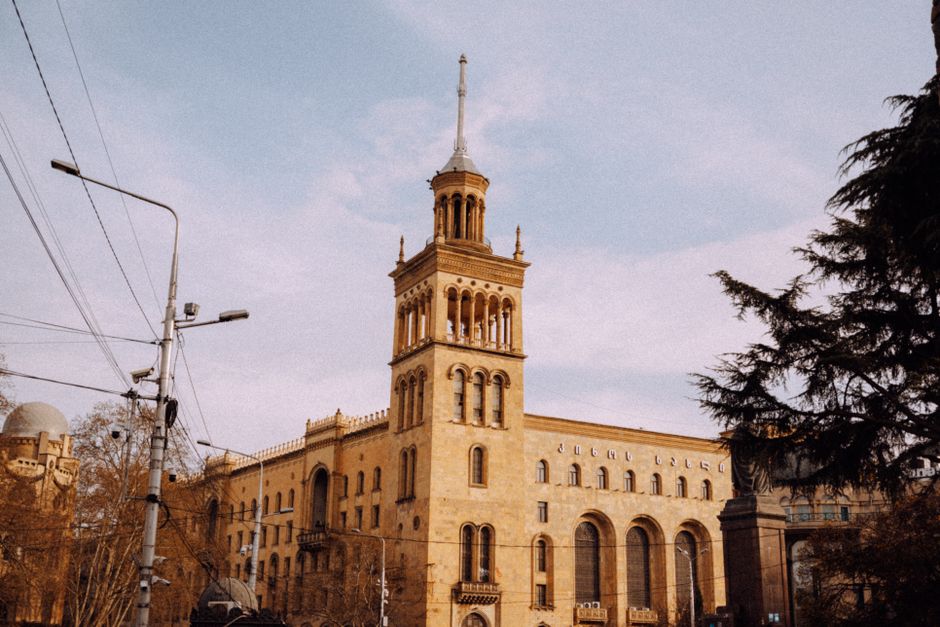
Photo: Ata Ebem / Pexels
Do not choose a university from a brochure. Choose it from results. The table below is compiled from NBEMS FMGE results, 2020–2024, for Georgian universities where a meaningful number of Indian graduates appeared:
| University | City | FMGE Appeared (2020–24) | Passed | Pass Rate |
|---|---|---|---|---|
| Tbilisi State Medical University | Tbilisi | 1,857 | 501 | 27.0% |
| European University | Tbilisi | 984 | 368 | 37.4% |
| New Vision University | Tbilisi | 913 | 332 | 36.4% |
| Teaching University Geomedi | Tbilisi | 660 | 212 | 32.1% |
| David Tvildiani Medical University | Tbilisi | 462 | 230 | 49.8% |
| Batumi Shota Rustaveli State University | Batumi | 376 | 110 | 29.3% |
| Akaki Tsereteli State University | Kutaisi | 256 | 71 | 27.7% |
| Georgian National University SEU | Tbilisi | 158 | 93 | 58.9% |
A few pointers from this data:
- Tbilisi State Medical University (TSMU), founded in 1918, is the oldest and largest medical university in Georgia and sends the biggest Indian cohort to the FMGE. Scale cuts both ways: its 27% pass rate reflects a very large, mixed batch.
- David Tvildiani Medical University (DTMU) has the strongest FMGE record among universities with large Indian cohorts — 49.8% across 462 candidates. It is known for a USMLE-oriented curriculum and selective intake.
- Georgian National University SEU posted 58.9% — the best rate in the table — though on a smaller sample of 158 candidates, so read it with that caveat.
- Batumi Shota Rustaveli and Akaki Tsereteli are public state universities outside the capital, which usually means lower tuition and living costs.
Whichever university you shortlist, confirm two things directly: it is authorised by Georgia's NCEQE (the national quality body) and listed in the World Directory of Medical Schools (WDOMS) — both are prerequisites for your degree to count for FMGE registration.
MBBS in Georgia: Fees and Cost of Living

Photo: Valentin Ivantsov / Pexels
All figures below are approximate ranges — exact fees vary by university and change year to year, so verify the current fee letter before paying anything. INR figures are rounded at roughly ₹88 per US dollar.
| Expense | Per Year (approx.) | In INR (approx.) |
|---|---|---|
| Tuition fees | US$4,000–8,000 | ₹3.5–7 lakh |
| Hostel / shared flat | US$1,000–2,500 | ₹0.9–2.2 lakh |
| Food and groceries | US$1,800–2,700 | ₹1.6–2.4 lakh |
| Transport, books, misc. | US$500–1,000 | ₹0.4–0.9 lakh |
Over the full six years, most Indian students end up spending roughly ₹35–60 lakh all-in (approx.) — tuition plus living. Compare that with private MBBS seats in India, where total costs commonly run from around ₹60 lakh to over ₹1 crore, and the arithmetic behind Georgia's popularity becomes obvious.
Two practical notes. First, public universities such as Akaki Tsereteli and Batumi Shota Rustaveli generally sit at the lower end of the tuition band, while TSMU and DTMU sit at the higher end. Second, Tbilisi is costlier to live in than Kutaisi or Batumi, though still far cheaper than most European capitals.
Admission Process: Step by Step
The main intake is September–October; a few universities also run a spring intake around February–March. Start at least four to six months before your target intake.
- Shortlist universities using FMGE results, NCEQE authorisation and total cost — in that order.
- Apply online with your 10+2 mark sheets, NEET scorecard and passport copy. Most universities charge no application fee or a small one.
- Receive the offer letter, usually within a few weeks.
- Pay the initial tuition instalment to confirm your seat, and keep every payment receipt.
- Wait for the enrolment order — international admissions are confirmed through an order from Georgia's Ministry of Education, which the university processes on your behalf.
- Apply for the study (D3) visa at the Georgian mission or through the official e-visa channel, as applicable to your documents.
- Travel, register at the university, and apply for your residence permit within the window the university advises after arrival.
One warning from experience: deal with the university's official admissions office or a consultant who shows you the university's own fee letter. Inflated "package" pricing from middlemen is the most common way students overpay in Georgia.
FMGE, NMC Rules and Practising in India
Photo: Yusuf Çelik / Pexels
This is the part that decides whether your degree becomes a career, so read it carefully.
To practise in India after an MBBS abroad, you must clear the FMGE (Foreign Medical Graduate Examination), conducted by NBEMS twice a year, in June and December. You need 150 out of 300 to pass. The NExT exam remains deferred — FMGE continues to be the licensing route for foreign graduates for now, and any decision to change that rests with the NMC.
Under the NMC's Foreign Medical Graduate Licentiate Regulations, 2021 (the NMC replaced the Medical Council of India in 2020), your foreign degree should involve the entire course, internship and clinical training in English at the same institution abroad, with a duration meeting NMC's minimum norms. Georgian six-year English-track MD programmes are structured with these requirements in mind, but always check the NMC's latest advisories for your admission year before enrolling — regulations are amended from time to time.
On outcomes: across 2020–2024, 7,965 Georgia-trained Indian graduates appeared for the FMGE and 2,617 passed — an overall pass rate of about 33%, with the 2024 cycles at 35%. That is a real number, not a marketing one, and it carries two lessons. University choice matters (compare 49.8% at DTMU with 20-odd percent elsewhere), and the FMGE demands serious self-preparation from your first year, not your last. Our FMGE guide explains the exam pattern and preparation timeline, and you can compare countries on our country-wise FMGE pass rate page.
Pros and Cons of MBBS in Georgia
Pros
- English-medium, six-year MD aligned with NMC's structure
- Total cost far below Indian private colleges — ₹35–60 lakh all-in (approx.)
- No entrance exam beyond NEET at most universities
- Safe country, short travel distance, established Indian student community
- Verifiable FMGE track record, with some universities near or above 50%
Cons
- Patient interaction in clinical years requires basic Georgian, since hospital patients speak Georgian, not English
- Quality varies widely between universities — the gap between 20% and 58% pass rates in the table above is the proof
- Limited scope to practise in Georgia itself after graduation; most Indian students return home or attempt USMLE/PLAB
- Winters in Tbilisi and Kutaisi are cold by Indian standards
FAQs on MBBS in Georgia
Q1: Is NEET compulsory for MBBS in Georgia? A: Yes. NEET-UG qualification is mandatory for Indian students who intend to practise in India after a foreign MBBS. Georgian universities admit on 10+2 marks, but without NEET qualification you will not be eligible for the FMGE later.
Q2: What is the total cost of MBBS in Georgia? A: Approximately ₹35–60 lakh for the full six years, covering tuition (about US$4,000–8,000 a year) and living costs. Public universities outside Tbilisi sit at the lower end. Treat all figures as approximate and verify the current fee letter.
Q3: Is a Georgian MBBS degree valid in India? A: Yes — provided your university is WDOMS-listed, your programme meets the NMC's 2021 foreign-graduate regulations, and you clear the FMGE. After passing, you complete the required internship and register with the NMC/state medical council.
Q4: Which university in Georgia has the best FMGE record? A: On 2020–2024 NBEMS data, Georgian National University SEU (58.9% on 158 candidates) and David Tvildiani Medical University (49.8% on 462 candidates) lead. DTMU's figure is the more statistically solid given its larger cohort.
Q5: How long is MBBS in Georgia? A: Six years, including clinical training. Georgian universities award the MD degree, which is the equivalent stage of qualification to MBBS for Indian licensing purposes.
Q6: Is Georgia better than Russia for MBBS? A: They are comparable on cost. Georgia's advantages are fully English-medium teaching (many Russian programmes shift to bilingual instruction in clinical years), shorter travel, and a six-year course; Russia's are larger government universities. Compare both on FMGE results for the specific universities you are considering, not on country reputation alone.
Q7: What is the average salary of an MBBS doctor in Georgia in Indian rupees? A: Doctor salaries in Georgia vary widely by hospital, city and specialisation, and junior doctors there earn modest amounts by Indian metro standards. There is no reliable single figure to quote. In practice, most Indian students treat Georgia as a place to earn the degree, then return to India, clear the FMGE and practise here, or pursue postgraduate options in Europe or the USMLE route.
Q8: How much fees for MBBS in Georgia in Indian rupees? A: Tuition at Georgian medical universities is approximately Rs 4-7 lakh per year, which works out to around Rs 25-40 lakh for the full six-year course. Adding hostel, food and living expenses, the total budget typically reaches approximately Rs 35-50 lakh. Fees vary noticeably between universities in Tbilisi and smaller cities, so confirm the current fee structure directly with the university before paying any agent.
Q9: What are the disadvantages of MBBS in Georgia? A: The main drawbacks are the Georgian language barrier during clinical years, since most patients do not speak English; cold winters that take adjustment; limited part-time work options; and fees higher than Central Asian alternatives. After graduating, you must clear the FMGE to practise in India, so choose a university with a track record of Indian graduates and strong clinical exposure rather than the cheapest option.
Q10: Which are the best universities for MBBS in Georgia? A: Georgia's most popular options for Indian students are concentrated in Tbilisi, Batumi and Kutaisi, with Tbilisi State Medical University being the best-known public institution. Rather than trusting agent rankings, shortlist universities with a long English-medium record and strong FMGE results, and verify each one against NMC norms and the World Directory of Medical Schools before applying.
Q11: Can I get a scholarship for MBBS in Georgia? A: Scholarships for Indian MBBS students in Georgia are limited. Some universities offer partial merit-based fee discounts or early-admission concessions, but there is no widespread full-scholarship scheme for foreign medical students. Budget for the full tuition and living cost, and treat any agent promising a guaranteed full scholarship with suspicion. Genuine concessions come directly from the university, in writing.
Q12: Can I study MBBS in Georgia for free? A: No — realistically, Indian students cannot study MBBS in Georgia for free. Georgian universities charge tuition to international students, and free seats or full scholarships for foreigners are extremely rare. Georgia's appeal is affordability, not zero cost: the total expense is a fraction of a private medical seat in India. Plan your finances for the full course rather than counting on free education.
Q13: What is it like doing MBBS in Georgia? A: Doing MBBS in Georgia means a six-year, fully English-medium medical degree about five to six hours' flying time from Delhi. Thousands of Indian students are enrolled across Tbilisi, Batumi and Kutaisi, and between 2020 and 2024 over 2,600 Georgia-trained graduates cleared the FMGE. Life is safe and student-friendly, though you must self-prepare seriously for FMGE alongside your degree.
Q14: Are there government universities for MBBS in Georgia? A: Yes. Georgia has both public (state) and private medical universities — Tbilisi State Medical University is the most prominent public institution teaching medicine in English. Public status alone does not guarantee recognition in India, so whichever university you consider, confirm it appears in the World Directory of Medical Schools and meets NMC requirements before taking admission.
📍 Planning your MBBS in georgia? Our complete guide covers every NMC-approved university, real fees, FMGE pass rates and the step-by-step admission process.
Read the complete MBBS in georgia guide →Get Free Expert Guidance
Our FMGE-qualified counselors will help you choose the right university based on your NEET score and budget.
No spam. Your data is secure. We call during 9 AM - 8 PM IST.
Frequently Asked Questions
About the Author
Neha Tripathi
Neha Tripathi is a content writer at iAMBBS, focused on MBBS-abroad guidance for Indian students — covering NMC-approved universities, fees, FMGE, and admissions.